Have you ever paused while writing an email and wondered whether “not able” or “unable” sounds more natural? Understanding Not Able vs. Unable: Which Is Correct? can instantly improve your English usage, grammar, and formal writing, whether you’re handling business communication, replying to clients, or speaking in everyday conversations.
Although both expressions describe a lack of ability, they differ in tone, context, and level of formality.
Choosing the right expression becomes even more important in professional situations involving meetings, project management, scheduling, calendar updates, online booking, broadcasting, and effective time management.
A small wording choice can influence how polished, respectful, and professional your message sounds. Learning when to use not able instead of unable helps you communicate with greater consistency and confidence across different situations.
In this guide, you’ll discover the exact difference between not able and unable, explore their meanings, compare their grammatical usage, and learn when each option works best.
You’ll also find practical examples, common mistakes to avoid, and simple usage tips that make choosing the correct phrase effortless in both everyday and professional writing.
Quick Answer:
The short answer is simple:
- Both “not able” and “unable” are grammatically correct.
- Both mean that someone cannot do something.
- In many cases, you can replace one with the other without changing the meaning.
For example:
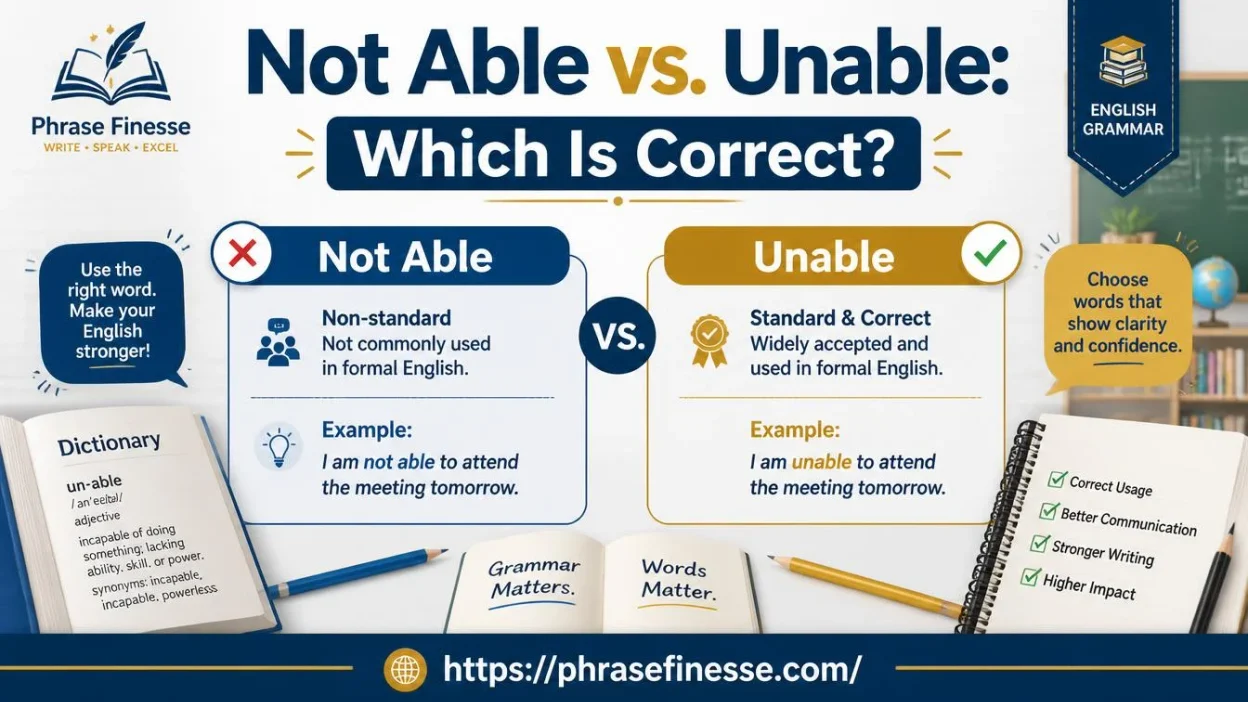
- I am not able to attend the meeting.
- I am unable to attend the meeting.
Both sentences communicate the same idea.
However, there is an important difference:
| Expression | Typical Tone |
| Not able | More conversational and natural |
| Unable | More formal and professional |
Think of it this way:
“Unable” sounds like office language. “Not able” sounds like everyday conversation.
That distinction often determines which option native speakers choose.
What Does “Unable” Mean?
The word unable is an adjective that means:
Lacking the ability, power, opportunity, or means to do something.
It combines the prefix un- with able, creating a single word that expresses inability.
Dictionary Definition
Most dictionaries define unable as:
Not having the skill, capacity, permission, or opportunity required to perform an action.
Examples:
- She was unable to answer the question.
- We were unable to access the building.
- The company is unable to process refunds at this time.
Notice how these examples sound somewhat formal.
Why Is “Unable” Considered More Formal?
Many organizations, businesses, and institutions prefer unable because it sounds professional and concise.
For example:
Customer Service
- We are unable to fulfill your request.
Human Resources
- We are unable to offer you the position.
Banking
- We are unable to verify your identity.
Government Communication
- We are unable to issue the document without additional information.
In these situations, unable creates emotional distance and professionalism.
Common Situations Where “Unable” Appears
You will often find unable in:
- Business correspondence
- Customer support responses
- Legal documents
- Academic writing
- Official notices
- Government communications
Examples:
- The committee was unable to reach a unanimous decision.
- Researchers were unable to replicate the results.
- The airline was unable to accommodate all passengers.
What Does “Not Able” Mean?
The phrase not able contains two parts:
- The negative word not
- The adjective able
Together, they mean that someone lacks the ability or opportunity to do something.
Examples:
- I’m not able to come today.
- We are not able to find the file.
- They were not able to finish the project.
The meaning is almost identical to unable.
Why Does “Not Able” Sound More Natural?
In everyday speech, people often prefer not able because it feels less formal.
Consider these examples:
Formal:
- I am unable to attend tonight.
Conversational:
- I’m not able to attend tonight.
Most native speakers would choose the second version during casual conversation.
That’s because contractions such as I’m naturally pair well with not able.
Common Everyday Examples
You might hear:
- I’m not able to help right now.
- She’s not able to drive yet.
- We weren’t able to get tickets.
- They’re not able to join us this weekend.
These sentences sound friendly and natural.
Not Able vs. Unable: Key Differences
Although the meanings are nearly identical, important differences exist.
| Feature | Not Able | Unable |
| Formality | Less formal | More formal |
| Common in conversation | Very common | Less common |
| Common in emails | Sometimes | Very common |
| Common in legal writing | Rare | Frequent |
| Natural in speech | Very natural | Slightly formal |
| Length | Two words | One word |
The Main Difference Is Tone
The biggest distinction isn’t grammar.
It’s tone.
Consider these examples:
Casual
- Sorry, I’m not able to make it today.
Professional
- Unfortunately, I am unable to attend today’s meeting.
Both are correct.
The second simply sounds more polished and formal.
When “Unable” Sounds Better
Certain situations practically invite the use of unable.
Let’s examine them.
Professional Emails
Business communication often benefits from concise, formal language.
Examples:
- I am unable to attend the conference.
- We are unable to approve the request.
- The department is unable to provide additional funding.
These sentences sound professional without appearing rude.
Customer Service Responses
Companies frequently use unable because it softens negative messages.
Example:
- We are unable to issue a refund.
Compare that with:
- We can’t issue a refund.
The second version feels more direct and potentially harsher.
Academic Writing
Academic writing values precision and formality.
Examples:
- Researchers were unable to establish causation.
- Scientists were unable to reproduce the results.
The tone fits scholarly work.
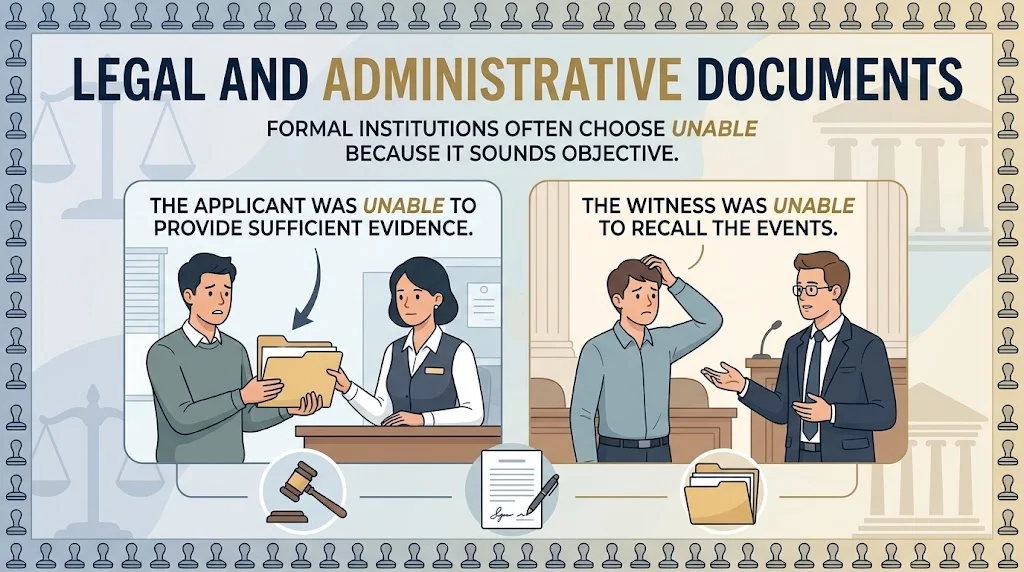
Legal and Administrative Documents
Formal institutions often choose unable because it sounds objective.
Examples:
- The applicant was unable to provide sufficient evidence.
- The witness was unable to recall the events.
When “Not Able” Sounds Better
Sometimes formality gets in the way.
That’s where not able shines.
Everyday Conversation
Most people naturally say:
- I’m not able to come.
- We’re not able to leave yet.
- She’s not able to answer.
These expressions sound relaxed and authentic.
Personal Messages
Imagine texting a friend.
Which sounds more natural?
- I’m unable to meet tonight.
- I’m not able to meet tonight.
Most native speakers prefer the second option.
Friendly Emails
Informal emails often benefit from a warmer tone.
Example:
- Thanks for the invitation. Unfortunately, I’m not able to attend this weekend.
The message sounds polite without feeling overly formal.
Unable To vs. Can’t
Many learners also wonder whether unable to and can’t mean the same thing.
The answer is mostly yes.
However, tone again plays a role.
Comparing the Three Expressions
| Expression | Tone |
| Can’t | Very casual |
| Not able to | Neutral |
| Unable to | Formal |
Examples:
- I can’t attend.
- I’m not able to attend.
- I’m unable to attend.
All three communicate the same basic meaning.
Which Sounds Best?
That depends on your audience.
1. Use “can’t” when:
- Talking casually
- Texting friends
- Speaking informally
2. Use “not able to” when:
- Writing conversationally
- Maintaining a friendly tone
- Avoiding excessive formality
3. Use “unable to” when:
- Writing professionally
- Communicating officially
- Preparing formal documents
Common Grammar Patterns With “Unable”
The most common structure is:
Be + Unable + To + Verb
Examples:
- She is unable to swim.
- We are unable to continue.
- They were unable to locate the missing records.
Present Tense Examples
- I am unable to attend.
- She is unable to drive.
- They are unable to participate.
See More :More Than Happy To Help: Meaning, Usage, and Alternatives
Past Tense Examples
- He was unable to finish.
- We were unable to arrive on time.
- The team was unable to score.
Perfect Tense Examples
- We have been unable to contact them.
- She has been unable to sleep.
- The company has been unable to recover losses.
Common Grammar Patterns With “Able”
The standard structure is:
Be + Able + To + Verb
Examples:
- I am able to help.
- She is able to swim.
- They are able to participate.
Negative Forms
Negative versions include:
| Positive | Negative |
| Am able | Am not able |
| Is able | Is not able |
| Are able | Are not able |
| Was able | Was not able |
| Were able | Were not able |
Examples:
- I’m not able to help.
- She isn’t able to come.
- We weren’t able to finish.
Situations Where “Not Able” and “Unable” Are Interchangeable
Many sentences allow both forms.
Examples:
| Not Able | Unable |
| I’m not able to attend. | I’m unable to attend. |
| We weren’t able to help. | We were unable to help. |
| She isn’t able to travel. | She is unable to travel. |
| They’re not able to join us. | They’re unable to join us. |
In each case, the meaning remains unchanged.
Only the tone differs.
Situations Where One Choice Sounds Better
Sometimes context influences which version feels natural.
Scenario: Business Meeting
Better:
- I am unable to attend tomorrow’s meeting.
Reason:
Formal business settings generally favor unable.
Scenario: Talking to Friends
Better:
- I’m not able to come tonight.
Reason:
Conversation typically favors simpler language.
Scenario: University Report
Better:
- Researchers were unable to verify the hypothesis.
Reason:
Academic writing values formal wording.
Scenario: Family Text Message
Better:
- Sorry, I’m not able to make it.
Reason:
The phrase sounds warmer and more personal.
Real-Life Case Studies
Understanding theory helps.
Seeing real-world examples helps even more.
Case Study: Job Application
Formal Response
Dear Applicant,
Thank you for your interest. After careful consideration, we are unable to offer you the position at this time.
Sincerely,
Hiring Team
This wording sounds professional and respectful.
Case Study: Friend’s Birthday Invitation
Hey Sarah,
Thanks for inviting me. Unfortunately, I’m not able to make it this weekend.
Hope you have a great time!
This version feels genuine and friendly.
Case Study: Customer Support
Hello,
We are unable to locate your order using the information provided.
Please submit additional details.
Thank you.
Again, unable fits the professional context.
Common Mistakes Writers Make
Even experienced writers occasionally misuse these expressions.
Using “Unable” in Casual Conversation
While not technically wrong, it can sound stiff.
Example:
- I’m unable to grab lunch today.
Most speakers would naturally say:
- I’m not able to grab lunch today.
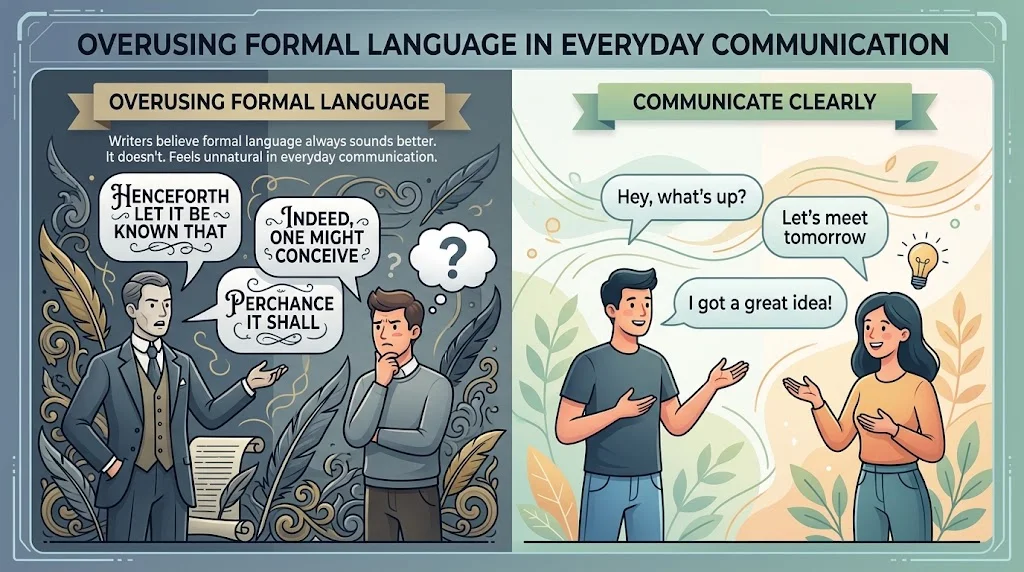
Overusing Formal Language
Some writers believe formal language always sounds better.
It doesn’t.
Using overly formal wording in everyday communication can feel unnatural.
Confusing “Unable” With “Disabled”These terms are not interchangeable.
Unable
Temporary or situational lack of ability.
Example:
- I’m unable to attend the meeting.
Disabled
A physical, mental, sensory, or medical condition.
Example:
- The building includes facilities for disabled visitors.
The meanings are entirely different.
Choosing the Wrong Tone
The biggest mistake isn’t grammatical.
It’s stylistic.
Always match your language to your audience.
Alternative Expressions You Can Use
English offers several alternatives.
Can’t
Most common.
Example:
- I can’t attend.
Cannot
Slightly more formal than can’t.
Example:
- I cannot participate.
Incapable Of
Emphasizes inability.
Example:
- He is incapable of lifting the box.
Not In A Position To
Often used in business communication.
Example:
- We are not in a position to approve the request.
Prevented From
Highlights an external obstacle.
Example:
- She was prevented from attending due to weather conditions.
Lack The Ability To
Useful in formal writing.
Example:
- Some systems lack the ability to process large datasets.
Quick Reference Chart
Use this table whenever you’re unsure.
| Situation | Best Choice |
| Casual conversation | Not able |
| Text messages | Can’t |
| Friendly email | Not able |
| Professional email | Unable |
| Academic writing | Unable |
| Legal document | Unable |
| Customer support | Unable |
| Social media post | Can’t / Not able |
| Workplace memo | Unable |
| Family discussion | Not able |
How Native Speakers Usually Choose
Native speakers rarely stop and analyze grammar rules in conversation.
Instead, they rely on instinct.
Generally:
- Casual settings → not able
- Professional settings → unable
- Very casual settings → can’t
That’s the pattern you’ll encounter most often.
A Simple Trick to Remember
Here’s an easy memory device:
If you could wear a suit while saying it, use “unable.”
If you’d say it while talking to a friend, use “not able.”
It’s not a grammar rule.
But it works surprisingly well.
FAQs
1. Is “unable” more formal than “not able”?
Yes. “Unable” is generally considered more formal and concise. It is commonly used in business communication, formal writing, and professional emails, while “not able” sounds more conversational and is often preferred in everyday speech.
2. Can I use “not able” and “unable” interchangeably?
In many situations, yes. Both expressions mean that someone cannot do something. However, “unable” usually sounds smoother and more polished, whereas “not able” can place extra emphasis on the inability or fit better in informal conversations.
3. Which is better for professional emails?
For most professional emails, “unable” is the better choice because it is shorter, more formal, and widely accepted in workplace communication. For example, “I am unable to attend the meeting” sounds more professional than “I am not able to attend the meeting.”
4. Is “not able” grammatically correct?
Absolutely. “Not able” is grammatically correct and commonly used by native English speakers. The choice between “not able” and “unable” depends mainly on the tone, context, and level of formality you want to achieve.
5. When should I use “unable” instead of “not able”?
Use “unable” in formal documents, reports, academic writing, customer support messages, and workplace communication. Use “not able” in casual conversations or when you want a slightly more natural, spoken tone.
6. How can I remember the difference between “not able” and “unable”?
A simple rule is this: choose “unable” for formal and professional writing, and choose “not able” for everyday conversation when a more relaxed tone feels appropriate. Both are correct, but selecting the right one improves clarity and consistency.
Conclusion
Although “not able” and “unable” share the same basic meaning, they are not always the best choice in every context. “Unable” offers a more formal, concise tone, making it ideal for professional emails, reports, and business communication
. In contrast, “not able” sounds more conversational and fits naturally into everyday speech. By understanding the subtle differences, you can choose the expression that best matches your audience, purpose, and writing style.
With regular practice, using the right phrase will become second nature, helping you write with greater confidence, clarity, and professionalism.

Emma Brooke is an English language specialist, editor, and content writer at Phrase Finesse, where she helps readers develop stronger writing and communication skills through clear, practical, and engaging content. With a passion for the English language, she specializes in simplifying grammar rules, vocabulary, spelling, punctuation, and word usage for learners at every level.
Emma has extensive experience creating educational content that is accurate, well-researched, and easy to understand. She is particularly skilled at explaining confusing word pairs, grammar concepts, idioms, sentence structure, and effective writing techniques, making complex topics approachable for students, professionals, educators, and English learners worldwide.