Have you ever paused before writing “I worked,” “I was working,” or “I have been working” because they all seemed correct? Understanding I Worked vs. I Was Working vs. I Have Been Working is essential for clear English usage, accurate grammar, and confident communication.
Whether you’re writing an email, preparing a report, or speaking in a professional setting, choosing the right tense helps your message sound natural, precise, and easy to understand.
Each of these verb forms describes work in a different way, but the differences often confuse both native and non-native English speakers. In this guide, you’ll learn when to use each tense, how context changes meaning, and why the correct choice matters in formal writing, business communication, meetings, project management, broadcasting, and everyday conversations.
You’ll also discover how tense selection improves clarity when discussing scheduling, time management, calendar events, and even online booking activities where accurate timelines are important.
Through detailed explanations, practical rules, comparison tables, and plenty of real-world examples, this article will help you recognize the subtle distinctions between these commonly confused expressions.
By the end, you’ll understand how to avoid frequent mistakes, maintain grammatical consistency, and confidently use the right tense in both spoken and written English, regardless of the situation.
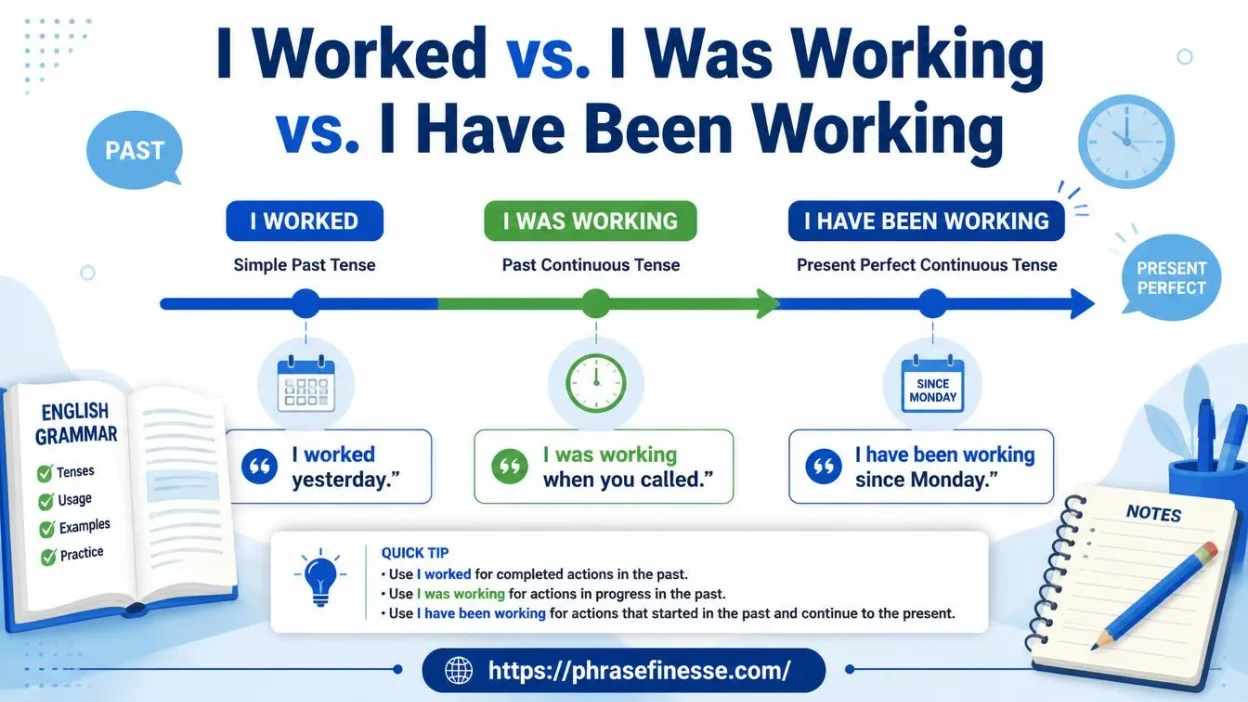
Timeline Comparison
Visualizing the timeline often makes these tenses easier to remember.
I worked
Past ●──────────── End
I was working
Past ───●──────────
(Action in progress)
I have been working
Past ●────────────► Present
(Started before and continues or has a present result)
Notice how only I have been working reaches the present.
I Worked vs. I Was Working
Although both describe the past, they answer different questions.
I Worked emphasizes completion.
The speaker simply states that the work happened.
Examples
- I worked late yesterday.
- I worked in New York for five years.
- I worked on that project in March.
Nothing in these sentences suggests the action was interrupted.
I Was Working emphasizes an ongoing action.
Here, the action was happening at a particular time.
Examples
- I was working when my phone rang.
- I was working at 8 p.m.
- I was working while everyone else was relaxing.
The focus shifts from completion to progress.
Comparison Table
| I Worked | I Was Working |
| Finished action | Ongoing action |
| Simple Past | Past Continuous |
| Focus on result | Focus on process |
| Often uses finished time expressions | Often appears with “when” and “while” |
I Worked vs. I Have Been Working
Many English learners confuse these because both can describe employment.
The difference lies in whether the action still connects to the present.
Use I Worked when the job has ended.
Examples:
- I worked there in 2020.
- I worked as a sales manager before changing careers.
- I worked every weekend during college.
Each sentence describes something that belongs entirely in the past.
Use I Have Been Working when the action continues or has recently stopped.
Examples:
- I have been working here since January.
- I have been working on this article all morning.
- I have been working remotely for two years.
The action remains relevant now.
Comparison Table
| I Worked | I Have Been Working |
| Past only | Past connected to present |
| Finished | Continuing or recently completed |
| Often uses yesterday, last year | Often uses since and for |
| Focus on completion | Focus on duration |
I Was Working vs. I Have Been Working
These two tenses often appear similar because both describe ongoing actions.
However, their timelines differ.
I Was Working
The action stayed completely in the past.
Example:
I was working when the fire alarm sounded.
Everything happened in the past.
I Have Been Working
The action extends to the present or has just finished.
Example:
I have been working since 8 a.m.
The work either continues now or has only recently ended.
Common Mistakes and How to Fix Them
Even advanced English learners make mistakes with these tenses because time expressions can change the correct answer.
Here’s how to avoid the most common errors.
| Incorrect | Correct | Explanation |
| I have been working yesterday. | I worked yesterday. | Yesterday refers to a completed past time. |
| I worked when you called. | I was working when you called. | The action was already in progress. |
| I was working here since May. | I have been working here since May. | Since connects the past with the present. |
| I have worked all morning. | I have been working all morning. | Continuous action should use the continuous form. |
| I worked since January. | I have been working since January. | “Since” usually requires Present Perfect or Present Perfect Continuous. |
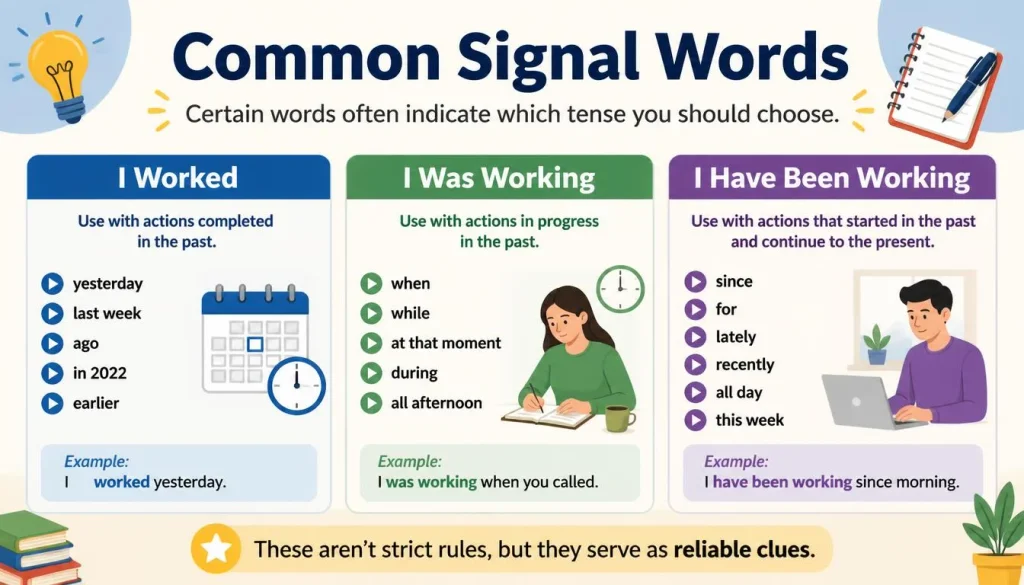
Common Signal Words
Certain words often indicate which tense you should choose.
I Worked
- yesterday
- last week
- ago
- in 2022
- earlier
I Was Working
- when
- while
- at that moment
- during
- all afternoon
I Have Been Working
- since
- for
- lately
- recently
- all day
- this week
These aren’t strict rules, but they serve as reliable clues.
Read More :“Talk To You Then” Meaning: Usage, Examples & Alternatives
Real-Life Conversation Examples
Understanding grammar becomes much easier when you hear it in natural conversations.
Workplace Conversation
Manager:
What were you doing at 4 p.m.?
Employee:
I was working on the quarterly report.
Talking About Previous Jobs
Friend:
Have you ever worked abroad?
You:
Yes. I worked in Canada for three years.
Talking About Today
Coworker:
You look exhausted.
You:
I have been working since six this morning.
Family Conversation
Mom:
Why didn’t you answer your phone?
Son:
Sorry. I was working in the garage.
Case Study: One Situation, Three Different Meanings
Imagine Sarah is talking about her job.
Situation One
I worked at GreenTech in 2021.
This means Sarah’s employment ended.
Situation Two
I was working at GreenTech when the company moved offices.
The sentence focuses on what was happening during another event.
Situation Three
I have been working at GreenTech since 2021.
Sarah still works there today.
Although each sentence discusses the same workplace, the tense completely changes the meaning.
Which One Should You Use?
Ask yourself three simple questions.
Is the action completely finished?
Use:
✅ I worked
Example:
I worked late yesterday.
Was the action happening at a specific time?
Use:
✅ I was working
Example:
I was working when you called.
Does the action continue until now?
Use:
✅ I have been working
Example:
I have been working here for five years.
Quick Memory Trick
Here’s an easy way to remember these three tenses.
| Tense | Memory Trick |
| I worked | Finished. |
| I was working | Happening then. |
| I have been working | Started before and still matters now. |
Whenever you’re unsure, think about the timeline instead of memorizing grammar rules.
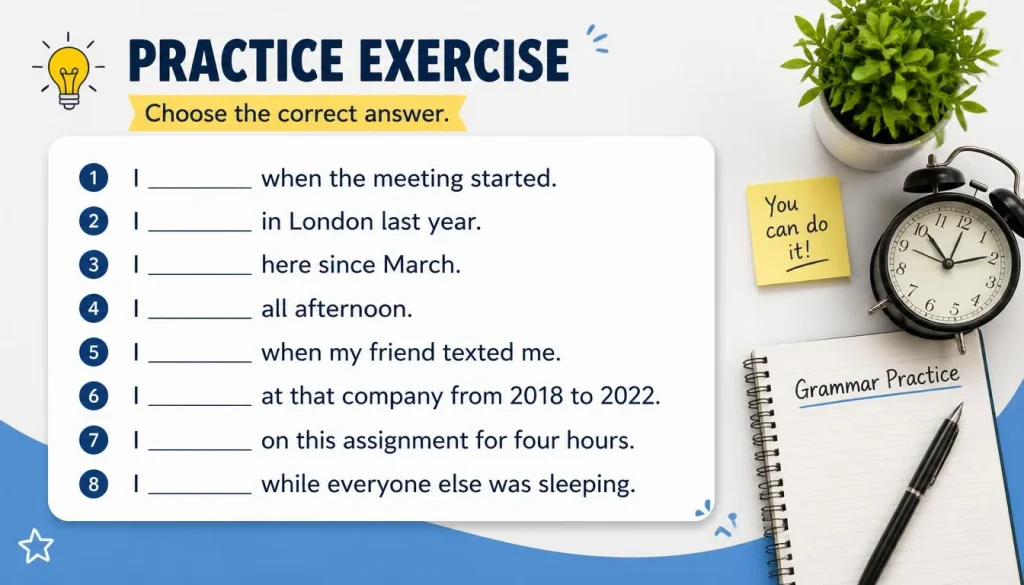
Practice Exercise
Choose the correct answer.
Questions
- I ______ when the meeting started.
- I ______ in London last year.
- I ______ here since March.
- I ______ all afternoon.
- I ______ when my friend texted me.
- I ______ at that company from 2018 to 2022.
- I ______ on this assignment for four hours.
- I ______ while everyone else was sleeping.
Answer Key
- was working
- worked
- have been working
- have been working
- was working
- worked
- have been working
- was working
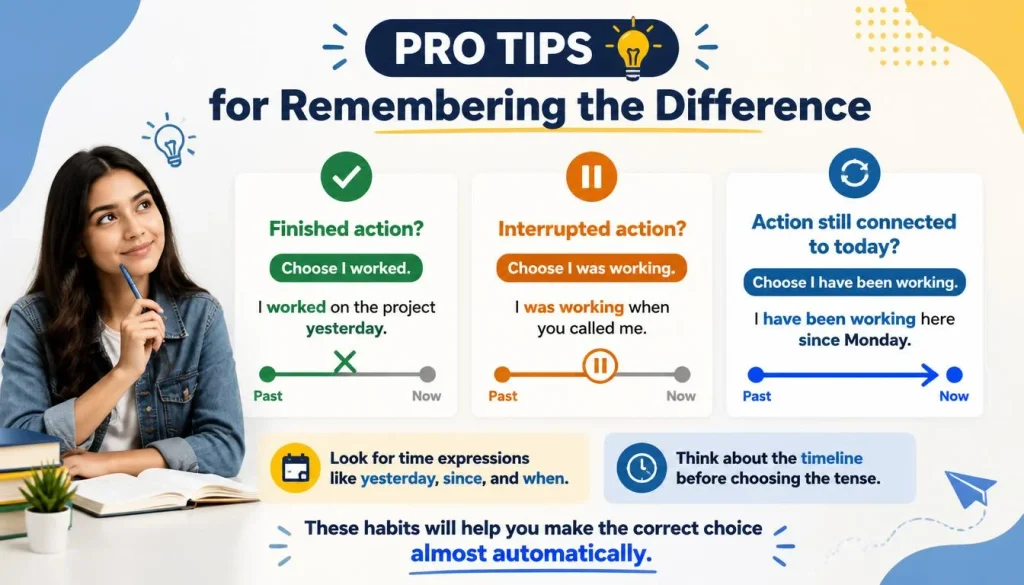
Pro Tips for Remembering the Difference
- Finished action? Choose I worked.
- Interrupted action? Choose I was working.
- Action still connected to today? Choose I have been working.
- Look for time expressions like yesterday, since, and when.
- Think about the timeline before choosing the tense.
These habits will help you make the correct choice almost automatically.
FAQs
1. What is the main difference between I worked, I was working, and I have been working?
I worked refers to a completed action in the past. I was working describes an action that was in progress at a particular time in the past. I have been working emphasizes that the action started in the past and has continued until now or has only recently ended.
2. When should I use I worked instead of I have been working?
Use I worked when talking about a finished activity with no connection to the present. Use I have been working when the activity is still continuing or its effects are still relevant now.
3. Is I was working always followed by another event?
Not always. It often introduces background information or describes an action interrupted by another event, but it can also simply describe what someone was doing during a specific period in the past.
4. Which tense is more appropriate in professional emails?
It depends on the context. I worked is suitable for completed tasks, while I have been working is better when updating someone on ongoing work. I was working is useful when explaining what was happening at a particular moment in the past.
5. Can I use these three expressions interchangeably?
No. Although they all refer to work, each tense has a different meaning and time reference. Using the wrong one can make your sentence sound unnatural or change its intended meaning.
6. How can I remember which tense to choose?
Think about the timeline. If the work is finished, use I worked. If it was in progress at a specific past time, use I was working. If it started in the past and continues or affects the present, use I have been wor
Conclusion
Understanding I Worked, I Was Working, and I Have Been Working is more than memorizing grammar rules. It’s about choosing the verb tense that accurately reflects when an action happened and how it relates to the present. While I worked describes a completed action in the past, I was working emphasizes an ongoing activity at a specific moment in the past, and I have been working connects a past activity with the present by highlighting its duration or continued relevance.
Mastering these differences will improve your English usage, strengthen your formal writing, and make your business communication more precise. Whether you’re discussing meetings, project management, time management, scheduling, calendar events, online booking, or everyday experiences, using the correct tense helps your message remain clear, professional, and consistent.
With regular practice and the examples in this guide, choosing the right expression will soon become second nature.

Emma Brooke is an English language specialist, editor, and content writer at Phrase Finesse, where she helps readers develop stronger writing and communication skills through clear, practical, and engaging content. With a passion for the English language, she specializes in simplifying grammar rules, vocabulary, spelling, punctuation, and word usage for learners at every level.
Emma has extensive experience creating educational content that is accurate, well-researched, and easy to understand. She is particularly skilled at explaining confusing word pairs, grammar concepts, idioms, sentence structure, and effective writing techniques, making complex topics approachable for students, professionals, educators, and English learners worldwide.