
Have you ever wondered where to place a suffix when listing a last name first in a document, record, or professional setting? Names like Smith Jr., Johnson III, or Williams Sr. can create confusion when the order changes. Understanding Suffix Placement in Last-Name-First Names helps you maintain correct grammar, proper name formatting, and consistent English usage across personal, academic, and professional writing.
When you write a last name first format, such as on a calendar entry, business document, database, or formal record, knowing the correct position of a name suffix becomes essential. This guide explains the rules behind suffix placement, surname order, and punctuation choices while showing how proper formatting supports business communication, formal writing, meetings, scheduling, and project management. Clear naming conventions also improve accuracy in systems like online booking platforms, broadcasting records, and official documents.
Whether you are preparing a contact list, organizing a professional file, or improving your writing skills, this article will help you understand the best practices for listing names with suffixes. You’ll learn how grammar rules, consistency, and standard naming conventions work together to create polished communication. By the end, you’ll know exactly how to handle suffixes after last names and avoid common mistakes in everyday and professional English.
Chicago Manual of Style Rules For Suffix Placement When Listing The Last Name First
The Chicago Manual of Style is commonly used in publishing, historical writing, and professional editing.
Chicago style generally treats suffixes as part of the complete personal name. When names are inverted for alphabetical organization, the suffix usually remains after the given name.
Example:
Normal format:
Robert James Carter Jr.
Last name first:
Carter, Robert James, Jr.
Another example:
Normal format:
William Henry Davis III
Last name first:
Davis, William Henry, III
The comma placement helps readers understand the structure:
Last Name → First Name → Suffix
| Name Component | Example |
| Last Name | Carter |
| First Name | Robert |
| Middle Name | James |
| Suffix | Jr. |
Chicago-style formatting is especially useful when creating:
- Author lists
- Indexes
- Bibliographies
- Historical records
- Professional publications
MLA And APA Considerations For Last Name First Suffix Formatting
Academic writing often requires strict name formatting.
Two popular academic styles are:
- MLA (Modern Language Association)
- APA (American Psychological Association)
These systems use different rules depending on the type of citation.
MLA Style And Suffix Placement
MLA style often lists authors by surname first in the Works Cited section.
Example:
Normal:
Robert James Carter Jr.
MLA-style entry:
Carter, Robert James, Jr.
The suffix remains after the given name.
The purpose is to make alphabetical sorting easier without changing the person’s actual name.

APA Style And Name Suffixes
APA style also recognizes suffixes as part of an author’s name.
For example:
Normal:
Michael Thomas Brown III
Reference list format:
Brown, M. T., III.
The suffix follows the initials.
However, APA handles initials differently from general writing because references have their own formatting system.
The important point remains:
Do not attach the suffix directly to the surname when reversing names.
Business And Professional Formatting For Names With Suffixes
Professional environments often use last-name-first formats for organization.
Common examples include:
- Employee databases
- Customer records
- Membership lists
- Conference programs
- Legal documents
- Medical systems
A company directory may organize names alphabetically:
| Normal Name | Directory Format |
| Michael Andrew Wilson Jr. | Wilson, Michael Andrew, Jr. |
| Sarah Elizabeth Adams III | Adams, Sarah Elizabeth, III |
This format makes searching easier because people usually sort records by surname.
How To Enter Suffixes In Forms And Databases
Modern systems usually handle suffixes differently from handwritten documents.
Many online forms provide separate fields:
| Field | Example Entry |
| First Name | Robert |
| Middle Name | James |
| Last Name | Carter |
| Suffix | Jr. |
This is the cleanest method because the system stores each part separately.
A database can then display the name in different ways:
Normal display:
Robert James Carter Jr.
Alphabetical display:
Carter, Robert James, Jr.
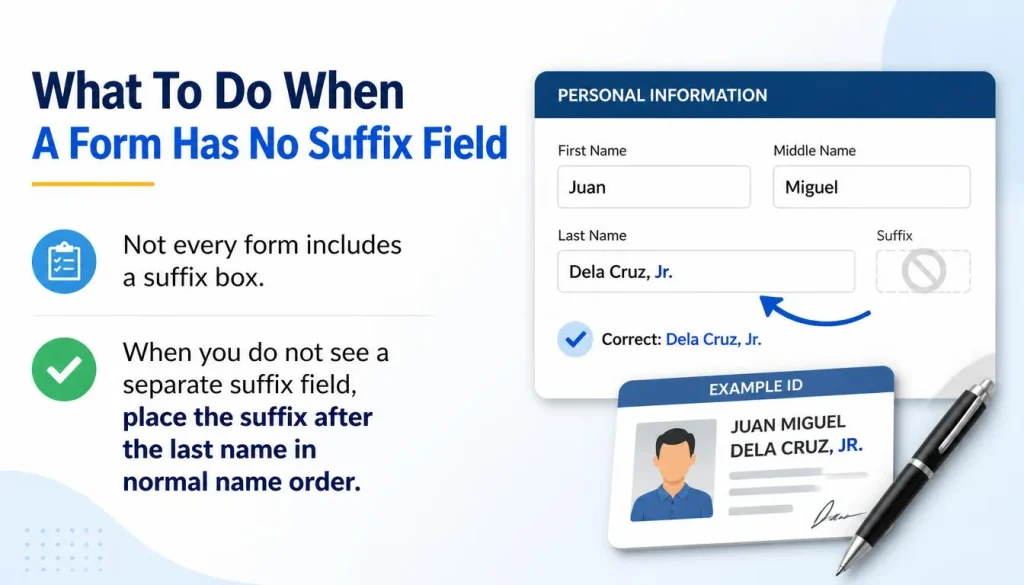
What To Do When A Form Has No Suffix Field
Not every form includes a suffix box.
When you do not see a separate suffix field, place the suffix after the last name in normal name order.
Example:
Correct:
Robert James Carter Jr.
Avoid:
Robert Jr. James Carter
The suffix should never interrupt the person’s first or middle names.
For a last-name-first document, use:
Carter, Robert James, Jr.
Read More: Invite vs. Invitation: Difference and Usage Examples
Case Study: Why Correct Suffix Placement Matters
Imagine a university database contains these two students:
- Thomas Edward Johnson Jr.
- Thomas Edward Johnson Sr.
If the system stores both names as:
Thomas Edward Johnson
the records become difficult to separate.
A missing suffix could cause problems with:
- Enrollment records
- Financial documents
- Academic transcripts
- Graduation certificates
Correct formatting prevents confusion.
The small detail of adding Jr. or Sr. can protect someone’s identity.

How Suffixes Appear In Legal Documents
Legal writing requires precision.
Names on official documents must match identification records. A suffix can become an important part of a person’s legal name depending on jurisdiction and personal usage.
Examples of documents where suffixes may appear:
- Birth certificates
- Passports
- Driver’s licenses
- Contracts
- Property records
- Court documents
When a legal document lists names alphabetically, it may use:
Johnson, Michael Thomas, Jr.
However, the exact format depends on the institution creating the document.
The safest approach is:
Follow the official name format used by the person’s identification documents.
How Suffixes Work In Genealogy And Family Records
Family historians often rely on suffixes to track generations.
For example:
- John William Smith Sr.
- John William Smith Jr.
- John William Smith III
- John William Smith IV
Without suffixes, a family tree can become confusing.
A genealogy record might organize names like this:
| Generation | Name |
| First generation | Smith, John William, Sr. |
| Second generation | Smith, John William, Jr. |
| Third generation | Smith, John William, III |
| Fourth generation | Smith, John William, IV |
The suffix acts as a generation marker.
It tells researchers which person belongs to which branch of the family.
Common Mistakes When Listing The Last Name First With A Suffix
Even though the rule is straightforward, several mistakes appear frequently.
Mistake: Treating The Suffix As Part Of The Last Name
One of the biggest errors is writing:
Smith Jr., Robert
This suggests that Smith Jr. is the surname.
It is not.
The surname is:
Smith
The suffix is:
Jr.
Correct:
Smith, Robert, Jr.
Mistake: Forgetting The Comma Before The Suffix
Many writers wonder:
Should there be a comma before Jr. when the last name comes first?
Traditional inverted-name formatting uses:
Smith, Robert, Jr.
The comma separates the suffix from the given name.
However, everyday writing may sometimes appear as:
Smith, Robert Jr.
Both styles exist, but formal alphabetical lists often prefer the extra comma.
Mistake: Adding Apostrophes To Suffixes Incorrectly
Suffixes do not normally use apostrophes.
Incorrect:
John Smith Jr.’s
Correct possessive form:
John Smith Jr.’s car
When creating possession, the apostrophe attaches according to normal possessive rules.
Examples:
- Jr.’s office
- III’s collection
The suffix itself does not become:
- Jr’s
- III’s
unless it is being used possessively.
Mistake: Changing The Suffix Order
Incorrect:
Davis, III Robert James
Correct:
Davis, Robert James, III
The suffix should always appear after the full given name.
Quick Reference Guide: Where To Put The Suffix When Listing The Last Name First
Use this chart whenever you need a quick answer.
| Original Name | Correct Last Name First Format |
| James Carter Jr. | Carter, James, Jr. |
| Michael Brown Sr. | Brown, Michael, Sr. |
| Robert Wilson II | Wilson, Robert, II |
| David Anderson III | Anderson, David, III |
| William Parker IV | Parker, William, IV |
The formula is simple:
Last Name, First Name Middle Name, Suffix
FAQs
1. Where does the suffix go when listing the last name first?
When you list the last name first, the suffix usually remains after the person’s full name, not directly after the last name. For example, write Smith, John Jr. rather than Smith Jr., John. The suffix stays connected to the person’s complete name, even when the surname appears first.
2. Do you put a comma before a suffix when the last name comes first?
Yes, a comma may appear before a suffix in traditional American English when writing a person’s name in normal order, such as John Smith, Jr. However, when using the last name first format, the punctuation style can vary depending on the purpose and style guide. The most important rule is to maintain clarity and consistency throughout your document.
3. Should the suffix come before or after the first name in a last-name-first format?
The suffix comes after the complete name, including the first name. For example, the correct format is Brown, Michael Jr. rather than Brown Jr., Michael. The suffix identifies the person and should remain attached to the full name rather than separating from it.
4. How do you write names with suffixes in formal documents?
In formal writing, legal records, professional documents, and official databases, follow the organization’s preferred naming style. A common format is Last Name, First Name Suffix, such as Anderson, Robert III. Maintaining proper name formatting and consistency helps prevent confusion in records, communication, and documentation.
5. Are suffixes like Jr. and III part of a person’s last name?
No, suffixes are not part of the last name. Terms such as Jr., Sr., II, and III provide additional information about a person’s family naming tradition or generational connection. They follow the person’s name but do not change the actual surname.
6. Why is correct suffix placement important?
Correct suffix placement improves accuracy in English usage, professional communication, and record management. Incorrect formatting can create problems in business communication, online booking systems, scheduling tools, and official documents. Using consistent naming rules makes information easier to read, organize, and verify.
Conclusion
Understanding where to put the suffix when listing the last name first helps you write names accurately in both everyday and professional situations. While formats like Last Name, First Name Suffix may look different from traditional name order, the key is keeping the suffix connected to the complete name and following consistent grammar rules.
Proper name formatting, punctuation, and consistency play an important role in formal writing, business communication, and digital record management. Whether you are creating a contact list, organizing a calendar, preparing documents, or managing information through project management systems, correct suffix placement improves clarity and professionalism.
By following the guidelines in this article, you can confidently handle names with Jr., Sr., II, III, and other suffixes without confusion. Good English usage and grammar practices make your writing more accurate, polished, and easier for readers to understand.