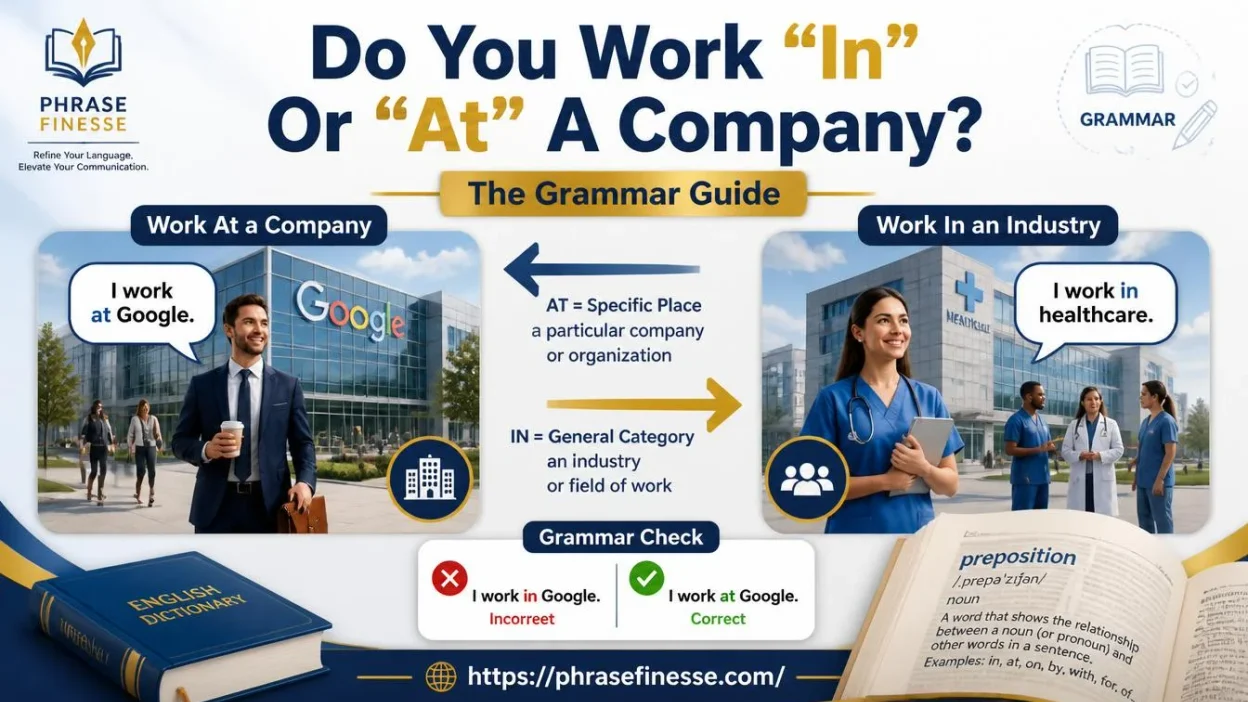
Have you ever paused while writing a resume or introducing yourself and wondered, Do You Work “In” Or “At” A Company? The Complete Grammar Guide Although the difference seems small, choosing the correct preposition can improve your English usage, grammar, formal writing, and everyday business communication.
Understanding when to use work in a company versus work at a company helps you sound more natural, accurate, and confident in both professional and casual conversations.
The distinction between these expressions depends on context rather than strict rules. In this guide, you’ll learn how native speakers use each phrase, when one sounds more appropriate than the other, and the common mistakes to avoid.
Whether you’re discussing meetings, project management, time management, scheduling, calendar planning, online booking systems, or broadcasting organizations, the right preposition makes your meaning clearer and ensures greater consistency in spoken and written English.
By the end of this article, you’ll understand the subtle differences between work in and work at a company through practical explanations, real-life examples, comparison tables, and expert grammar tips.
If you want to communicate more professionally, write with greater precision, and strengthen your overall English grammar skills, this guide will help you choose the correct expression every time.
Quick Answer:
Here’s the short answer:
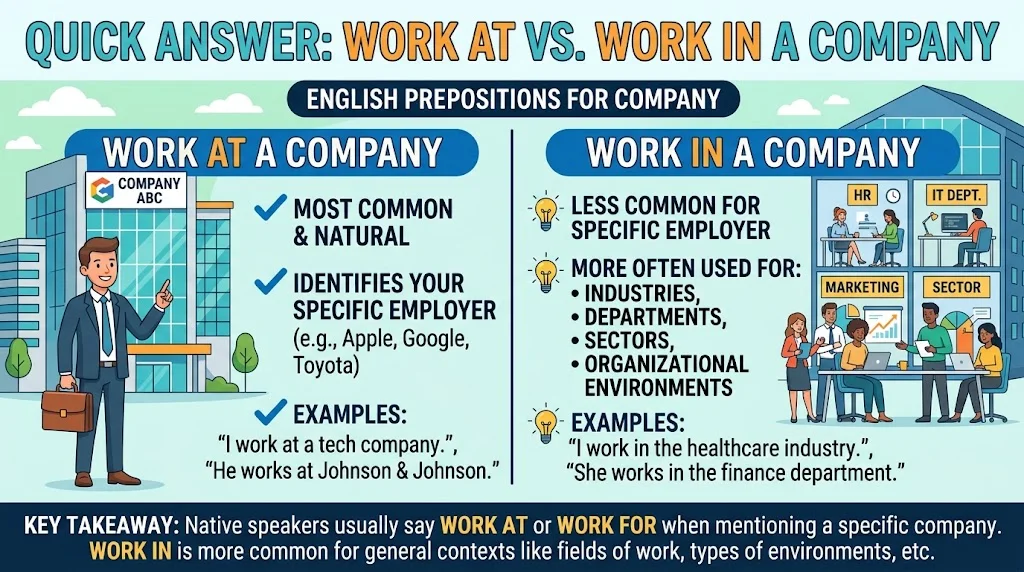
- Work at a company is the most common way to identify your employer.
- Work in a company is grammatically correct but less common.
- Native speakers usually say work at or work for when mentioning a specific company.
- Work in is more often used for industries, departments, sectors, and organizational environments.
Quick Comparison Table
| Expression | Meaning | Natural Usage |
| Work at a company | Refers to your employer | Very common |
| Work for a company | Focuses on employment relationship | Very common |
| Work in a company | Emphasizes being inside an organization | Less common |
| Work in an industry | Refers to a field or profession | Extremely common |
Examples
1.✅ I work at Google.
2.✅ I work for Google.
3✅ I work in the technology industry.
4.✅ I work in a multinational company.
❌ I work in Google.
When to Use “Work At” a Company
The preposition at is usually the safest choice when talking about your employer.
When someone asks where you work, native English speakers typically answer with work at followed by the company name.
Examples
- I work at Microsoft.
- She works at Apple.
- They work at Amazon.
- He works at a law firm.
- We work at a marketing agency.
In these examples, the focus is on the organization where the person is employed.
Think of at as pointing to a specific workplace.
Why Native Speakers Prefer “At”
In everyday conversation, people rarely overthink this choice. They naturally use at because it sounds direct and familiar.
For example:
Job Interview
Recruiter: “Where do you work?”
Candidate: “I work at Deloitte.”
Not:
Candidate: “I work in Deloitte.”
The second version sounds unusual because company names are generally treated as organizations rather than spaces.
Common Situations Where “At” Is Used
You will frequently hear work at in:
- Job interviews
- Networking events
- Professional meetings
- Business emails
- LinkedIn profiles
- Casual conversations
Real-World Examples
Consider these statements:
- “I work at Tesla.”
- “I work at Netflix.”
- “I work at IBM.”
These are natural and immediately understood by native speakers.
When to Use “Work In” a Company
While work at a company is more common, work in a company is not wrong.
The phrase simply focuses on a different aspect.
Instead of identifying your employer, it highlights your participation within an organization’s structure.
Examples
- She works in a large company.
- He works in a family business.
- They work in a multinational corporation.
- I work in a rapidly growing startup.
Notice something important.
These examples usually describe a type of company, not a specific company name.
Why “Work In” Sounds Different
Imagine a company as a system made up of people, departments, policies, and operations.
When you say:
“I work in a multinational company.”
You’re emphasizing your place within that organizational environment.
You’re not primarily identifying the employer.
Comparison
| Sentence | Focus |
| I work at Google. | Employer |
| I work in a multinational company. | Organizational environment |
| I work for Google. | Employment relationship |
Each sentence communicates something slightly different.
Why “I Work In Google” Sounds Unnatural
This is one of the most common mistakes among English learners.
Incorrect
❌ I work in Google.
Correct
✅ I work at Google.
✅ I work for Google.
But why?
The answer lies in how English speakers conceptualize companies.
Native speakers usually think of a company as an organization rather than a physical container.
The preposition in often suggests being inside a space, area, department, field, or industry.
Because of this, saying:
“I work in Google.”
sounds unusual.
Better Alternatives
| Unnatural | Natural |
| I work in Google. | I work at Google. |
| I work in Amazon. | I work for Amazon. |
| I work in Apple. | I work at Apple. |
| I work in Meta. | I work for Meta. |
Exception
You may hear phrases such as:
- I work in Google’s legal department.
- I work in Google’s headquarters.
- I work in Google’s research division.
Here, in refers to a department, office, or physical area.
That usage is perfectly natural.
Work In a Company vs. Work For a Company
Many learners focus only on in and at, but for deserves attention too.
In modern English, work for is just as common as work at.
Work For = Employer Relationship
When you use for, you’re emphasizing who employs you.
Examples
- I work for Google.
- She works for Amazon.
- They work for a global consulting firm.
- He works for a nonprofit organization.
Work At = Workplace
When you use at, you’re identifying the workplace.
Examples
- I work at Google.
- She works at Amazon.
The difference is subtle.
Most native speakers use them interchangeably.
Comparison Table
| Expression | Primary Focus |
| Work at | Workplace |
| Work for | Employer relationship |
| Work in | Industry, department, or environment |
Which Is More Common?
Both work at and work for are extremely common.
For example:
- “I work at Microsoft.”
- “I work for Microsoft.”
Both sound natural.
The choice often comes down to personal preference.
See More :Well Noted Meaning in Emails: 12 Professional Synonyms
Work In a Company vs. Work In an Industry
This distinction is crucial.
When discussing industries, professions, or fields, in is almost always the correct choice.
Examples
- I work in healthcare.
- She works in finance.
- They work in education.
- He works in construction.
- We work in marketing.
Why “In” Works Here
Industries are viewed as broad fields.
You participate within them.
Therefore, in naturally fits.
Examples of Common Industries
| Industry | Example Sentence |
| Finance | I work in finance. |
| Healthcare | She works in healthcare. |
| Technology | They work in technology. |
| Education | He works in education. |
| Manufacturing | We work in manufacturing. |
Incorrect Usage
1.❌ I work at healthcare.
2.❌ I work at finance.
3.❌ I work at education.
These sound unnatural because industries are not specific workplaces.
Work At a Company vs. Work At a Location
Another reason at is popular is its flexibility.
It works with organizations and physical locations.
Examples
- I work at Google.
- I work at headquarters.
- I work at the downtown office.
- She works at the London branch.
- They work at the regional center.
Understanding the Pattern
The preposition at often identifies a specific point or location.
That location can be:
- A company
- An office
- A branch
- A building
- A facility
This makes at one of the most versatile workplace prepositions in English.
Examples of “Work At” in Sentences
Seeing patterns in context helps reinforce correct usage.
Professional Examples
- I work at a software company that develops cybersecurity tools.
- She works at a global law firm.
- He works at a hospital in Chicago.
- They work at a startup specializing in artificial intelligence.
- We work at an international consulting agency.
Casual Examples
- My brother works at a bank.
- My friend works at Netflix.
- My cousin works at a local bakery.
- My neighbor works at an engineering company.
Notice how natural these sentences sound.
Examples of “Work In” in Sentences
Now let’s look at situations where in is appropriate.
Industry Examples
- I work in healthcare.
- She works in finance.
- They work in technology.
- He works in education.
Department Examples
- I work in marketing.
- She works in human resources.
- He works in accounting.
- They work in customer support.
Organizational Examples
- I work in a multinational company.
- She works in a growing startup.
- They work in a highly competitive industry.
These examples emphasize fields, departments, and environments.
Common Mistakes English Learners Make
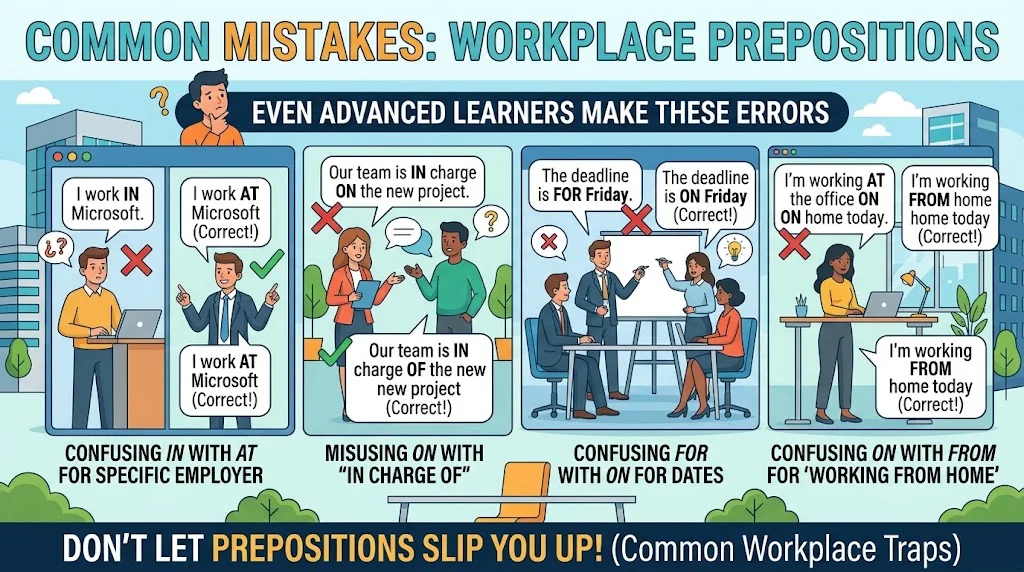
Even advanced English speakers sometimes misuse workplace prepositions.
Here are the most common errors.
Using “In” Before Company Names
Incorrect
❌ I work in Google.
Correct
✅ I work at Google.
✅ I work for Google.
Using “At” With Industries
Incorrect
❌ I work at finance.
Correct
✅ I work in finance.
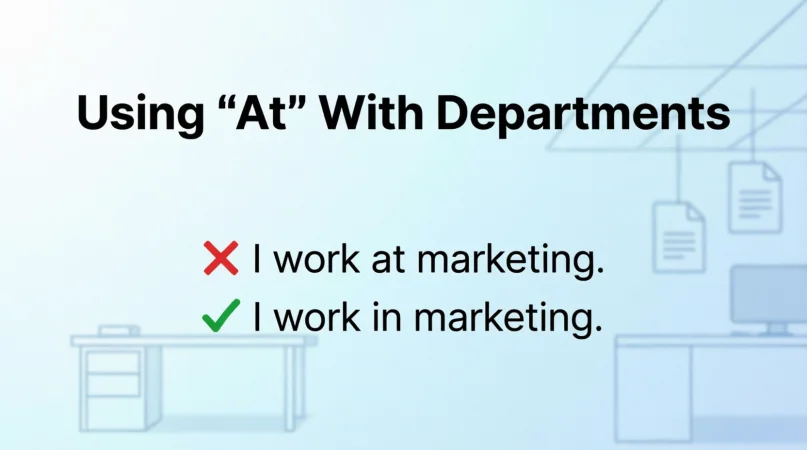
Using “At” With Departments
Incorrect
❌ I work at marketing.
Correct
✅ I work in marketing.
Confusing Physical Location With Employer
Consider these examples:
Employer
- I work at Microsoft.
Department
- I work in Microsoft’s marketing department.
Building
- I work in Microsoft’s headquarters.
The context changes the correct preposition.
How Native English Speakers Usually Talk About Their Jobs
If you listen to business professionals, you’ll notice recurring patterns.
Most Common Workplace Expressions
- I work at Google.
- I work for Apple.
- I work in marketing.
- I work in healthcare.
- I work at a law firm.
- I work for a nonprofit organization.
What You Rarely Hear
- I work in Google.
- I work at finance.
- I work at marketing.
These phrases sound unnatural because they don’t match standard English usage.
Mini Case Study
Imagine three people introducing themselves.
Sarah
“I work at Amazon.”
Focus: Employer.
Michael
“I work for Amazon.”
Focus: Employment relationship.
Emily
“I work in e-commerce.”
Focus: Industry.
All three are correct because each speaker emphasizes something different.
Easy Rule to Remember
Many learners want a quick formula.
Here’s a simple one.
| Talking About | Use |
| Company name | At / For |
| Industry | In |
| Department | In |
| Field | In |
| Employer | At / For |
| Organizational environment | In |
Memory Trick
Think of it this way:
At = Employer
For = Who pays you
In = Field, department, or environment
This simple rule works in the vast majority of situations.
Quick Reference Chart
| Example | Correct? |
| I work at Google. | ✅ |
| I work for Google. | ✅ |
| I work in Google. | ❌ |
| I work in healthcare. | ✅ |
| I work in marketing. | ✅ |
| I work at marketing. | ❌ |
| I work in a large company. | ✅ |
| I work at a large company. | ✅ |
| I work for a large company. | ✅ |
FAQs
1. Is it correct to say “I work in a company”?
Yes. “I work in a company” is grammatically correct. It usually emphasizes that you work inside an organization or may refer to your role within a company rather than simply naming your employer.
2. Is “I work at a company” more common than “I work in a company”?
Yes. In everyday English, “I work at a company” is generally more common when you’re identifying your employer. Native speakers often use this phrase in introductions and casual conversations.
3. Can I use both “in” and “at” with the same company?
Yes. Both can be correct, but they express slightly different meanings. “At” focuses on the workplace or employer, while “in” highlights being part of the organization or working within a specific department or context.
4. Which preposition should I use in a resume or job interview?
In most professional situations, “work at” is the safer and more natural choice when mentioning your employer. Use “work in” when discussing a department, field, or internal function, such as working in marketing or working in the finance department.
5. Do British and American English use these expressions differently?
Both British English and American English use work at and work in. While there may be minor regional preferences, the difference is primarily based on context rather than dialect.
6. How can I remember the difference between “work in” and “work at”?
A simple tip is to remember that “at” points to a place or employer, while “in” suggests being inside an organization, department, or field. If you’re naming where you’re employed, work at is usually the most natural option.
Conclusion
Choosing between work in a company and work at a company is easier once you understand the difference in meaning. In general, work at emphasizes your employer or workplace, while work in often highlights the organization as an environment or refers to a department, industry, or area within it.
Both expressions are grammatically correct, but the best choice depends on the context and the message you want to convey.
Mastering this small grammar point can make your English communication, business writing, and everyday conversations sound more natural and professional. Whenever you’re unsure, think about whether you’re referring to the company itself or your role within it.
With regular practice and exposure to authentic English, using work in and work at correctly will soon become second nature.

Alyan Ashraf is an English language writer and editor at Phrase Finesse, where he specializes in grammar, vocabulary, spelling, word usage, and clear communication. Passionate about the English language, he creates practical, research-backed content that helps readers avoid common mistakes and write with greater accuracy and confidence.
Known for his clear writing style and attention to detail, Alyan simplifies complex language topics into easy-to-understand guides filled with real-world examples and actionable insights. His work covers confusing word pairs, grammar rules, idioms, punctuation, and everyday English usage, making learning both accessible and engaging for students, professionals, writers, and non-native English speakers.
Every article Alyan writes is carefully researched, fact-checked, and designed to meet high editorial standards. His goal is to help readers strengthen their English skills, expand their vocabulary, and communicate more effectively in academic, professional, and everyday settings.
Through Phrase Finesse, Alyan is committed to publishing trusted language resources that make mastering English simpler, clearer, and more enjoyable for learners around the world



[…] See More : Do You Work “In” Or “At” A Company? The Grammar Guide […]