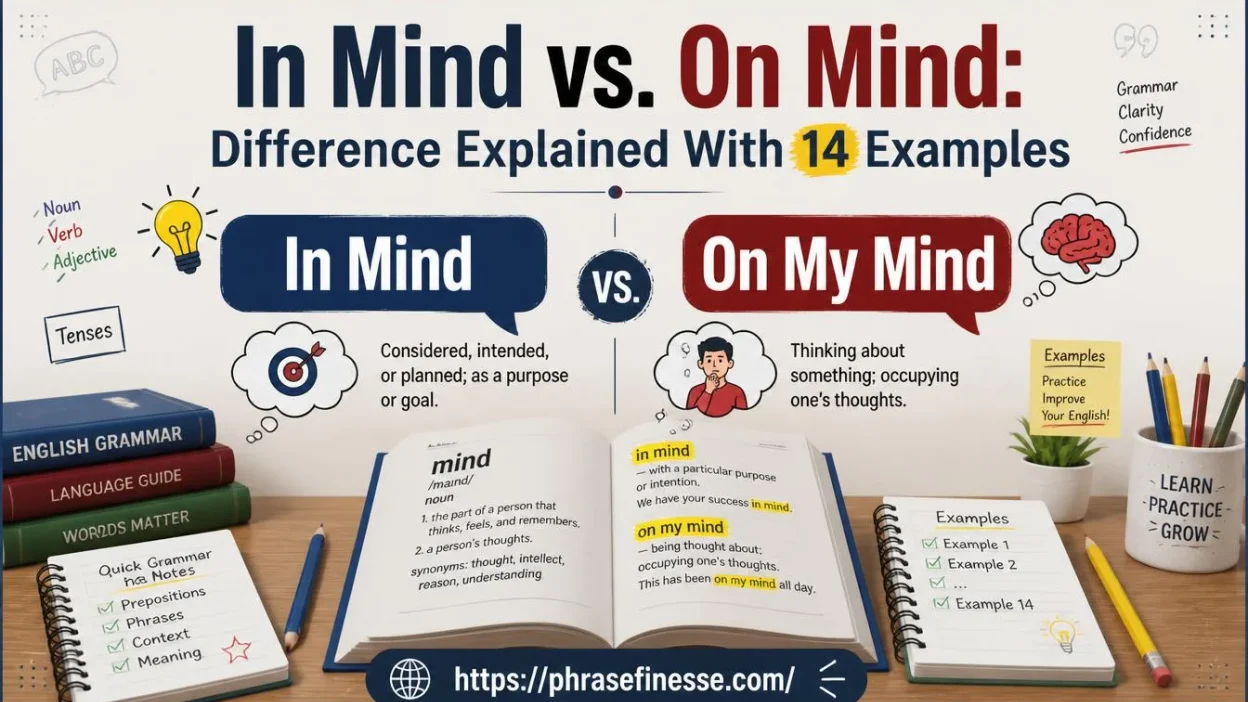
Have you ever wondered whether you should say something is “in your mind” or “on your mind”? These two phrases look similar, but they express different ideas in everyday English usage. In this guide, In Mind vs. On Mind: Difference Explained With 14 Examples explores the key differences, meanings, and correct sentence structures to help you use these expressions naturally and confidently.
Understanding the difference between “in mind” and “on mind” improves your grammar, formal writing, and everyday communication. While “in mind” often refers to thoughts, plans, intentions, or ideas you are considering, “on your mind” usually describes something that is occupying your thoughts or causing concern.
These subtle differences matter in business communication, meetings, project management, and professional conversations where clarity and consistency are important.
This article provides clear explanations, practical examples, and common usage tips to help you master these phrases. Whether you are writing emails, managing a calendar, handling scheduling, discussing time management, creating content for online booking platforms, or preparing professional broadcasting messages, knowing when to use these expressions can make your communication more accurate.
By the end, you’ll understand the grammar rules behind “in mind” and “on your mind” and avoid common mistakes in both casual and professional contexts.

Something Is Occupying Your Thoughts
The most common use of “on my mind” describes something that you are thinking about frequently.
It can refer to:
- A person
- A decision
- A memory
- A responsibility
- A problem
- An upcoming event
Examples:
“You have been on my mind lately.”
Meaning:
I have been thinking about you recently.
“The project deadline is on my mind.”
Meaning:
The deadline keeps getting my attention.
“Her advice has been on my mind since our conversation.”
Meaning:
She said something memorable that I keep thinking about.
“On My Mind” Can Describe Worries and Stress
Although “on my mind” does not always mean something negative, people often use it when something creates concern.
For example:
“I have a lot on my mind right now.”
This means the person has many thoughts, responsibilities, or worries.
They may be dealing with:
- Work pressure
- Personal decisions
- Financial concerns
- Family matters
- Important changes
Examples Showing Concern
| Sentence | Meaning |
| “The upcoming exam is on my mind.” | The exam keeps causing thoughts or worry. |
| “The conversation is still on my mind.” | The conversation continues to affect me. |
| “I have too much on my mind today.” | I have many things to think about. |
Can “On My Mind” Describe Positive Thoughts?
Yes. Many people think “on my mind” only refers to problems, but that is not true.
The phrase simply means something is receiving attention in your thoughts.
It can describe positive feelings too.
Examples:
“My family is always on my mind.”
Meaning:
I frequently think about my family.
“Your kindness has been on my mind.”
Meaning:
I keep remembering your kindness.
“That beautiful vacation memory is still on my mind.”
Meaning:
The memory remains important to me.
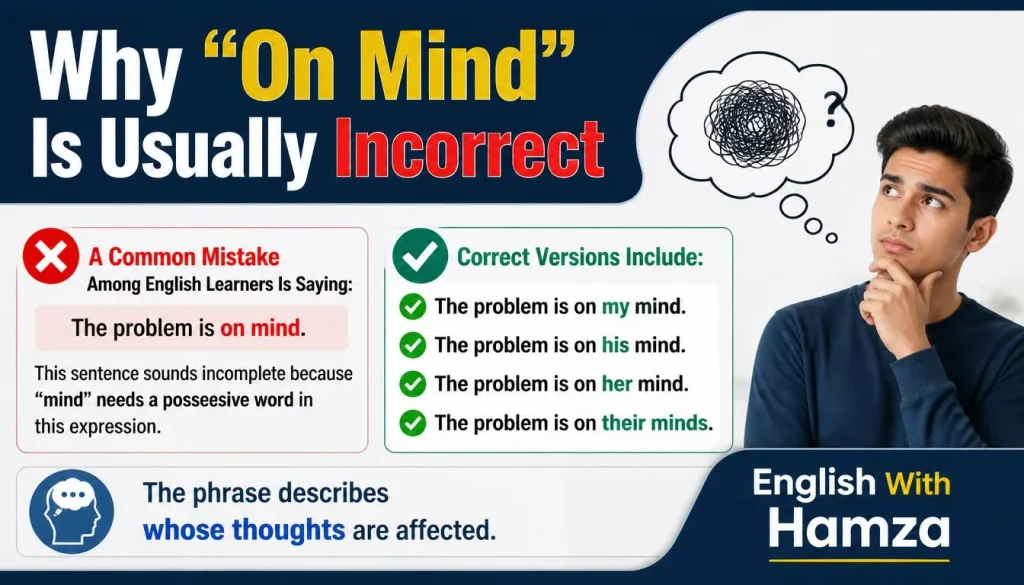
Why “On Mind” Is Usually Incorrect
A common mistake among English learners is saying:
❌ “The problem is on mind.”
This sentence sounds incomplete because “mind” needs a possessive word in this expression.
Correct versions include:
✅ The problem is on my mind.
✅ The problem is on his mind.
✅ The problem is on her mind.
✅ The problem is on their minds.
The phrase describes whose thoughts are affected.
Correct Forms of “On My Mind”
| Person | Correct Phrase |
| I | on my mind |
| You | on your mind |
| He | on his mind |
| She | on her mind |
| We | on our minds |
| They | on their minds |
Examples:
- “The decision is on my mind.”
- “The decision is on her mind.”
- “The decision is on their minds.”
In Mind vs. On My Mind: 14 Examples Showing the Difference
Understanding examples is the fastest way to master the difference between these expressions.
Example: Plans vs. Thoughts
In mind:
“I have a vacation destination in mind.”
Meaning:
I already have a destination I am considering.
On my mind:
“My vacation plans are on my mind.”
Meaning:
I keep thinking about my vacation.
Example: Ideas vs. Concerns
In mind:
“She has a career change in mind.”
Meaning:
She is considering changing careers.
On her mind:
“Her career problems are on her mind.”
Meaning:
Her career problems are worrying or occupying her thoughts.
Example: Solutions vs. Problems
In mind:
“I have a solution in mind.”
Meaning:
I already have an idea for solving the issue.
On my mind:
“The problem is still on my mind.”
Meaning:
I continue thinking about the problem.
Example: Choosing Someone
In mind:
“The manager has a candidate in mind.”
Meaning:
The manager already has someone considered for the position.
On the manager’s mind:
“The interview process is on the manager’s mind.”
Meaning:
The interview process is receiving the manager’s attention.
Example: Remembering Important Information
In mind:
“Keep the customer’s needs in mind.”
Meaning:
Consider customer needs when making decisions.
On my mind:
“Customer complaints have been on my mind.”
Meaning:
The complaints keep occupying my thoughts.
Example: Money and Budget
In mind:
“I have a budget in mind for the project.”
Meaning:
I have a specific budget amount I am considering.
On my mind:
“My financial situation has been on my mind lately.”
Meaning:
I keep thinking about my finances.
See More : When Should I Use “&” vs. “And”?
Example: Future Goals
In mind:
“He has a specific goal in mind.”
Meaning:
He already knows what he wants to achieve.
On his mind:
“His future is always on his mind.”
Meaning:
He often thinks about his future.
Mistake: Using “On Mind” Without a Possessive
Incorrect:
❌ I have something on mind.
Correct:
✅ I have something on my mind.
The phrase needs a person connected to the thought.
Mistake: Confusing Ideas With Worries
Some sentences become unclear because writers choose the wrong phrase.
Example:
❌ I have a solution on my mind.
This sounds like the solution is occupying your thoughts.
Better:
✅ I have a solution in mind.
This shows you already have an idea.
Another example:
❌ The problem is in mind.
This sounds like you have considered the problem.
Better:
✅ The problem is on my mind.
This shows the problem continues to affect your thoughts.
Mistake: Confusing “In My Mind” and “On My Mind”
These expressions look similar but serve different purposes.
“In My Mind”
Means:
- According to my opinion
- In my imagination
- In my personal thoughts
Examples:
“In my mind, this restaurant serves the best food in town.”
Meaning:
This is my personal opinion.
“I imagined the house differently in my mind.”
Meaning:
This was my mental picture.
“On My Mind”
Means:
- Something I keep thinking about
- Something affecting my attention
Examples:
“The decision is still on my mind.”
Meaning:
I continue thinking about it.
A Simple Trick to Remember “In Mind” vs. “On My Mind”
Use this mental picture:
“In Mind” : A Folder
An idea sits inside your mental folder.
You can open it whenever needed.
Examples:
- A business idea
- A plan
- A possible solution
- A person for a role
Sentence:
“I have a plan in mind.”

“On My Mind” : A Sticky Note
A thought sticks to your attention.
It keeps appearing.
Examples:
- A worry
- A memory
- A responsibility
- A person you miss
Sentence:
“The meeting is on my mind.”
Quick Reference Table: In Mind vs. On My Mind
| Situation | Correct Phrase | Example |
| You have an idea | In mind | “I have an idea in mind.” |
| You have a plan | In mind | “She has a plan in mind.” |
| You are considering someone | In mind | “They have him in mind for the role.” |
| You need to remember something | Keep in mind | “Keep this rule in mind.” |
| You cannot stop thinking about something | On my mind | “The issue is on my mind.” |
| Something worries you | On my mind | “Money problems are on my mind.” |
| You are thinking about someone | On my mind | “You are always on my mind.” |
FAQs
1. What is the difference between “in mind” and “on your mind”?
The main difference is related to meaning and context. “In mind” usually refers to an idea, plan, intention, or something you are considering. For example, “I have a new project idea in mind” means you are thinking about or planning something.
On the other hand, “on your mind” means something is occupying your thoughts, often because it is important, worrying, or emotionally significant. For example, “You seem quiet. Is something on your mind?”
2. Is “on mind” grammatically correct?
In standard English, “on mind” is usually incomplete and sounds unnatural. The correct expression is “on your mind,” “on my mind,” “on his mind,” or another possessive form.
For example:
- ✅ “I have something on my mind.”
- ❌ “I have something on mind.”
The possessive word is necessary because it shows whose thoughts are being affected.
3. When should I use “in mind” in a sentence?
Use “in mind” when you are talking about a thought, idea, goal, or plan you are considering. It often appears with verbs like keep, have, bear, or take.
Examples:
- “I have a few improvements in mind for the website.”
- “Keep this information in mind during the meeting.”
- “She has a specific career path in mind.”
This phrase works well in formal writing, professional discussions, and project management conversations.
4. When should I use “on your mind”?
Use “on your mind” when something is currently occupying your thoughts. It can describe emotions, concerns, memories, or problems.
Examples:
- “You look distracted. What’s on your mind?”
- “The upcoming presentation has been on my mind all week.”
- “Family responsibilities are always on her mind.”
This expression is common in personal conversations and informal business communication.
5. Can “in mind” and “on your mind” be used interchangeably?
No, these phrases have different meanings and cannot usually replace each other. Using the wrong phrase can change the meaning of your sentence.
Compare:
- “I have a new design in mind.”
→ You have an idea or plan. - “I have a new design on my mind.”
→ You are thinking about that design frequently.
The first focuses on an intention, while the second focuses on mental attention.
6. How can I remember the difference between “in mind” and “on your mind”?
A simple way to remember is:
- In mind = an idea inside your thoughts or a plan you are considering.
- On your mind = something sitting on your thoughts and demanding attention.
Think of “in mind” as something you are keeping as an option, while “on your mind” is something you cannot stop thinking about. This distinction will help you maintain accuracy and consistency in your everyday English usage.
Conclusion
Understanding the difference between “in mind” and “on your mind” helps you communicate with greater accuracy and confidence. Although these phrases look similar, they serve different purposes in English. “In mind” focuses on ideas, plans, and intentions, while “on your mind” describes thoughts, concerns, or feelings that are currently affecting you.
By learning these small but important grammar differences, you can improve your writing, conversations, and professional communication. Whether you are preparing formal writing, organizing meetings, managing scheduling tasks, or simply having everyday conversations, choosing the right phrase makes your message clearer and more natural.
Keep these examples in mind, practice using both expressions, and you’ll quickly develop a stronger understanding of English phrases and sentence structure. Small improvements in word choice can create a big difference in how effectively you express your ideas.

Emma Brooke is an English language specialist, editor, and content writer at Phrase Finesse, where she helps readers develop stronger writing and communication skills through clear, practical, and engaging content. With a passion for the English language, she specializes in simplifying grammar rules, vocabulary, spelling, punctuation, and word usage for learners at every level.
Emma has extensive experience creating educational content that is accurate, well-researched, and easy to understand. She is particularly skilled at explaining confusing word pairs, grammar concepts, idioms, sentence structure, and effective writing techniques, making complex topics approachable for students, professionals, educators, and English learners worldwide.

[…] See More : In Mind vs. On Mind: Difference Explained With Real Examples […]
[…] See More : In Mind vs. On Mind: Difference Explained With Real Examples […]
[…] Read More : In Mind vs. On Mind: Difference Explained With Real Examples […]
[…] See More : In Mind vs. On Mind: Difference Explained With Real Examples […]