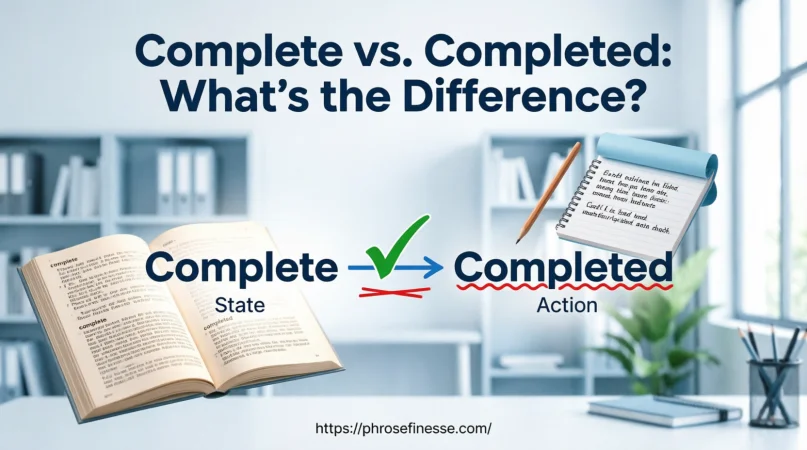
Have you ever paused while writing an email or report and wondered whether to use “complete” or “completed”? Although these words look closely related, choosing the wrong one can affect clarity, professionalism, and overall English usage.
In this guide,Complete vs. Completed: What’s the Difference? you’ll learn the exact difference between these commonly confused terms, when to use each one, and how they function in everyday and professional communication.
Understanding this distinction is especially important in areas such as business communication, formal writing, project management, scheduling, and time management.
Whether you are updating a calendar, confirming meetings, managing online booking systems, or reporting progress in a workplace setting, the correct word choice helps maintain consistency and prevents misunderstandings. Small grammar decisions often have a big impact on how clearly your message is received.
Throughout this article, you’ll discover practical grammar rules, real-world examples, common mistakes, and usage tips that make the difference easy to remember. We’ll also explore how broadcasting, workplace documentation, and professional correspondence use these terms differently.
By the end, you’ll know exactly when to use complete and when completed is the better choice, helping you write with greater confidence, accuracy, and precision.
Complete or Completed? Understanding the Difference in Meaning and Usage
The simplest way to understand the distinction is this:
- Complete usually describes a state or condition.
- Completed usually emphasizes the action of finishing something.
Although they can occasionally overlap, native English speakers often choose one over the other based on what they want to emphasize.
Consider these examples:
- The project is complete.
- The project was completed yesterday.
The first sentence focuses on the project’s current condition. The second focuses on the action and timing of finishing it.
That subtle difference matters more than many people realize.
The Short Answer: Complete vs. Completed
| Word | Part of Speech | Main Meaning | Example |
| Complete | Adjective, verb | Finished, whole, or having all parts | The report is complete. |
| Completed | Adjective, past tense verb, past participle | Finished through an action or process | The report was completed yesterday. |
Quick Summary
| If You Want To Emphasize | Use |
| Current condition | Complete |
| Finishing action | Completed |
| Something whole or entire | Complete |
| Something finished through work | Completed |
Think of it this way:
Complete describes what something is. Completed describes what happened to it.
This simple rule solves most usage questions.
What Does “Complete” Mean?
The word complete has several grammatical functions. It can act as both an adjective and a verb.
Let’s examine each use separately.
Complete as an Adjective
When used as an adjective, complete means:
- Finished
- Whole
- Having all necessary parts
- Not missing anything
Examples:
- The application is complete.
- The collection is complete.
- The information provided is complete.
- The project is finally complete.
In these examples, the focus isn’t on the process. Instead, it is on the current state.
Imagine building a puzzle.
When every piece is in place, the puzzle is complete.
Nobody is discussing how long it took or who finished it. They’re simply describing its condition.
Common Adjective Uses
| Phrase | Meaning |
| Complete guide | Covers everything |
| Complete collection | Nothing missing |
| Complete sentence | Grammatically whole |
| Complete record | Full information |
| Complete success | Total success |
Notice that completed would sound unnatural in most of these expressions.
For example:
✅ Complete success
❌ Completed success
Native speakers almost always choose complete here.
Complete as a Verb
As a verb, complete means:
- To finish
- To bring to an end
- To fulfill requirements
Examples:
- Please complete the application.
- She completed the assignment.
- We must complete the project by Friday.
- They completed construction ahead of schedule.
In these cases, complete refers to an action.
The verb form is extremely common in:
- Business communication
- Academic writing
- Government documents
- Workplace instructions
For example:
“Please complete all sections before submission.”
This instruction appears on countless forms worldwide.
Common Uses of “Complete”
The word appears frequently in everyday English.
Examples include:
Education
- Complete the homework
- Complete the course
- Complete the degree
Business
- Complete the transaction
- Complete the report
- Complete the application
Personal Tasks
- Complete the checklist
- Complete the registration
- Complete the booking
Descriptive Uses
- Complete stranger
- Complete control
- Complete confidence
- Complete disaster
These descriptive expressions rely on the adjective form rather than the verb form.
What Does “Completed” Mean?
The word completed comes directly from the verb complete.
It serves two primary purposes:
- Past tense verb
- Adjective
Understanding both roles helps eliminate confusion.
Completed as the Past Tense of Complete
This is perhaps the most straightforward usage.
Examples:
- She completed the report.
- We completed the project.
- They completed construction last month.
- He completed his degree in 2024.
Here, completed simply tells us that the action occurred in the past.
Timeline Example
Start Project → Work Progress → Completed
The focus remains on the action of finishing.
Completed as an Adjective
Sometimes completed acts as an adjective.
Examples:
- Completed form
- Completed application
- Completed questionnaire
- Completed checklist
These examples refer to items that have already gone through the completion process.
For instance:
A complete application may contain all required information.
A completed application specifically indicates someone has already filled it out.
This distinction is subtle but important.
Why “Completed” Often Focuses on Action
Native speakers frequently use completed when they want to highlight that effort, work, or a process occurred.
Examples:
- Completed training
- Completed project
- Completed survey
- Completed transaction
The emphasis is not merely on the end state.
It is on the fact that someone finished the task.
This explains why completed appears so often in professional and technical writing.
Complete vs. Completed: The Main Difference
Now let’s examine the core distinction.
| Situation | Complete | Completed |
| Describes current condition | ✓ | Sometimes |
| Describes past action | ✗ | ✓ |
| Indicates process occurred | Rarely | ✓ |
| Means whole or entire | ✓ | ✗ |
| Common in fixed expressions | ✓ | Rarely |
The difference becomes clearer through examples.
Side-by-Side Examples
| Complete | Completed |
| The report is complete. | The report was completed yesterday. |
| The form is complete. | The form was completed online. |
| The project is complete. | The project has been completed. |
| We need complete information. | We reviewed the completed forms. |
Notice how the left column focuses on the current state while the right column focuses on the action.
A Real-Life Analogy
Imagine baking a cake.
When the cake is sitting on the table ready to eat:
The cake is complete.
When talking about the baking process:
The cake was completed this morning.
The first describes its condition.
The second describes the action that finished it.
When Complete and Completed Are Interchangeable
Interestingly, there are situations where both words are grammatically correct.
Consider:
- The project is complete.
- The project is completed.
Both sentences work.
However, they don’t sound exactly the same.
Nuance Matters
The project is complete
This sounds:
- Natural
- Conversational
- Common
- State-focused
The project is completed
This sounds:
- More formal
- More technical
- Process-focused
- Slightly less common
Most native speakers would choose:
The project is complete.
unless they specifically want to emphasize completion.
Native Speaker Preferences
| Expression | Naturalness |
| The project is complete. | Very high |
| The project is completed. | Moderate |
| The form is complete. | Very high |
| The form is completed. | Context-dependent |
| The task is complete. | Very high |
| The task is completed. | Formal |
This pattern appears across American and British English.
Common Mistakes With Complete and Completed
Many writers make predictable mistakes.
Let’s examine them.
Using “Completed” When Describing a State
Incorrect:
❌ The package is completed.
Correct:
✅ The package is complete.
Why?
Because the sentence describes the package’s condition, not the finishing action.
Using “Complete” Instead of Past Tense
Incorrect:
❌ She complete the assignment yesterday.
Correct:
✅ She completed the assignment yesterday.
The sentence requires a past-tense verb.
Confusing Adjective and Verb Forms
Consider these examples:
Correct
- Please complete the form.
- The form is complete.
- The completed form was submitted.
Incorrect
- Please completed the form.
- The form is completed information.
- The complete form was already filled out.
Understanding grammatical roles solves most problems instantly.
Complete vs. Completed in Professional Writing
Business communication often uses both words.
The choice depends on context.
Business Communication
Examples:
Complete
- Complete information
- Complete documentation
- Complete proposal
Completed
- Completed application
- Completed report
- Completed transaction
Human resources departments frequently request:
“Submit your completed application.”
The word completed highlights that the applicant already finished filling it out.
See More :Hands-On Experience on a Resume: 4 Better Alternatives
Academic Writing
Students regularly encounter both terms.
Examples:
Complete
- Complete answer
- Complete explanation
- Complete bibliography
Completed
- Completed assignment
- Completed dissertation
- Completed coursework
Again, completed emphasizes that the work has been finished.
Technical and Administrative Documents
Government forms often contain wording such as:
- Completed application
- Completed questionnaire
- Completed registration form
Why?
Because the organization wants proof that someone actually performed the required action.
Popular English Expressions Using Complete
Many common phrases rely exclusively on complete.
These expressions have become fixed parts of English.
Common Expressions
Complete Success
Meaning:
Total success.
Example:
The event was a complete success.
Complete Failure
Meaning:
Total failure.
Example:
The plan turned into a complete failure.
Complete Control
Meaning:
Full authority or influence.
Example:
She maintained complete control throughout the negotiation.
Complete Confidence
Meaning:
Absolute trust.
Example:
We have complete confidence in the team.
Complete Stranger
Meaning:
Someone entirely unknown.
Example:
He was a complete stranger.
Complete Opposite
Meaning:
Entirely different.
Example:
Their personalities are complete opposites.
Why “Completed” Doesn’t Work Here
These phrases describe states or qualities.
They do not describe finishing actions.
Therefore:
✅ Complete confidence
❌ Completed confidence
✅ Complete stranger
❌ Completed stranger
The adjective complete is required.
Complete vs. Completed in American and British English
Fortunately, there is very little difference between American and British usage.
Both varieties generally follow the same rules.
Examples:
| American English | British English |
| The project is complete. | The project is complete. |
| The form was completed. | The form was completed. |
| Complete information | Complete information |
| Completed application | Completed application |
Any differences are usually stylistic rather than grammatical.
Grammar Rules to Remember
If you’re still unsure which word to choose, these simple rules can help.
Use Complete for a State
Examples:
- The work is complete.
- The set is complete.
- The information is complete.
The focus is the current condition.
Use Completed for an Action
Examples:
- She completed the project.
- They completed the survey.
- We completed construction.
The focus is the act of finishing.
Use Completed When Time Matters
Examples:
- The project was completed yesterday.
- Construction was completed in June.
- Training was completed last week.
The completion event is important.
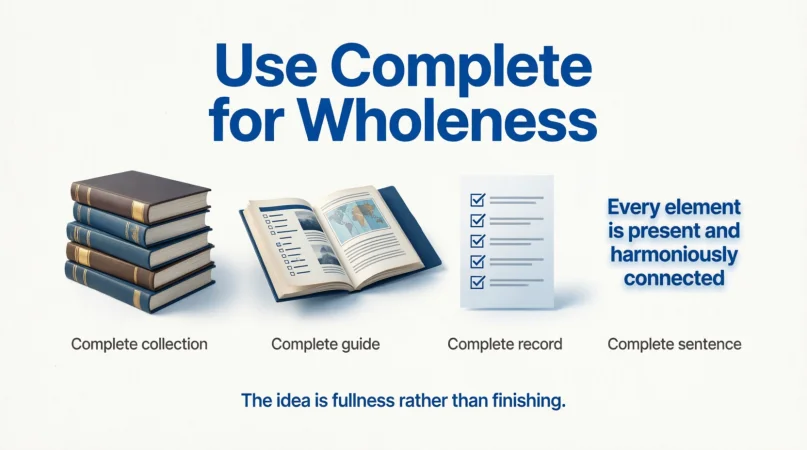
Use Complete for Wholeness
Examples:
- Complete collection
- Complete guide
- Complete record
- Complete sentence
The idea is fullness rather than finishing.
Memory Trick for Choosing the Right Word
A simple mental shortcut can help.
The State vs. Action Test
Current condition?
→ Complete
Finished action?
→ Completed
Examples
Current condition:
- The checklist is complete.
- The report is complete.
- The collection is complete.
Finished action:
- She completed the checklist.
- They completed the report.
- He completed the collection.
This single rule works in most situations.
Practice Sentences
Test your understanding.
Fill in the blanks with complete or completed.
Questions
- The renovation project was ______ last month.
- Please ensure the application is ______.
- She ______ all required training modules.
- The ______ questionnaire was submitted online.
- The database is now ______.
- We ______ the audit ahead of schedule.
Answers
| Sentence | Correct Answer |
| The renovation project was ______ last month. | completed |
| Please ensure the application is ______. | complete |
| She ______ all required training modules. | completed |
| The ______ questionnaire was submitted online. | completed |
| The database is now ______. | complete |
| We ______ the audit ahead of schedule. | completed |
Real-World Case Study: Project Management Language
Consider a software development team.
During a weekly meeting, a manager asks:
“Is the project complete?”
The question focuses on current status.
A team member responds:
“Yes, the project is complete.”
Later, when writing a progress report, the manager writes:
“The project was completed on June 15.”
Now the focus shifts to the completion event.
Both words are correct.
The context determines which one sounds most natural.
This pattern appears every day in business, education, engineering, healthcare, and government communication.
Quick Reference Table
| Question | Use |
| Is it finished now? | Complete |
| Was it finished earlier? | Completed |
| Are all parts included? | Complete |
| Did someone finish it? | Completed |
| Describing a current state? | Complete |
| Describing a past action? | Completed |
FAQs
Is “complete” the same as “completed”?
No. Complete usually describes something that is whole, finished, or lacking nothing, while completed refers to an action that has already been finished. The difference depends on whether you are describing a state or a completed action.
When should I use “complete” in a sentence?
Use complete when describing something as whole or finished. For example, “The report is complete and ready for review.” It can also function as a verb, as in “Please complete the form.”
When should I use “completed” in a sentence?
Use completed when referring to an action that has already been finished. For example, “The team completed the project ahead of schedule.”
Can “completed” be used as an adjective?
Yes. Completed can act as an adjective when describing something that has been finished. For example, “The completed application was submitted to the manager.”
Which word is more common in business communication?
Both are common, but they serve different purposes. Complete is often used to describe the current status of a task, while completed is frequently used in project updates, reports, and progress tracking to indicate that work has been finished.
How can I remember the difference between complete and completed?
A simple trick is to focus on the “-ed” ending. Completed usually points to an action that happened in the past, while complete often describes the current condition of something or serves as the base verb form.
Conclusion
Understanding the distinction between complete and completed can significantly improve your grammar, English usage, and professional writing. While complete typically describes a finished state or functions as a verb, completed emphasizes that an action has already been carried out.
This subtle difference appears frequently in business communication, project management, scheduling, and everyday conversations.
By learning when and how to use each term correctly, you can communicate with greater clarity, maintain consistency, and avoid common writing mistakes. Whether you are drafting emails, updating reports, managing tasks, or participating in formal discussions, choosing the right word will make your writing more accurate and professional.