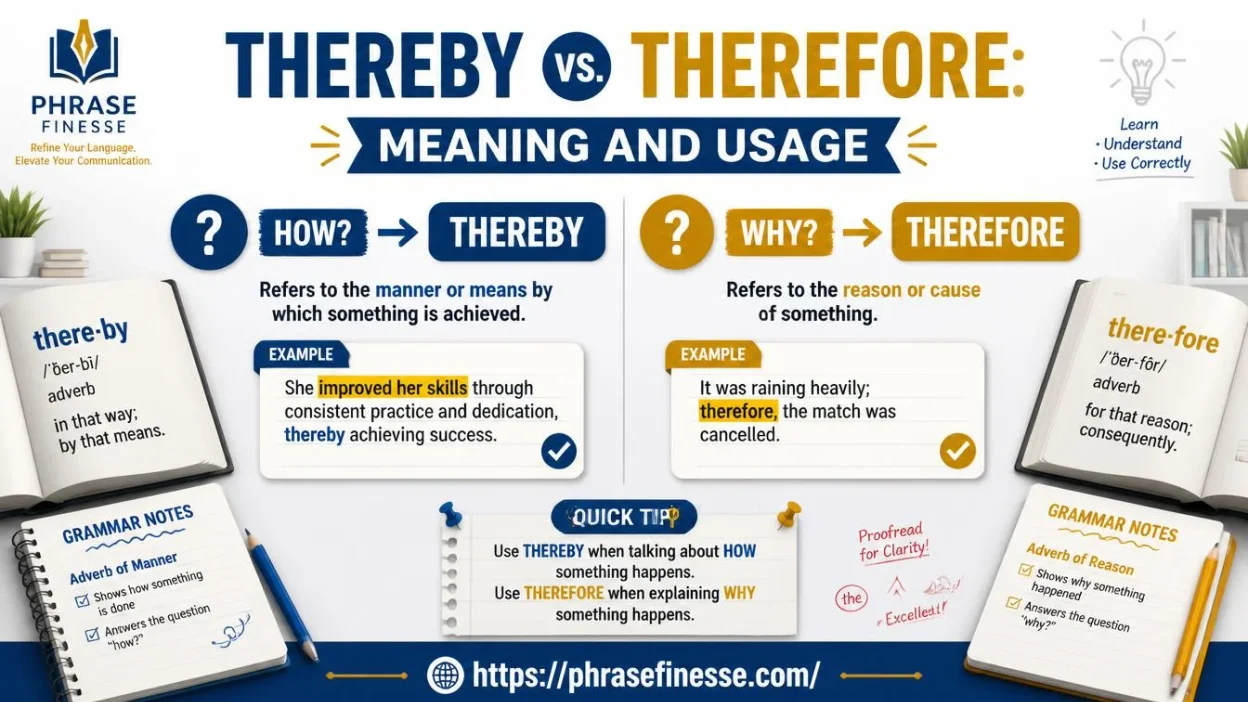
Have you ever paused while writing and wondered whetherThereby vs. Therefore: Meaning and Usage is the right choice for your sentence? Although these two transition words look similar, they serve different purposes in English usage, grammar, and formal writing.
Choosing the correct one improves clarity, consistency, and the overall quality of your message, whether you’re drafting emails, reports, or academic content.
Understanding the difference between thereby and therefore is more than a grammar exercise. It helps you communicate ideas with precision across business communication, project management, meetings, broadcasting, online booking, scheduling, calendar planning, and time management discussions.
Using the right connector strengthens logical flow, reduces ambiguity, and makes your writing more natural and professional.
In this guide, you’ll discover when to use thereby and when therefore is the better choice. You’ll explore clear explanations, practical grammar rules, common mistakes, and plenty of real-world examples that make these words easy to remember.
By the end, you’ll write with greater confidence, improve your formal writing skills, and develop stronger English usage habits that readers and search engines alike value.
Thereby vs. Therefore: What’s the Difference?
The simplest way to understand the difference is this:
- Thereby means “by that means” or “as a result of that action.”
- Therefore means “for that reason” or “consequently.”
Consider these examples:
Thereby:
The company automated its workflow, thereby reducing operational costs.
The word thereby explains how costs were reduced.
Therefore:
Operational costs were too high. Therefore, the company automated its workflow.
The word therefore explains why the company took action.
A useful memory trick:
| Word | Think Of |
| Thereby | By that action |
| Therefore | For that reason |
What Does “Thereby” Mean?
Definition of Thereby
Thereby is an adverb that means:
By that means.
Through that action.
As a result of what was just mentioned.
It shows that one action directly causes another outcome.
Unlike therefore, which introduces a conclusion, thereby explains the mechanism behind a result.
How Thereby Functions Grammatically
Grammatically, thereby connects an action with its direct consequence.
The structure often looks like this:
Action + thereby + verb-ing phrase
Examples:
- She increased her study time, thereby improving her grades.
- The team simplified the process, thereby increasing efficiency.
- The software detected errors automatically, thereby reducing manual work.
Notice that thereby answers the question:
“How did this happen?”
Examples of Thereby in Sentences
Business Examples
- The company merged two departments, thereby eliminating duplicate roles.
- Management adopted cloud technology, thereby improving collaboration.
Academic Examples
- Researchers expanded the sample size, thereby increasing reliability.
- Scientists refined the experiment, thereby reducing bias.
Everyday Examples
- He left earlier than usual, thereby avoiding traffic.
- She practiced every day, thereby becoming more confident.
Common Sentence Patterns with Thereby
You will frequently see these patterns:
Pattern 1: Action + Thereby + Result
- The organization reduced waste, thereby lowering expenses.
- The teacher clarified expectations, thereby improving student performance.
Pattern 2: Thereby Introducing a Consequence
- Employees completed additional training, thereby gaining new certifications.
Pattern 3: Process-Based Writing
- The system encrypts user data, thereby enhancing security.
This structure is especially common in technical and professional writing.
Synonyms of Thereby
| Alternative | Best Use |
| By doing so | Informal writing |
| Through that action | Explaining method |
| As a result | General consequence |
| Thus | Formal writing |
| In doing so | Process explanation |
Example
Original:
The company expanded internationally, thereby increasing revenue.
Alternative:
The company expanded internationally and, in doing so, increased revenue.
What Does “Therefore” Mean?
Definition of Therefore
Therefore means:
For that reason.
Consequently.
As a logical result.
It introduces a conclusion based on information that came before.
How Therefore Functions Grammatically
Unlike thereby, which focuses on the process, therefore focuses on reasoning.
It connects:
Cause → Conclusion
Examples:
- Sales increased significantly. Therefore, profits improved.
- The road was flooded. Therefore, the event was postponed.
In each example, therefore explains why something happened.
Examples of Therefore in Sentences
Workplace Examples
- Demand exceeded expectations. Therefore, production increased.
- Customer complaints declined. Therefore, satisfaction ratings improved.
Academic Examples
- The hypothesis was supported by the data. Therefore, researchers accepted the prediction.
- Results were statistically significant. Therefore, further study was justified.
Everyday Examples
- It was raining heavily. Therefore, we stayed indoors.
- She forgot her keys. Therefore, she couldn’t enter the building.
Common Sentence Patterns with Therefore
Statement + Therefore + Conclusion
- The budget was approved. Therefore, the project can begin.
Evidence + Therefore + Outcome
- Revenue grew by 20%. Therefore, expansion became possible.
Reason + Therefore + Decision
- Safety risks increased. Therefore, management changed the policy.
Synonyms of Therefore
| Alternative | Formality |
| Consequently | Formal |
| Thus | Formal |
| Hence | Academic |
| As a result | Neutral |
| For this reason | General |
Example
Original:
The machine failed inspection. Therefore, it was removed from service.
Alternative:
The machine failed inspection. Consequently, it was removed from service.
Thereby vs. Therefore: The Key Difference
Many grammar questions become easier when you focus on one distinction.
Thereby = Method
It explains how something happened.
Therefore = Reason
It explains why something happened.
Side-by-Side Comparison
| Feature | Thereby | Therefore |
| Meaning | By that means | For that reason |
| Function | Shows method | Shows conclusion |
| Answers | How? | Why? |
| Usage | Within a clause | Between ideas |
| Common Context | Processes | Logic and reasoning |
| Tone | Formal | Formal |
Quick Memory Trick
Imagine this sentence:
The company invested in automation.
Now ask:
How did productivity increase?
The company invested in automation, thereby increasing productivity.
Why did productivity increase?
The company invested in automation. Therefore, productivity increased.
The distinction becomes obvious.
When to Use Thereby
Describing How a Result Happens
Use thereby when explaining the mechanism behind a result.
Examples:
- The athlete trained consistently, thereby improving endurance.
- The city expanded public transit, thereby reducing congestion.
Explaining a Process
Process-oriented writing often relies on thereby.
Examples:
- The filter removes impurities, thereby improving water quality.
- The platform verifies identities, thereby reducing fraud.
Academic and Technical Writing
Researchers frequently use thereby because it links actions with measurable outcomes.
Example:
Researchers controlled external variables, thereby increasing internal validity.
This wording is concise and precise.
When to Use Therefore
Drawing Conclusions
Use therefore when evidence supports a conclusion.
Examples:
- The evidence was overwhelming. Therefore, the verdict was predictable.
- Market demand increased. Therefore, prices rose.
Presenting Cause and Effect
Therefore excels in logical arguments.
Examples:
- The bridge was unsafe. Therefore, officials closed it.
- Employee retention improved. Therefore, recruitment costs declined.
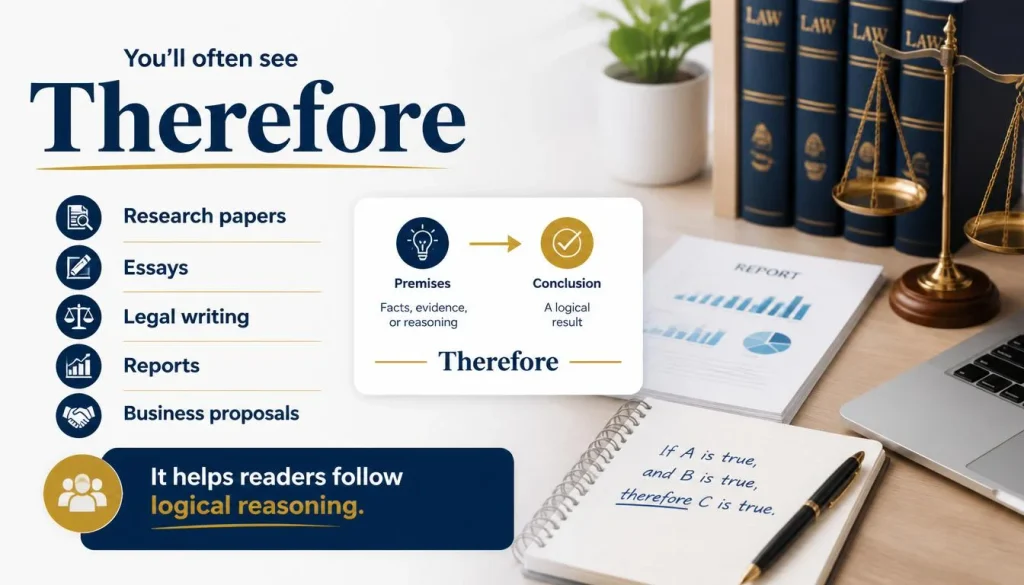
Analytical Writing
You’ll often see therefore in:
- Research papers
- Essays
- Legal writing
- Reports
- Business proposals
It helps readers follow logical reasoning.
Thereby vs. Therefore in Real Sentences
Understanding real examples helps cement the difference.
Comparison Examples
| Incorrect | Correct | Why |
| She exercised daily, therefore becoming healthier. | She exercised daily, thereby becoming healthier. | Explains method |
| Sales increased, thereby profits rose. | Sales increased. Therefore, profits rose. | Shows conclusion |
| The company hired specialists, therefore improving expertise. | The company hired specialists, thereby improving expertise. | Explains how |
| Demand surged. Thereby, production expanded. | Demand surged. Therefore, production expanded. | Shows reason |
Business Writing Examples
Correct Use of Thereby
The company upgraded its software, thereby increasing efficiency.
Correct Use of Therefore
Efficiency increased significantly. Therefore, operating costs decreased.
Academic Writing Examples
Thereby
Researchers expanded the dataset, thereby improving statistical accuracy.
Therefore
Statistical confidence exceeded the threshold. Therefore, the findings were considered reliable.
Professional Email Examples
Thereby
We consolidated vendor contracts, thereby reducing administrative workload.
Therefore
Administrative workload has decreased. Therefore, resources can be redirected to strategic initiatives.
Common Mistakes People Make
Even experienced writers sometimes misuse these words.
Using Thereby Instead of Therefore
Incorrect:
Revenue increased. Thereby, the company expanded.
Correct:
Revenue increased. Therefore, the company expanded.
The second statement is a conclusion.
Using Therefore Instead of Thereby
Incorrect:
The company introduced automation, therefore reducing errors.
Correct:
The company introduced automation, thereby reducing errors.
The reduction in errors occurred through the action.
Misplacing Therefore
Incorrect:
The market changed therefore companies adapted.
Correct:
The market changed. Therefore, companies adapted.
Proper punctuation improves clarity.
Overusing Formal Transitions
Although useful, both words can sound repetitive.
Instead of writing:
Therefore… Therefore… Therefore…
Consider alternatives:
- Consequently
- Thus
- As a result
- For this reason
- Hence
Variation keeps writing engaging.
Grammar Rules and Punctuation Tips
Commas with Therefore
At the Beginning
Correct:
Therefore, we revised the strategy.
In the Middle
Correct:
The proposal, therefore, deserves approval.
Between Independent Clauses
Correct:
Sales increased; therefore, profits improved.
A semicolon often works best here.
Punctuation with Thereby
Generally, thereby appears inside a clause.
Examples:
- The company expanded overseas, thereby increasing revenue.
- He revised the manuscript, thereby improving readability.
A comma usually precedes thereby.
Style Guidelines
For professional writing:
- Use thereby for process explanations.
- Use therefore for conclusions.
- Avoid mixing their roles.
- Keep sentence structure clear.
Thereby and Therefore in Academic and Professional Writing
Formal writing values precision.
That is why both words remain popular.
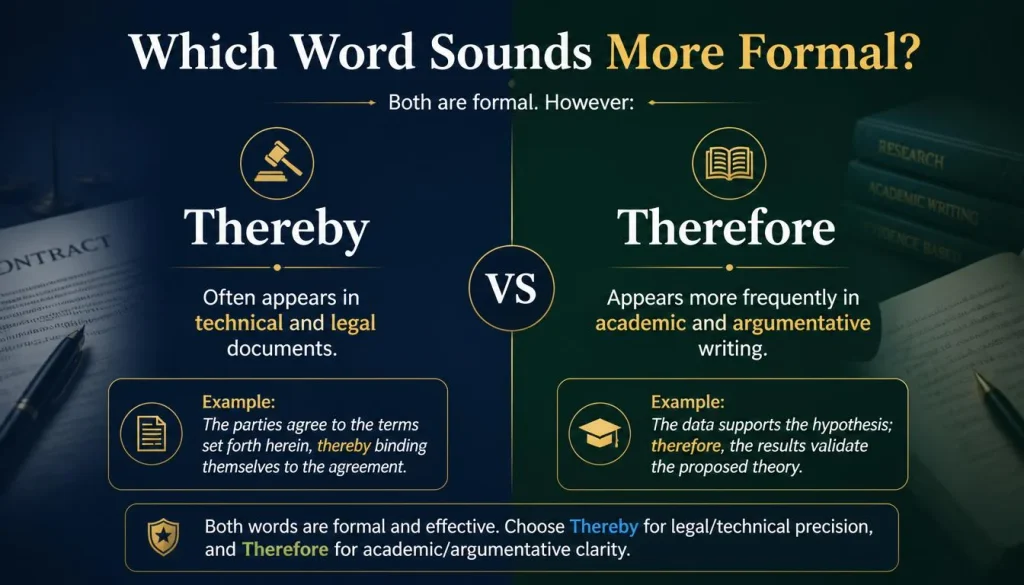
Which Word Sounds More Formal?
Both are formal.
However:
- Thereby often appears in technical and legal documents.
- Therefore appears more frequently in academic and argumentative writing.
Usage in Research Papers
Researchers use:
Thereby
To explain experimental outcomes.
Example:
Scientists controlled environmental factors, thereby reducing variability.
Therefore
To present conclusions.
Example:
The hypothesis was supported. Therefore, the theory gained credibility.
Usage in Business Communication
Business leaders use these words to explain actions and results.
Example:
We streamlined operations, thereby reducing overhead.
Example:
Overhead costs declined. Therefore, margins improved.
See More :Thank You for Your Effort: 6 Better Ways to Praise Someone
Usage in Legal Documents
Legal writing often uses thereby because it precisely links actions and consequences.
Example:
The defendant waived certain rights, thereby accepting specified obligations.
Thereby vs. Therefore vs. Thus vs. Hence
These words often appear together in formal writing.
Understanding the distinctions prevents confusion.
Meaning Comparison
| Word | Meaning | Best Use |
| Thereby | By that means | Process |
| Therefore | For that reason | Conclusion |
| Thus | As a result | Flexible |
| Hence | Consequently | Academic |
Example Sentences
Thereby
The firm adopted automation, thereby increasing productivity.
Therefore
Productivity increased significantly. Therefore, profits rose.
Thus
Demand declined. Thus, prices fell.
Hence
The evidence was insufficient. Hence, the claim was rejected.
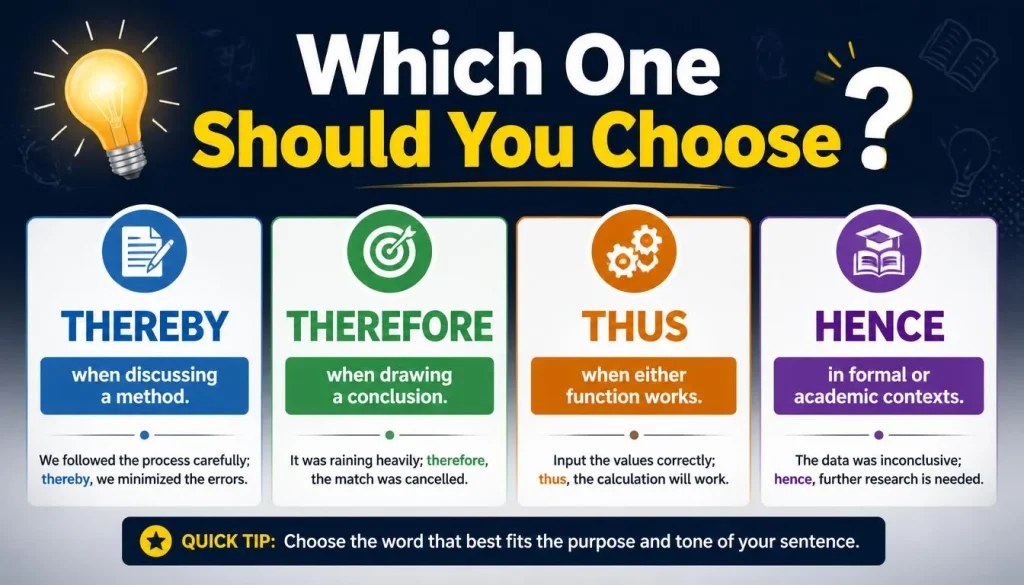
Which One Should You Choose?
Choose:
- Thereby when discussing a method.
- Therefore when drawing a conclusion.
- Thus when either function works.
- Hence in formal or academic contexts.
Quick Test: Can You Identify the Correct Word?
Fill in the blanks.
Questions
- The team adopted new software, ______ improving collaboration.
- Costs rose sharply. ______, management reduced spending.
- Researchers increased the sample size, ______ enhancing accuracy.
- Demand exceeded supply. ______, prices increased.
- The company digitized records, ______ reducing paperwork.
- Safety concerns emerged. ______, operations stopped.
- Employees received training, ______ improving performance.
- The data was incomplete. ______, conclusions remained tentative.
- The city expanded transit routes, ______ reducing traffic.
- Revenue declined. ______, restructuring became necessary.
Answers
- Thereby
- Therefore
- Thereby
- Therefore
- Thereby
- Therefore
- Thereby
- Therefore
- Thereby
- Therefore
If you correctly identified most answers, you’ve likely mastered the distinction.
Thereby vs. Therefore Cheat Sheet
| If You Mean… | Use |
| By doing that | Thereby |
| Through that action | Thereby |
| By that means | Thereby |
| For that reason | Therefore |
| Consequently | Therefore |
| As a logical result | Therefore |
FAQs
1. What is the main difference between thereby and therefore?
Therefore means “for that reason” and introduces a conclusion or result. Thereby means “by doing that” and explains the method through which a result is achieved.
2. Can thereby and therefore be used interchangeably?
No. Although both relate to results, they have different meanings and grammatical roles. Replacing one with the other often changes the meaning of a sentence or makes it grammatically incorrect.
3. Is therefore a conjunction?
No. Therefore is a conjunctive adverb, not a coordinating conjunction. It connects two related ideas by showing cause and effect and is usually separated with appropriate punctuation.
4. When should I use thereby in a sentence?
Use thereby when you want to show that one action directly leads to another result.
Example: She automated the process, thereby reducing processing time.
5. Is therefore appropriate in formal writing?
Yes. Therefore is widely accepted in formal writing, academic papers, business reports, and professional communication because it clearly expresses logical conclusions.
6. How can I remember the difference between thereby and therefore?
A simple trick is:
- Therefore = For that reason (shows a conclusion)
- Thereby = By that action (shows the method or means)
This memory aid makes it easier to choose the correct word while writing.
Conclusion
Although thereby and therefore are often confused, they perform different grammatical functions and should not be used interchangeably. Therefore introduces a result or conclusion, while thereby explains how an action produces a result.
Understanding this distinction makes your English usage more accurate, improves formal writing, and creates better consistency in professional and everyday communication.
Whether you’re writing emails, reports, academic papers, or business documents, choosing the correct transition word helps your ideas flow naturally. Keep practicing with real-life examples, and you’ll soon know exactly when to use thereby and therefore with confidence.

Mia Rose is an English language specialist and editorial writer at Phrase Finesse, where she helps readers master grammar, vocabulary, spelling, and effective communication. Passionate about making English simple and practical, she creates well-researched, reader-friendly content that explains complex language concepts in a clear and engaging way.
With extensive experience in English language education, content writing, and editorial review, Mia specializes in grammar, punctuation, word choice, idioms, confusing word pairs, and writing style. Her articles are carefully researched, fact-checked, and designed to help students, professionals, writers, and English learners build confidence in both written and spoken English.
[…] See More :Thereby vs. Therefore: Meaning and Usage […]