Have you ever paused while writing an email or speaking in a meeting and wondered, “Spoke or Spoken: Which Is Correct?” It’s a common question, even among fluent English speakers. Understanding the difference between spoke and spoken is essential for accurate English usage, stronger grammar, and clear everyday communication.
Whether you’re preparing reports, sending messages, or participating in professional discussions, choosing the right form helps you communicate with confidence.
The confusion usually comes from how these two words relate to the verb “speak.” While spoke functions as the simple past tense, spoken serves as the past participle and often appears with helping verbs.
Knowing when to use each form improves formal writing, strengthens business communication, and promotes greater consistency across emails, presentations, and workplace interactions. This distinction also matters in fields such as project management, broadcasting, and professional documentation, where precise language is highly valued.
In this guide, you’ll learn the grammatical differences between spoke and spoken, discover practical examples, and avoid common mistakes that can affect clarity. We’ll also explore how correct verb usage supports effective communication in contexts like scheduling, time management, online booking, meetings, and calendar coordination.
By the end, you’ll know exactly when to use each word and how to apply them naturally in both spoken and written English.
The Short Answer: Spoke or Spoken?
Here’s the simple answer:
- Spoke is the simple past tense of speak.
- Spoken is the past participle of speak.
Quick Examples
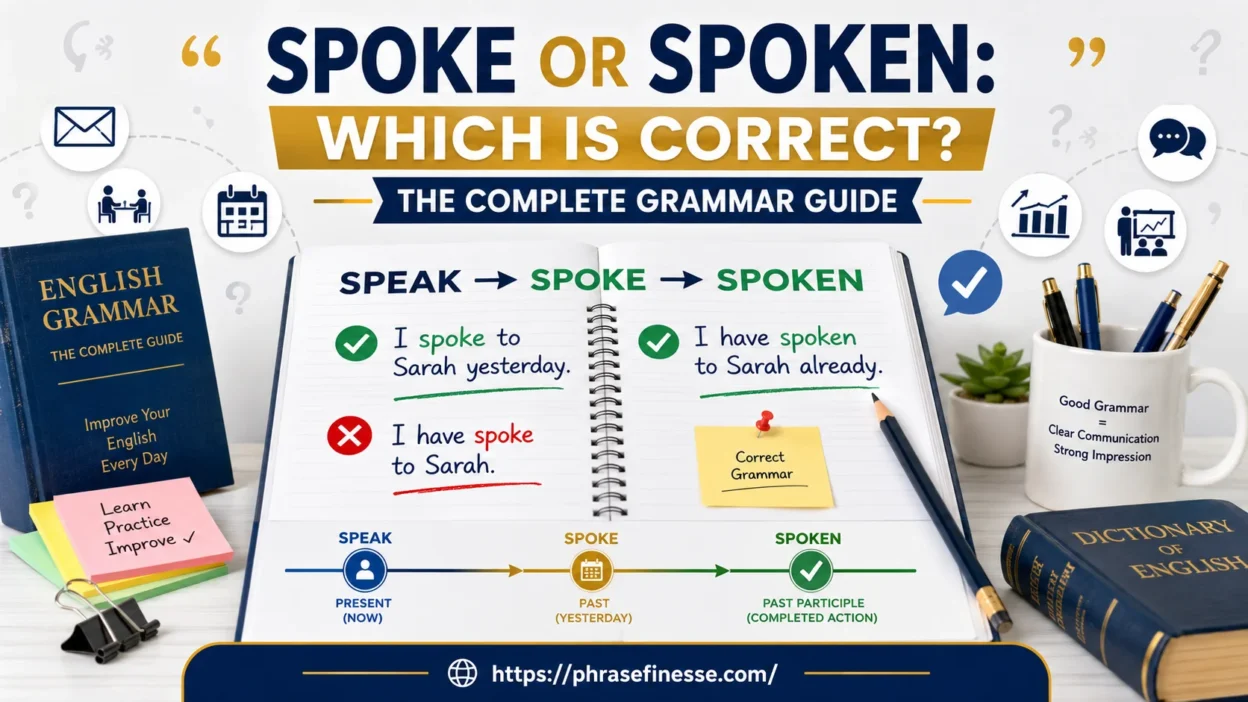
✅ I spoke to Sarah yesterday.
✅ I have spoken to Sarah already.
❌ I have spoke to Sarah already.
❌ I spoken to Sarah yesterday.
The difference comes down to sentence structure and verb tense.
Verb Forms of Speak
| Verb Form | Word |
| Base Form | Speak |
| Simple Past | Spoke |
| Past Participle | Spoken |
| Present Participle | Speaking |
Understanding these forms makes the entire topic much easier.
Understanding the Verb “Speak”
The verb speak belongs to a group called irregular verbs.
Most English verbs form the past tense by adding -ed.
Examples:
- Walk → Walked
- Talk → Talked
- Work → Worked
However, irregular verbs don’t follow this pattern.
Examples of Irregular Verbs
| Base Verb | Past Tense | Past Participle |
| Speak | Spoke | Spoken |
| Write | Wrote | Written |
| Drive | Drove | Driven |
| Break | Broke | Broken |
| Choose | Chose | Chosen |
Because English inherited vocabulary from several language families, many frequently used verbs evolved differently over centuries.
That is why we say:
- Speak → Spoke → Spoken
instead of:
- Speak → Speaked → Speaked
When to Use “Spoke”
What Does Spoke Mean?
Spoke is the simple past tense form of speak.
Use it when describing an action that happened and finished in the past.
Grammar Rule
Use spoke without a helping verb.
Formula
Subject + spoke + rest of sentence
Examples
- I spoke with the manager yesterday.
- She spoke at the conference.
- We spoke about the budget.
- They spoke for nearly an hour.
- The professor spoke clearly during the lecture.
Each action happened in the past and is complete.
Everyday Examples
Casual Conversation
- I spoke to my brother last night.
- We spoke after dinner.
Workplace Communication
- The CEO spoke during the annual meeting.
- The sales team spoke with several clients.
Academic Writing
- The researcher spoke about recent findings.
- The speaker spoke on climate policy.
News Reporting
- The minister spoke at a press conference.
- Witnesses spoke to reporters after the incident.
Read More: Chose vs Chosen: Guide That Finally Makes Sense
Common Sentence Patterns With Spoke
1. Subject + Spoke + Object
- She spoke the truth.
- They spoke several languages.
2. Subject + Spoke + To + Person
- I spoke to the teacher.
- We spoke to our lawyer.
3. Subject + Spoke + About + Topic
- He spoke about leadership.
- They spoke about future plans.
4. Subject + Spoke + At + Event
- The author spoke at the seminar.
- The scientist spoke at the symposium.
Learning these structures helps you use spoke naturally.
When to Use “Spoken”
What Does Spoken Mean?
Spoken is the past participle form of speak.
Unlike spoke, it usually requires a helping verb.
Grammar Rule
Use spoken with:
- Have
- Has
- Had
- Is
- Are
- Was
- Were
- Been
- Being
Formula
Helping Verb + Spoken
Examples
- I have spoken with the client.
- She has spoken publicly before.
- We had spoken earlier.
- The issue was spoken about extensively.
- English is spoken around the world.
Notice that every example includes a helping verb.
Helping Verbs Commonly Used With Spoken
Present Perfect
- I have spoken.
- They have spoken.
Present Perfect Singular
- She has spoken.
- He has spoken.
Past Perfect
- We had spoken before the meeting.
Passive Voice
- The topic was spoken about frequently.
- The language is spoken globally.
Examples
| Sentence | Correct Usage |
| I have spoken to him. | Correct |
| She has spoken already. | Correct |
| They had spoken before lunch. | Correct |
| The issue was spoken about. | Correct |
Spoke vs Spoken: Side-by-Side Comparison
Many people learn faster through comparison.
| Feature | Spoke | Spoken |
| Verb Type | Simple Past | Past Participle |
| Helping Verb Needed | No | Yes |
| Can Stand Alone? | Yes | Usually No |
| Example | I spoke yesterday. | I have spoken already. |
Compare These Sentences
Correct
- I spoke with her yesterday.
- I have spoken with her already.
Incorrect
- I have spoke with her already.
- I spoken with her yesterday.
The second pair breaks standard English grammar rules.
How to Instantly Know Whether You Need Spoke or Spoken
Here’s a quick test.
Look for a Helping Verb
If the sentence contains:
- Have
- Has
- Had
- Is
- Are
- Was
- Were
Use spoken.
Examples:
- I have spoken.
- She has spoken.
- English is spoken worldwide.
No Helping Verb?
Use spoke.
Examples:
- I spoke yesterday.
- We spoke after class.
This simple technique eliminates most mistakes.
Why “I Have Spoke” Is Incorrect
One of the most common grammar mistakes online is:
❌ I have spoke to him.
Why is it wrong?
Because have requires a past participle.
The past participle of speak is spoken, not spoke.
Correct Version
✅ I have spoken to him.
More Examples
| Incorrect | Correct |
| I have spoke. | I have spoken. |
| She has spoke. | She has spoken. |
| They had spoke. | They had spoken. |
| We have spoke before. | We have spoken before. |
Whenever you see have, has, or had, think spoken.
Common Mistakes People Make With Spoke and Spoken
Using Spoken Without a Helping Verb
Incorrect:
- I spoken to him yesterday.
Correct:
- I spoke to him yesterday.
Using Spoke After Have
Incorrect:
- I have spoke with the director.
Correct:
- I have spoken with the director.
Mixing Tenses
Incorrect:
- I have spoke yesterday.
Correct:
- I spoke yesterday.
Or:
- I have spoken with him recently.
Overcorrecting
Some learners start using spoken everywhere.
Incorrect:
- She spoken at the event.
Correct:
- She spoke at the event.
Real-World Examples of Spoke and Spoken
Learning grammar through real situations helps reinforce the rule.
Business English
Spoke
- The manager spoke with the client yesterday.
- The director spoke during the quarterly meeting.
Spoken
- The CEO has spoken about expansion plans.
- The proposal has been spoken about extensively.
Academic Writing
Spoke
- The guest lecturer spoke on artificial intelligence.
Spoken
- Researchers have spoken about the challenges of data privacy.
Professional Emails
Spoke
- I spoke with your representative earlier today.
Spoken
- I have spoken with our finance department regarding your request.
Public Speaking
Spoke
- The keynote speaker spoke for forty minutes.
Spoken
- The topic has been spoken about at numerous conferences.
Spoke and Spoken in Questions
Questions often reveal whether you understand verb forms correctly.
Questions With Did
Use the base verb speak after did.
Correct:
- Did you speak to her?
Incorrect:
- Did you spoke to her?
Questions With Have
Use spoken.
Correct:
- Have you spoken to her?
Incorrect:
- Have you spoke to her?
Comparison Table
| Question | Correct |
| Did you speak to him? | Yes |
| Did you spoke to him? | No |
| Have you spoken to him? | Yes |
| Have you spoke to him? | No |
Spoke and Spoken in Negative Sentences
Negative sentences follow similar rules.
Using Did Not
Use the base verb.
Correct:
- I did not speak to him.
Incorrect:
- I did not spoke to him.
Using Have Not
Use the past participle.
Correct:
- I have not spoken to him.
Incorrect:
- I have not spoke to him.
Examples
| Incorrect | Correct |
| I didn’t spoke. | I didn’t speak. |
| She hasn’t spoke. | She hasn’t spoken. |
| We hadn’t spoke. | We hadn’t spoken. |
Easy Memory Trick to Never Confuse Spoke and Spoken Again
Grammar becomes easier when you have a shortcut.
The Helper Verb Rule
If you see:
- Have
- Has
- Had
- Is
- Are
- Was
- Were
Use spoken.
If you don’t see a helping verb and you’re talking about the past, use spoke.
Simple Formula
Past Action = Spoke
Helping Verb + Past Participle = Spoken
Example
Yesterday?
➡ Use spoke
Already?
➡ Use have spoken
Before that happened?
➡ Use had spoken
Spoke, Spoken, and Speak: Understanding All Three Forms
Many learners benefit from seeing all three forms together.
| Form | Function | Example |
| Speak | Base Form | I speak English. |
| Spoke | Past Tense | I spoke English during the interview. |
| Spoken | Past Participle | I have spoken English for years. |
Timeline Example
Present:
- I speak with clients daily.
Past:
- I spoke with a client yesterday.
Present Perfect:
- I have spoken with three clients today.
Seeing the progression makes the pattern easier to remember.
British English vs American English Usage
Good news.
The distinction between spoke and spoken is exactly the same in both British and American English.
American English
- I spoke with him yesterday.
- I have spoken with him already.
British English
- I spoke with him yesterday.
- I have spoken with him already.
There is no regional difference in this grammatical rule.
Historical Evolution of the Verb Speak
Language lovers may appreciate the history behind the word.
The English verb speak traces its roots to Old English specan and sprecan.
Over centuries, pronunciation shifted and the irregular forms evolved naturally.
Historical Progression
| Period | Form |
| Old English | Specan |
| Middle English | Speken |
| Modern English | Speak |
The past tense eventually became spoke, while the past participle settled into spoken.
This pattern mirrors several other Germanic verbs.
Examples include:
- Break → Broke → Broken
- Wake → Woke → Woken
- Steal → Stole → Stolen
Most Common Google Searches About Spoke and Spoken
Is It “Spoke To” or “Spoken To”?
Both can be correct.
Examples:
- I spoke to her yesterday.
- I have spoken to her already.
Have Spoke or Have Spoken?
Correct:
✅ Have spoken
Incorrect:
❌ Have spoke
Had Spoke or Had Spoken?
Correct:
✅ Had spoken
Incorrect:
❌ Had spoke
Was Spoke or Was Spoken?
Correct:
✅ Was spoken
Incorrect:
❌ Was spoke
Speak, Spoke, Spoken Examples
- I speak English.
- I spoke English during the interview.
- I have spoken English for years.
Quick Practice Quiz
Choose the correct answer.
Questions
- I _____ to the manager yesterday.
- spoke
- spoken
- We have _____ about the issue already.
- spoke
- spoken
- She _____ at the conference last week.
- spoke
- spoken
- They had _____ before the meeting started.
- spoke
- spoken
- Have you _____ with the client?
- spoke
- spoken
FAQs
1. What is the difference between spoke and spoken?
Spoke is the simple past tense of the verb “speak,” while spoken is the past participle. You use spoke on its own, but spoken usually requires a helping verb such as has, have, had, is, or was.
Examples:
- I spoke to my manager yesterday.
- I have spoken to my manager already.
2. Is it correct to say “I spoken to him”?
No. “I spoken to him” is grammatically incorrect because spoken needs a helping verb.
Correct forms:
- I spoke to him yesterday.
- I have spoken to him already.
3. When should I use spoke?
Use spoke when referring to a completed action in the past without a helping verb.
Examples:
- She spoke during the meeting.
- They spoke about the project last week.
4. When should I use spoken?
Use spoken as a past participle with a helping verb or as an adjective.
Examples:
- We have spoken about this issue before.
- Spoken English can differ from written English.
5. Can spoken be used as an adjective?
Yes. Spoken often functions as an adjective to describe language or communication.
Examples:
- She has excellent spoken English.
- The course focuses on spoken communication skills.
6. Which form is more common in formal writing?
Both forms are common, but they serve different grammatical purposes. Spoke appears in simple past constructions, while spoken is frequently used in perfect tenses and passive structures found in formal writing and professional communication.
Conclusion
Understanding the difference between spoke and spoken is an important part of mastering English grammar. The key rule is simple: use spoke as the simple past tense and spoken as the past participle, usually with a helping verb. While the two words are closely related, they cannot always be used interchangeably.
By learning when each form is appropriate, you can improve your English usage, strengthen your formal writing, and communicate with greater consistency in both personal and professional settings. Whether you’re writing emails, participating in meetings, or working on business communication, choosing the correct form will help your message sound natural, accurate, and polished.