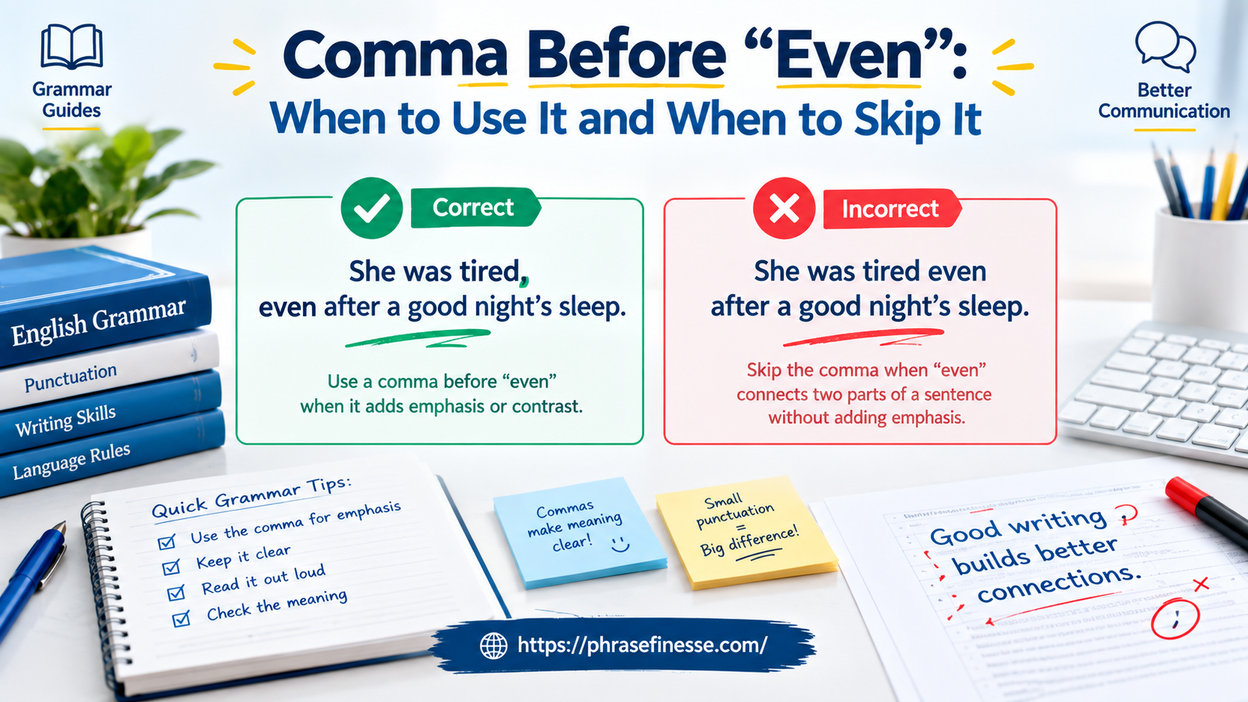
Have you ever stopped mid-sentence and wondered whether a comma belongs before the word “even”? If so, you’re not alone. Comma Before “Even” Explained For Beginners (Helpful Examples) explores one of the most common punctuation questions in English usage.
Understanding when a comma is necessary—and when it isn’t—can improve grammar, strengthen formal writing, and help you communicate with greater consistency in both professional and everyday situations.
The word “even” appears in many contexts, from casual conversations to business communication, emails, reports, and presentations.
Whether you are managing meetings, coordinating project management tasks, handling online booking confirmations, or discussing scheduling and time management, proper punctuation can make your writing clearer and easier to understand. Small comma choices often have a big impact on meaning, tone, and readability.
In this guide, you’ll learn the key rules for using a comma before “even,” along with practical examples that demonstrate correct usage. We’ll examine common sentence patterns, frequent mistakes, and real-world applications in broadcasting, calendar planning, workplace correspondence, and other writing scenarios.
By the end, you’ll have a clear understanding of how to use “even” confidently and accurately in a wide range of contexts.
Do You Put a Comma Before “Even”?
The short answer is:
Usually, no.
Most sentences do not require a comma before even.
That’s because even typically functions as an adverb that adds emphasis to a word, phrase, or idea. It does not automatically trigger punctuation.
Consider these examples:
✅ She even remembered my birthday.
✅ They even offered a full refund.
✅ We didn’t even notice the mistake.
In each sentence, even naturally belongs within the sentence structure. Adding a comma would create an awkward pause.
Incorrect:
❌ She, even remembered my birthday.
❌ They, even offered a refund.
❌ We didn’t, even notice the mistake.
The commas interrupt the flow and separate words that should stay together.
Quick Reference Table
| Sentence Type | Comma Before Even? | Example |
| Simple emphasis | No | She even called me. |
| Integrated adverb | No | They even apologized. |
| Introductory phrase before sentence | Yes | Surprisingly, even the experts agreed. |
| Parenthetical interruption | Yes | The project, even after revisions, failed. |
| Even though at beginning | Yes | Even though it rained, we played. |
| Even though in middle | Usually No | We played even though it rained. |
What Does “Even” Mean in a Sentence?
Before discussing commas, it’s important to understand what even actually does.
The word even acts as an emphasizer. It highlights something surprising, unexpected, extreme, or noteworthy.
Think of it as a spotlight.
It directs the reader’s attention toward a particular idea.
For example:
- Even John passed the exam.
- John even passed the exam.
- John passed even the hardest exam.
Each sentence contains the same word, yet each one emphasizes something different.
How Placement Changes Meaning
| Sentence | Emphasis |
| Even John passed. | John is surprising. |
| John even passed. | Passing is surprising. |
| John passed even the hardest exam. | The hardest exam is surprising. |
This flexibility explains why punctuation rules depend on sentence structure rather than the word itself.
The role of even changes depending on where it appears.
Why Writers Get Confused About Commas Before “Even”
Many punctuation questions arise because writers confuse emphasis with sentence structure.
A common assumption goes like this:
“If a word creates emphasis, it probably needs commas.”
That isn’t how English punctuation works.
Commas exist primarily to:
- Separate clauses
- Mark introductory elements
- Set off nonessential information
- Prevent confusion
- Improve readability
They do not appear simply because a word adds emphasis.
As a result, the presence of even alone never guarantees a comma.
When You Should NOT Use a Comma Before “Even”
Most of the time, even blends naturally into the sentence.
When it forms part of the main idea, leave the comma out.
Even Within the Main Clause
Examples:
✅ She even baked a cake.
✅ They even stayed late.
✅ I even checked twice.
✅ We didn’t even hear the alarm.
In all four examples, even directly modifies part of the sentence.
Adding commas would interrupt the meaning.
Incorrect:
❌ She, even baked a cake.
❌ They, even stayed late.
❌ I, even checked twice.
Why These Commas Are Wrong
Think of a sentence as a train.
The main clause is the engine pulling everything forward.
Words like even often ride inside the engine. They belong there.
Adding unnecessary commas is like disconnecting a train car for no reason.
The sentence still exists, but the ride becomes rough and awkward.
Common Everyday Examples
Conversation
- I didn’t even see your message.
- She even laughed at the joke.
- They even invited us over.
Business Writing
- The company even exceeded its sales targets.
- Management even approved additional funding.
Academic Writing
- Researchers even observed similar patterns in later studies.
- Participants even reported improved outcomes.
Notice how none of these sentences require a comma before even.
When a Comma Before “Even” Is Correct
Although even rarely demands a comma, certain sentence structures do.
The comma exists because of the structure surrounding even, not because of the word itself.
Comma Before “Even” After Introductory Elements
One of the most common situations involves introductory phrases and clauses.
Examples:
✅ After reviewing the evidence, even the jury had doubts.
✅ Surprisingly, even the experts disagreed.
✅ During the investigation, even minor details became important.
The comma separates the introductory material from the main clause.
Notice that the comma doesn’t belong to even.
It belongs to the introductory phrase.
Examples Explained
Example One
After reviewing the evidence, even the jury had doubts.
Introductory phrase:
After reviewing the evidence
Main clause:
even the jury had doubts
The comma marks the transition.
Example Two
Surprisingly, even the experts disagreed.
Introductory adverb:
Surprisingly
Main clause:
even the experts disagreed
Again, the comma serves the introductory element.
Quick Rule
If you would use the comma without even, keep it.
Example:
After reviewing the evidence, the jury had doubts.
Adding even changes emphasis but not punctuation.
After reviewing the evidence, even the jury had doubts.
Comma Before “Even” in Parenthetical Phrases
Another common situation involves nonessential information.
These are details that interrupt the main sentence.
Writers often set them off with commas.
Examples:
✅ The project, even after several revisions, failed.
✅ Her proposal, even with additional support, was rejected.
✅ The system, even during testing, showed errors.
Why Commas Appear Here
Let’s remove the parenthetical phrase:
The project failed.
That’s the core sentence.
Now add extra information:
The project, even after several revisions, failed.
The phrase provides additional context.
Because it interrupts the sentence, commas set it apart.
Visual Diagram
Main Clause
↓
The project, even after several revisions, failed.
↑
Extra Information
The sentence remains complete without the inserted phrase.
That is why commas work.
Comma Before “Even Though”
The phrase even though introduces a subordinate clause.
Comma rules depend on where that clause appears.
When “Even Though” Starts the Sentence
Use a comma.
Examples:
✅ Even though it was raining, we went hiking.
✅ Even though she was exhausted, she finished the report.
✅ Even though the market slowed, the company remained profitable.
The introductory dependent clause comes first.
A comma separates it from the main clause.
Why This Rule Exists
The reader needs a signal showing where the introductory thought ends.
The comma provides that signal.
Without it, reading becomes more difficult.
Incorrect:
❌ Even though it was raining we went hiking.
Correct:
✅ Even though it was raining, we went hiking.
When “Even Though” Comes After the Main Clause
Usually, no comma is needed.
Examples:
✅ We went hiking even though it was raining.
✅ She finished the report even though she was exhausted.
✅ The company remained profitable even though the market slowed.
The sentence flows naturally without punctuation.
Comparison Table
| Structure | Comma? | Example |
| Even though + dependent clause + main clause | Yes | Even though it was late, we stayed. |
| Main clause + even though + dependent clause | No | We stayed even though it was late. |
Comma Before “Even If”
The phrase even if introduces a condition.
Its punctuation follows the same pattern.
Introductory Even If Clauses
Use a comma.
Examples:
✅ Even if you disagree, you should listen.
✅ Even if prices fall, demand may remain weak.
✅ Even if nobody helps, we’ll continue.
The dependent clause appears first.
Therefore, a comma separates it from the main clause.
Mid-Sentence Even If Clauses
Usually no comma.
Examples:
✅ We’ll continue even if nobody helps.
✅ I won’t buy it even if the price drops.
✅ She’ll attend even if she feels tired.
The conditional clause follows naturally.
No comma is needed.
Real-Life Example
Imagine a coach speaking to a team:
Even if we’re behind at halftime, we keep fighting.
The comma signals the shift from condition to action.
Now reverse it:
We keep fighting even if we’re behind at halftime.
The sentence reads smoothly without punctuation.
See More :Comma Before “Like”: Explained for Beginners
Comma Before “Even When”
The phrase even when refers to time or circumstances.
The same principle applies.
Introductory Clause First
Use a comma.
Examples:
✅ Even when life gets difficult, she stays optimistic.
✅ Even when demand drops, the business remains stable.
✅ Even when tired, he exercises daily.
Clause at the End
Usually no comma.
Examples:
✅ She stays optimistic even when life gets difficult.
✅ The business remains stable even when demand drops.
✅ He exercises daily even when tired.
Quick Summary
| Position | Comma Required? |
| Beginning of sentence | Yes |
| End of sentence | Usually No |
Comma Before “Not Even”
The phrase not even creates strong emphasis.
In most cases, no comma is necessary.
Examples:
✅ He did not even apologize.
✅ Not even the manager knew the answer.
✅ We couldn’t hear not even a whisper.
✅ Not even a million dollars could change his mind.
The phrase functions as a single unit.
Separating it with commas weakens the flow.
How Professional Writers Handle “Even”
Experienced editors rarely ask:
“Should there be a comma before even?”
Instead, they ask:
“What is the sentence structure?”
Professional writing focuses on relationships between clauses, phrases, and ideas.
That’s why newspapers, magazines, academic journals, and business publications follow structural punctuation rather than word-based punctuation.
Example From Business Writing
Correct:
The company, even after facing supply chain disruptions, exceeded expectations.
Why?
Because even after facing supply chain disruptions is parenthetical information.
Example From Academic Writing
Correct:
Even though the sample size was small, the findings remained statistically significant.
The introductory dependent clause requires a comma.
Example From Marketing Copy
Correct:
Our software helps businesses save time even when workloads increase.
No comma needed because the clause follows the main idea.
Common Comma Mistakes With “Even”
Many errors appear repeatedly.
Understanding them helps you avoid awkward writing.
Mistake: Adding a Comma Just Because “Even” Appears
Incorrect:
❌ I, even called her yesterday.
Correct:
✅ I even called her yesterday.
The word itself does not require punctuation.
Mistake: Forgetting Introductory Clause Commas
Incorrect:
❌ Even though it was expensive we bought it.
Correct:
✅ Even though it was expensive, we bought it.
The introductory clause needs separation.
Mistake: Missing Parenthetical Commas
Incorrect:
❌ The proposal even with extra funding failed.
Correct:
✅ The proposal, even with extra funding, failed.
The inserted phrase interrupts the main clause.
Mistake: Over-Punctuating
Incorrect:
❌ She, even then, wasn’t convinced.
Sometimes writers add unnecessary punctuation everywhere.
Better:
✅ She wasn’t convinced even then.
Or:
✅ She, even then, wasn’t convinced.
Use the parenthetical version only if you genuinely want the interruption.
Case Study: How One Comma Changes Readability
Consider these two sentences:
Version One
Even though the project faced delays, the team met every deadline.
Version Two
Even though the project faced delays the team met every deadline.
The second version isn’t impossible to understand.
However, readers must work harder.
The comma creates a visual pause.
That pause improves clarity.
Good punctuation reduces friction.
Great writing feels effortless because readers never notice the mechanics behind it.
Practical Editing Checklist
Whenever you see even in a sentence, ask yourself these questions:
Is “even” simply adding emphasis?
If yes, don’t use a comma.
Example:
She even called twice.
Is there an introductory clause?
If yes, use a comma after the clause.
Example:
Even though she was busy, she helped.
Is “even” inside a parenthetical phrase?
If yes, commas may be needed.
Example:
The plan, even with extra funding, failed.
Does the sentence remain complete without the phrase?
If yes, commas probably belong around it.
Example:
The project, even after revisions, struggled.
Comma Before “Even” Cheat Sheet
| Situation | Use Comma? |
| She even called. | No |
| They even agreed. | No |
| Even though it rained, we stayed. | Yes |
| We stayed even though it rained. | No |
| Even if you disagree, listen. | Yes |
| Listen even if you disagree. | No |
| Even when tired, she works. | Yes |
| She works even when tired. | No |
| The plan, even with funding, failed. | Yes |
| Not even the manager knew. | No |
FAQs
1. Do you always need a comma before “even”?
No, you do not always need a comma before “even.” In most cases, “even” functions as an adverb and does not require a comma. A comma is only used when sentence structure or clarity calls for it.
Example:
✔ She even finished the project early.
✘ She, even finished the project early.
2. When should a comma come before “even”?
A comma may appear before “even” when it introduces additional emphasis, follows an introductory phrase, or separates clauses where punctuation improves readability.
Example:
After reviewing the report, even the manager was surprised.
3. Can “even” start a sentence?
Yes. “Even” can begin a sentence when used for emphasis.
Example:
Even experienced writers sometimes make punctuation mistakes.
This usage is grammatically correct and common in both formal and informal writing.
4. Is a comma required after “even” at the beginning of a sentence?
Usually, no. When “even” starts a sentence and directly modifies the words that follow, a comma is not needed.
Example:
✔ Even the experts agreed with the decision.
✘ Even, the experts agreed with the decision.
5. Does the rule change in formal writing?
The basic rule remains the same in formal writing, business communication, academic papers, and professional emails. Commas should be used according to sentence structure rather than personal preference.
Example:
Even after several revisions, the proposal required additional changes.
6. How can I tell if a comma before “even” is correct?
Read the sentence aloud and determine whether the comma separates clauses or improves clarity. If removing the comma does not affect meaning or readability, it is often unnecessary.
Example:
The team completed the task, even though the deadline was tight.
Here, the comma helps separate the main clause from the dependent clause.
Conclusion
Understanding whether to use a comma before “even” becomes much easier once you focus on the sentence structure rather than the word itself.
In most cases, “even” does not require a comma because it acts as an adverb that emphasizes a word, phrase, or idea. However, commas may be appropriate when they help separate clauses, introduce additional information, or improve readability.
By learning these punctuation patterns and reviewing practical examples, you can write with greater confidence and accuracy. Whether you’re working on formal writing, business communication, emails, reports, or everyday messages, mastering the rules surrounding “even” will improve your grammar, enhance clarity, and ensure greater consistency in your writing.
When in doubt, prioritize meaning and readability good punctuation should always help your reader understand your message more easily.

Emma Brooke is an English language specialist, editor, and content writer at Phrase Finesse, where she helps readers develop stronger writing and communication skills through clear, practical, and engaging content. With a passion for the English language, she specializes in simplifying grammar rules, vocabulary, spelling, punctuation, and word usage for learners at every level.
Emma has extensive experience creating educational content that is accurate, well-researched, and easy to understand. She is particularly skilled at explaining confusing word pairs, grammar concepts, idioms, sentence structure, and effective writing techniques, making complex topics approachable for students, professionals, educators, and English learners worldwide.

[…] Read More :Comma Before “Even”: When to Use It and When to Skip It […]
[…] Read More :Comma Before “Even”: When to Use It and When to Skip It […]