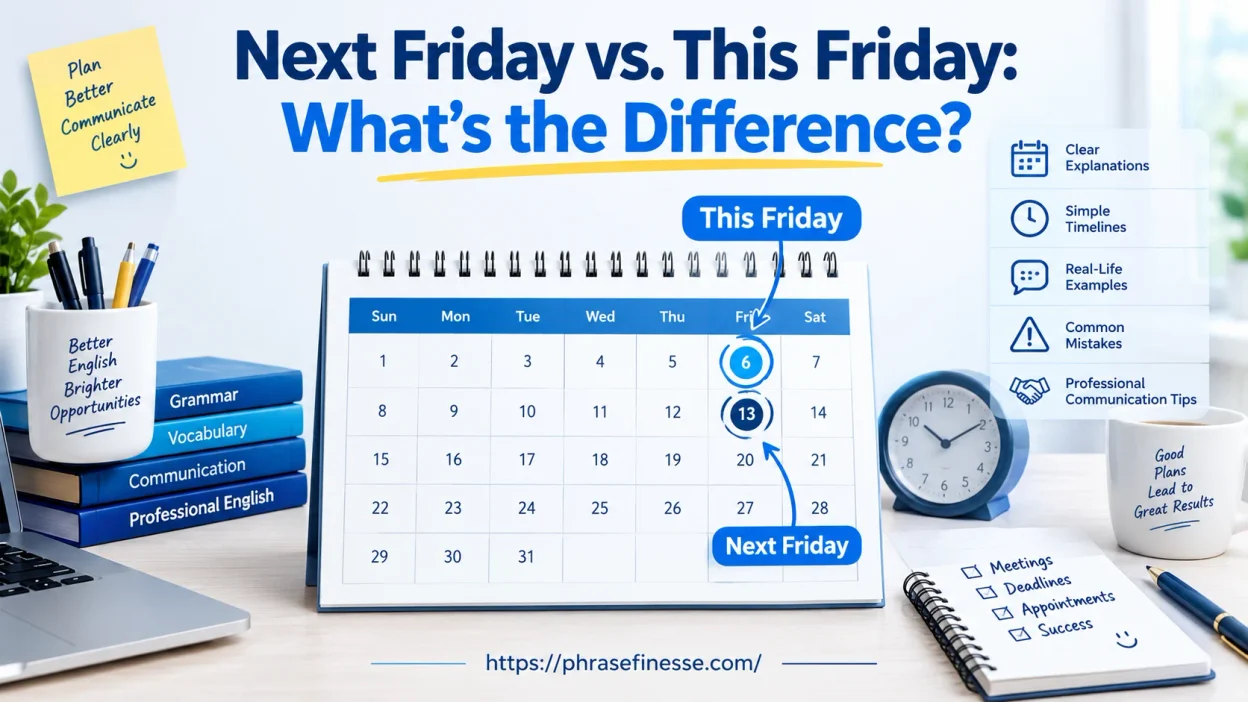
Have you ever scheduled an event for Friday, only to realize everyone had a different idea of which Friday you meant? The distinction between Next Friday vs. This Friday: What’s the Difference?often creates confusion in everyday conversations, professional emails, and team discussions.
Understanding the difference is essential for clear English usage, accurate grammar, and effective business communication, especially when dates, deadlines, and appointments matter.
In both personal and professional settings, terms like “next Friday” and “this Friday” can affect scheduling, time management, meetings, online booking, and even project management workflows. While the phrases may seem straightforward, their meaning can vary depending on context, regional language habits, and the speaker’s intent.
A small misunderstanding can lead to missed events, incorrect calendar entries, or unnecessary follow-up conversations.
This complete guide breaks down the key differences between “next Friday” and “this Friday” using practical examples and easy-to-follow explanations.
You’ll learn when each phrase is appropriate, how they are used in formal writing, workplace communication, and everyday speech, and how to maintain clarity and consistency in your messages.
Whether you work in broadcasting, manage projects, schedule appointments, or simply want to improve your communication skills, this guide will help you use these expressions with confidence.
Quick Answer:
The most common distinction is:
| Phrase | Typical Meaning |
| This Friday | The nearest upcoming Friday |
| Next Friday | The Friday after the nearest upcoming Friday |
For example, if today is Tuesday:
| Day Today | This Friday | Next Friday |
| Tuesday | Upcoming Friday | Friday of the following week |
However, language isn’t always that simple.
Some speakers use “next Friday” to mean the very next Friday that occurs. Others use it to mean the Friday after the upcoming one.
That’s why context matters.
Quick Rule
If precision matters:
❌ Meet me next Friday.
✅ Meet me on Friday, October 16.
Specific dates remove uncertainty.
What Does “This Friday” Mean?
In modern English, “this Friday” usually refers to the nearest Friday that has not yet occurred.
Think of it as the Friday contained within the current week or the next immediately approaching Friday.
Examples
1.If today is Monday:
- This Friday = four days away
2. If today is Wednesday:
- This Friday = two days away
3. If today is Thursday:
- This Friday = tomorrow
Example Sentences
- The project report is due this Friday.
- We’re hosting a company lunch this Friday.
- My dentist appointment is this Friday at 2 PM.
- The concert takes place this Friday night.
In each example, the speaker refers to the closest upcoming Friday.
Why Speakers Prefer “This Friday”
The phrase feels immediate.
It creates a sense of proximity and urgency.
When someone says:
“Can you finish this by this Friday?”
Most listeners understand that the deadline is approaching very soon.
What Does “Next Friday” Mean?
Traditionally, “next Friday” refers to the Friday after the upcoming Friday.
In other words, it skips the nearest Friday and points to the one after it.
Example
Imagine today is Monday.
Calendar:
Monday
Tuesday
Wednesday
Thursday
Friday ← This Friday
Saturday
Sunday
Friday ← Next Friday
In this interpretation:
- This Friday = nearest Friday
- Next Friday = Friday of the following week
Example Sentences
- The conference begins next Friday.
- Let’s schedule the training session for next Friday.
- I’ll return from vacation next Friday.
- The new software launches next Friday.
Each example typically refers to a Friday more than one week away from the current Monday.
The Timeline Difference Between This Friday and Next Friday
Visual timelines help explain the difference better than definitions alone.
Consider this scenario.
Today is Tuesday.
Tuesday → Wednesday → Thursday → Friday → Saturday → Sunday → Friday
↑ ↑
This Friday Next Friday
The first Friday encountered is generally this Friday.
The second Friday encountered is generally next Friday.
Why Timelines Matter
Scheduling language relies heavily on relative time.
People naturally think differently about upcoming dates.
Some focus on the nearest occurrence.
Others focus on the next occurrence.
That difference creates confusion.
Why “Next Friday” Can Be Ambiguous
Here’s where things become interesting.
Many English speakers don’t agree on the definition.
Two Common Interpretations
Interpretation One
- This Friday = nearest Friday
- Next Friday = following week’s Friday
Interpretation Two
- Next Friday = nearest upcoming Friday
Both interpretations exist in everyday conversation.
Real-Life Example
Today is Wednesday.
Someone says:
“Let’s meet next Friday.”
One person marks the calendar for two days later.
Another person marks it for nine days later.
Both believe they’re correct.
The misunderstanding isn’t caused by grammar.
It’s caused by differing assumptions.
Regional Differences in Usage
Different English-speaking regions sometimes interpret these phrases differently.
American English
Many Americans use:
- This Friday = upcoming Friday
- Next Friday = following week’s Friday
However, plenty of Americans also use “next Friday” to mean the immediately upcoming Friday.
British English
British speakers often rely heavily on context.
The same ambiguity can occur.
Australian English
Australian speakers frequently clarify dates when scheduling important events.
This practice helps reduce confusion.
Practical Reality
Regional patterns exist, but no universal rule guarantees that everyone interprets these phrases identically.
When This Friday and Next Friday Can Mean the Same Day
Surprisingly, both phrases sometimes refer to the exact same Friday.
Example
Imagine today is Thursday.
Someone says:
“I’ll see you next Friday.”
Some listeners hear:
- Tomorrow
Others hear:
- Eight days from tomorrow
Now imagine someone says:
“I’ll see you this Friday.”
Most listeners assume tomorrow.
But confusion can still occur.
Why This Happens
English uses relative time expressions.
Relative expressions depend on perspective.
Different people visualize the calendar differently.
As a result, overlap occasionally occurs.
The Hidden Psychology Behind Date Interpretation
Language experts have studied how people process time-related expressions.
Humans don’t always think about time linearly.
Some people focus on:
- The current week
Others focus on:
- The next occurrence of a weekday
This mental difference affects interpretation.
Consider these two thoughts:
Person A thinks:
“The next Friday that arrives.”
Person B thinks:
“The Friday after this Friday.”
Both approaches seem logical.
That’s why ambiguity persists.
8 Helpful Examples of Next Friday vs. This Friday
Manager says:
“We’ll discuss the budget next Friday.”
Possible Interpretation
Employee A schedules the meeting for this week’s Friday.
Employee B schedules it for the following week’s Friday.
Better Version
“We’ll discuss the budget on Friday, October 16.”
No confusion exists.
Doctor’s Appointment
Receptionist says:
“Your appointment is next Friday.”
The patient may interpret this differently than the receptionist intended.
Better Version
“Your appointment is Friday, October 16 at 10 AM.”
Dinner Invitation
Friend says:
“Let’s grab dinner next Friday.”
Without clarification, uncertainty remains.
Better Version
“Let’s grab dinner on Friday, October 16.”
School Event
A teacher tells parents:
“The field trip is next Friday.”
Some parents may prepare one week early.
Others may prepare one week late.
Better Communication
Include the actual date.
Project Deadline
Project managers frequently avoid relative dates.
Instead of saying:
“Submit everything next Friday.”
They write:
“Submit everything by Friday, October 16 at 5 PM.”
This reduces mistakes.
Flight Booking
Travel plans require precision.
Imagine arriving at the airport a week early.
Not ideal.
Best Practice
Always communicate exact dates.
Read More :9 Alternatives to “However” With Examples
Wedding Planning
Wedding vendors often handle dozens of events each month.
Using exact dates prevents expensive misunderstandings.
Example
Instead of:
“We’ll meet next Friday.”
Use:
“We’ll meet Friday, October 16.”
Team Training Session
Large organizations often use calendar invitations.
Calendar invites remove ambiguity because participants see the exact date.
This method works better than relative expressions.
Which Phrase Is More Common in Professional Communication?
Professional communication values clarity above everything else.
Because ambiguity creates problems, many businesses avoid both phrases whenever possible.
Common Workplace Alternatives
- Friday, October 16
- October 16
- Friday the 16th
- The upcoming Friday
- The following Friday
Why Companies Prefer Dates
Consider the cost of confusion:
- Missed meetings
- Delayed projects
- Lost productivity
- Customer frustration
A specific date eliminates those risks.
Better Alternatives to Avoid Confusion
The easiest solution is simple.
Use dates.
Comparison Table
| Ambiguous Phrase | Clear Alternative |
| Next Friday | Friday, October 16 |
| This Friday | Friday, October 9 |
| Friday | Friday, October 9 at 3 PM |
| Next week | Week beginning October 12 |
| Tomorrow afternoon | October 9 at 2 PM |
Communication Formula
Use:
Day + Date + Time
Example:
Friday, October 16 at 3:00 PM
This format is almost impossible to misunderstand.
This Coming Friday vs. Next Friday
Another phrase often appears in conversations:
This coming Friday
Meaning
“This coming Friday” almost always refers to the nearest upcoming Friday.
Example
Today is Monday.
“This coming Friday” means the Friday four days away.
Comparison
| Phrase | Meaning |
| This Friday | Usually nearest Friday |
| This coming Friday | Nearest Friday |
| Next Friday | Often following week’s Friday |
| Friday after next | Two Fridays away |
Why It Helps
“This coming Friday” removes some ambiguity because it emphasizes the approaching Friday.
Common Mistakes Native Speakers Make
Even native English speakers misunderstand these expressions.
Assuming Everyone Shares the Same Interpretation
Language isn’t always universal.
What seems obvious to one person may seem unclear to another.
Forgetting Regional Differences
Different communities develop different conventions.
Using Relative Dates in Formal Settings
Formal communication benefits from precision.
Failing to Confirm
A simple question can prevent confusion.
For example:
“Do you mean Friday the 16th?”
That clarification takes seconds.
Quick Rules to Remember
Use “This Friday” for the Nearest Upcoming Friday
This is the most common interpretation.
Use “Next Friday” for the Following Week’s Friday
Many speakers follow this convention.
Use Exact Dates When Accuracy Matters
Dates eliminate ambiguity.
Clarify When Unsure
Never assume.
Ask.
Use Calendar Invitations for Business Events
Digital calendars provide a visual confirmation of dates and times.
Practical Communication Tips
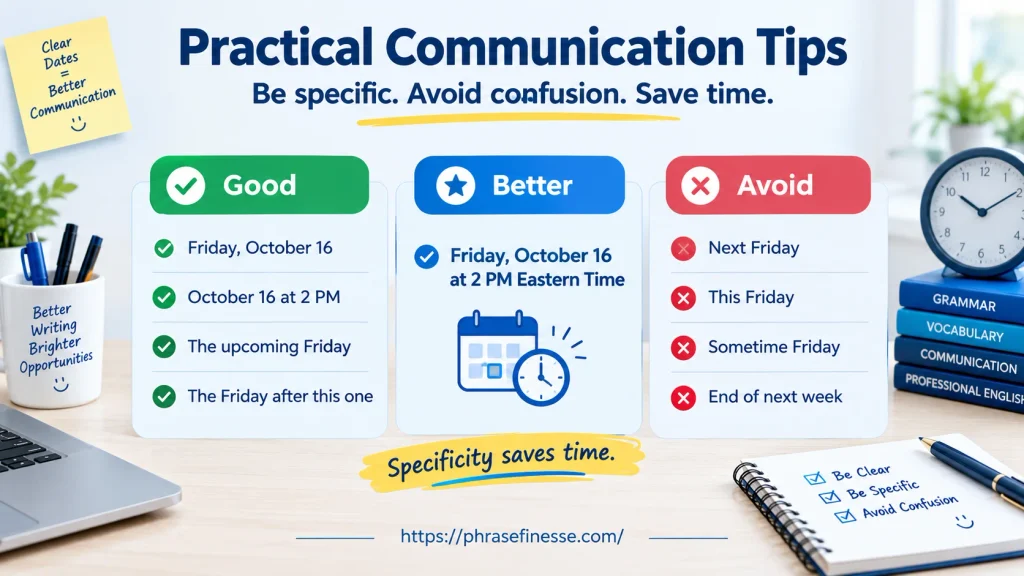
If you’re scheduling something important, follow these guidelines.
Good
- Friday, October 16
- October 16 at 2 PM
- The upcoming Friday
- The Friday after this one
Better
- Friday, October 16 at 2 PM Eastern Time
Avoid
- Next Friday
- This Friday
- Sometime Friday
- End of next week
Specificity saves time.
A Real-World Case Study: The Cost of Ambiguous Scheduling
A software company planned a client presentation.
The project manager emailed:
“We’ll review the final version next Friday.”
Half the team interpreted that as the upcoming Friday.
The other half assumed the following week.
As a result:
- Preparation timelines differed.
- Documents were submitted late.
- Meeting schedules conflicted.
The issue wasn’t technical.
It was linguistic.
Afterward, the company adopted a new rule:
Every meeting invitation must include a full date.
Confusion dropped significantly.
What Style Guides Recommend
Many business communication experts recommend avoiding relative weekday expressions when precision matters.
Instead, they suggest:
- Full dates
- Calendar invitations
- Time zones
- Meeting links
The goal is simple:
Make misunderstanding impossible.
FAQs
Is “this Friday” always the closest upcoming Friday?
In most cases, yes. “This Friday” usually refers to the nearest Friday that has not yet occurred. However, context can sometimes affect the meaning, especially if the conversation takes place on a Friday.
Does “next Friday” mean the Friday after this coming Friday?
Often, “next Friday” refers to the Friday in the following week. However, some speakers use it to mean the nearest upcoming Friday, which is why misunderstandings can occur. Clarifying the exact date is often the best approach.
Which is more common in business communication: “this Friday” or “next Friday”?
Both are common, but professionals often include the actual date to avoid confusion. For example, writing “this Friday, March 12” improves clarity in business communication and formal writing.
How can I avoid confusion when using “next Friday”?
The simplest solution is to mention the specific date. Instead of saying “next Friday,” write “Friday, June 18.” This ensures consistency and prevents scheduling errors.
Do British and American English use these phrases differently?
There can be slight regional differences in interpretation. Some speakers in both British English and American English may understand “next Friday” differently, making context and date references important.
Should I use the date instead of “this Friday” or “next Friday”?
Yes, especially for meetings, project management, online booking, and important appointments. Including the exact date removes ambiguity and improves communication accuracy.
Conclusion
Understanding the difference between “this Friday” and “next Friday” is essential for clear and effective communication. While “this Friday” typically refers to the nearest upcoming Friday, “next Friday” often points to the Friday of the following week.
However, because interpretations can vary, these expressions sometimes create confusion in both casual conversations and professional settings.
The best way to avoid misunderstandings is to consider the context and, when necessary, include the exact date. Whether you are handling scheduling, organizing meetings, managing a calendar, or writing professional emails, clear date references improve accuracy and consistency.
By applying the examples and guidelines in this guide, you can confidently choose the correct phrase and ensure your message is understood exactly as intended.

Mia Rose is an English language specialist and editorial writer at Phrase Finesse, where she helps readers master grammar, vocabulary, spelling, and effective communication. Passionate about making English simple and practical, she creates well-researched, reader-friendly content that explains complex language concepts in a clear and engaging way.
With extensive experience in English language education, content writing, and editorial review, Mia specializes in grammar, punctuation, word choice, idioms, confusing word pairs, and writing style. Her articles are carefully researched, fact-checked, and designed to help students, professionals, writers, and English learners build confidence in both written and spoken English.