Have you ever paused before writing “Published In” or “Published On” and wondered which one is actually correct? Choosing the right preposition may seem like a small detail, but it has a big impact on English usage, grammar, formal writing, and professional credibility.
This Published In vs. Published On: Which Is Correct?will explain the difference in clear, practical language, helping you write with greater consistency and confidence.
Although these expressions are closely related, they are used in different contexts depending on what is being published and where it appears. Whether you’re referring to a book, magazine, journal, newspaper, website, or social media post, understanding the correct choice improves both accuracy and readability.
You’ll also discover common mistakes, real-world examples, and simple rules that make everyday writing easier. These principles are especially valuable in business communication, broadcasting, and professional content creation, where precision matters.
Beyond grammar rules, this guide connects correct preposition usage with real communication scenarios, including scheduling announcements, calendar updates, meetings, project management, and online booking systems that regularly involve publication dates and content releases.
By the end of this article, you’ll know exactly when to use “Published In” and “Published On”, avoid frequent errors, and write naturally in both academic and professional settings while strengthening your overall command of English grammar.
Published In vs. Published On: The Short Answer
The simplest rule is this:
| Phrase | Use It For |
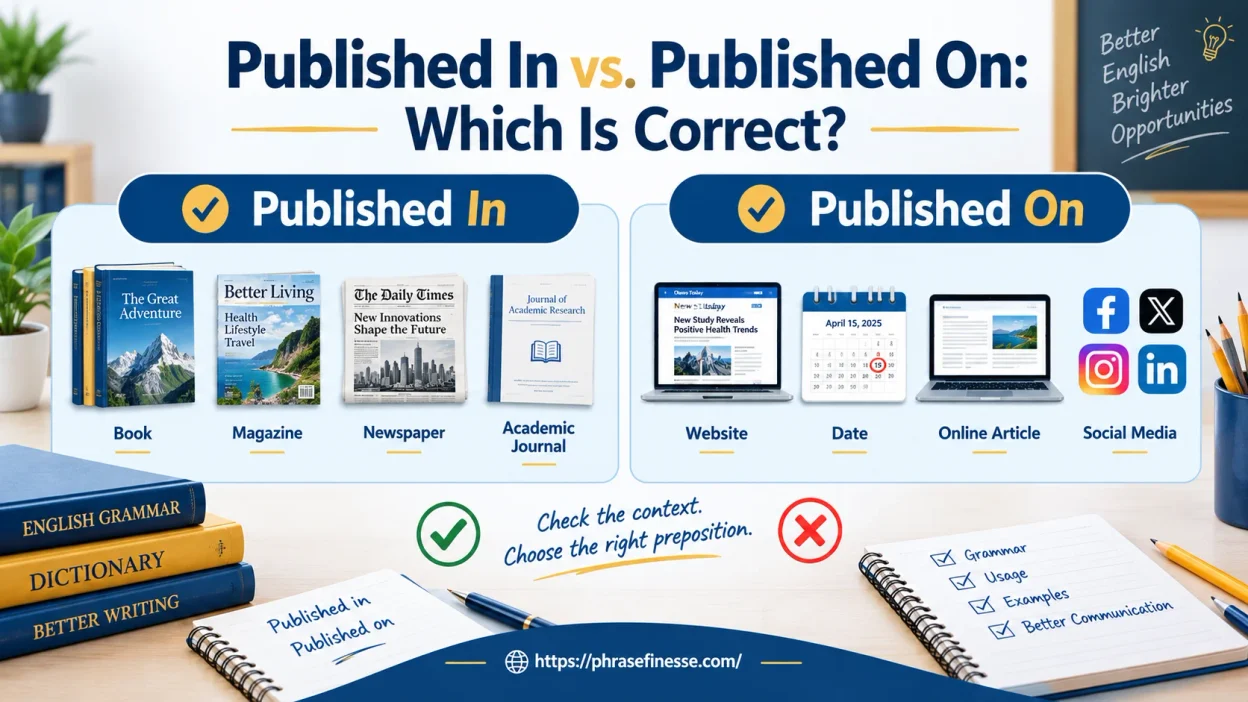
| Published in | Books, magazines, journals, newspapers, collections, and publications |
| Published on | Dates, days, websites, web pages, and online platforms |
Examples
1.✅ The article was published in a scientific journal.
2.✅ Her story was published in a magazine.
3.✅ The report was published on June 15.
4.✅ The announcement was published on LinkedIn.
If you’re talking about where content exists inside a publication, use in.
If you’re talking about when content appeared or on which platform it appeared, use on.
What Does “Published” Mean?
Before examining the prepositions, it’s helpful to understand what the verb publish actually means.
Definition of Published
The word published refers to making content available to the public.
This can include:
- Books
- Articles
- Newspapers
- Academic studies
- Blogs
- Reports
- Social media posts
- Digital media
According to major English dictionaries, publishing involves distributing information so that other people can access, read, or consume it.
Common Publishing Contexts
Today, publishing occurs in many forms:
| Traditional Publishing | Digital Publishing |
| Books | Blogs |
| Newspapers | Websites |
| Magazines | Online journals |
| Academic journals | Social media |
| Research papers | Digital newsletters |
Because publishing now happens across multiple mediums, confusion about in and on has become increasingly common.
When to Use “Published In”
The phrase published in refers to content contained within a larger publication.
Think of the publication as a container.
If something exists inside that container, English usually uses in.
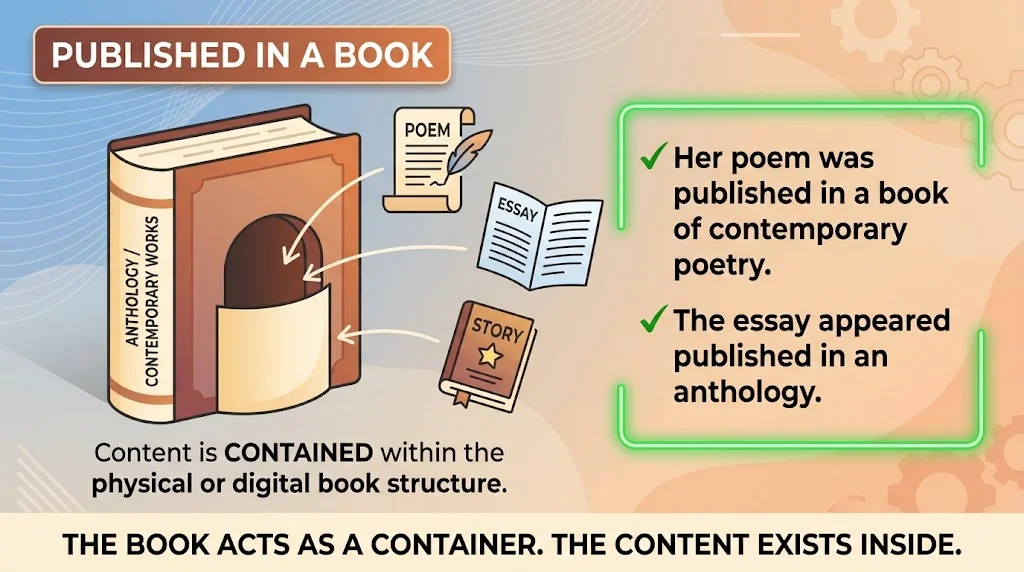
Published In a Book
Books contain chapters, stories, essays, and other written works.
Therefore:
✅ Her poem was published in a book of contemporary poetry.
✅ The essay appeared published in an anthology.
Why?
The content exists inside the book.
The book acts as a container.
Published In a Magazine
Magazines are another classic example.
Examples:
1.✅ His interview was published in Time Magazine.
2.✅ The recipe was published in a cooking magazine.
3.✅ Her photograph was published in National Geographic.
The article exists within the publication.
Therefore, in is correct.
Published In a Newspaper
Newspapers contain articles, editorials, announcements, and reports.
Examples:
1.✅ The story was published in the local newspaper.
2.✅ The correction was published in Sunday’s edition.
3.✅ Her opinion piece appeared published in The Wall Street Journal.
Again, the publication serves as the container.
Published In an Academic Journal
Academic writing almost always uses published in.
Examples:
1.✅ The study was published in Nature.
2.✅ The research was published in The Lancet.
3.✅ The findings were published in a peer-reviewed journal.
This usage dominates scientific and academic communication worldwide.
Published In an Online Publication
Many digital publications function like traditional magazines.
Examples:
1.✅ The article was published in an online journal.
2.✅ The essay appeared published in a digital magazine.
3.✅ The report was published in an industry publication.
Even though the content exists online, the publication itself remains the container.
Why “Published In” Works
English frequently uses in to describe inclusion inside something.
Examples:
- In a box
- In a room
- In a building
- In a magazine
The same logic applies to publishing.
The Container Rule
Book = Container
Magazine = Container
Journal = Container
Newspaper = Container
Content exists INSIDE them.
Use: Published IN
This simple concept explains most cases involving published in.
Examples of Published In
| Sentence | Correct |
| The study was published in Nature. | ✓ |
| Her article was published in a magazine. | ✓ |
| The story appeared in a newspaper. | ✓ |
| The paper was published in a journal. | ✓ |
| The poem was published in an anthology. | ✓ |
When to Use “Published On”
The phrase published on usually refers to a date, day, platform, or webpage.
Think of on as pointing to a surface or specific point in time.
Published On a Date
Dates always use on.
Examples:
1.✅ The report was published on June 10.
2.✅ The article was published on May 15, 2025.
3.✅ The announcement appeared on December 1.
This rule applies consistently throughout English.
Published On a Day
Days also require on.
Examples:
1.✅ The story was published on Monday.
2.✅ The paper appeared on Friday.
3.✅ The update was published on Sunday.
Published On a Website
Modern English commonly uses published on when referring to websites.
Examples:
1.✅ The article was published on the company website.
2.✅ The guide was published on Medium.
3.✅ The announcement was published on the official blog.
In these cases, the website acts more like a platform than a publication.
Published On Social Media
Social media platforms almost always take on.
Examples:
1.✅ Published on LinkedIn
2.✅ Published on Facebook
3.✅ Published on Instagram
4.✅ Published on X
5.✅ Published on YouTube
Example Sentences
- The announcement was published on LinkedIn.
- The update was published on Facebook.
- The campaign launch was published on Instagram.
Why “Published On” Works
English uses on for:
Specific Dates
- On June 15
- On Monday
- On Christmas Day
Platforms and Surfaces
- On a website
- On LinkedIn
- On Facebook
The preposition points toward a location or time reference.
Examples of Published On
| Sentence | Correct |
| Published on Monday | ✓ |
| Published on June 10 | ✓ |
| Published on LinkedIn | ✓ |
| Published on Medium | ✓ |
| Published on the company blog | ✓ |
Can Both “Published In” and “Published On” Be Correct?
Interestingly, yes.
Sometimes both expressions work because they describe different aspects of the same content.
Consider this example:
✅ The article was published in The New York Times.
✅ The article was published on The New York Times website.
Both are correct.
However, they communicate different meanings.
Understanding the Difference
Published In
Refers to the publication.
Published On
Refers to the platform.
| Sentence | Meaning |
| Published in a journal | Refers to the journal itself |
| Published on the journal website | Refers to the platform |
| Published in a newspaper | Refers to the publication |
| Published on a website | Refers to the digital location |
This distinction becomes increasingly important in modern publishing.
Published In or Published On a Website?
This question causes more confusion than any other.
Traditional Grammar View
Historically, websites were considered platforms.
Therefore:
✅ Published on a website
became the preferred form.
See More :“I Need Your Help” 6 Polite Ways to Ask for Help
Modern Usage
Today, many websites function as full publications.
Examples:
- Online magazines
- Digital newspapers
- Industry journals
- News platforms
This creates situations where both prepositions may be correct.
Example
✅ Published in an online magazine.
✅ Published on the magazine’s website.
Notice the subtle difference.
The first refers to the publication.
The second refers to the platform.
Quick Website Rule
| Meaning | Correct Choice |
| Referring to the website itself | On |
| Referring to the publication | In |
Examples
1.✅ Published on Forbes.com
2.✅ Published on Medium
3.✅ Published in Forbes Magazine
4.✅ Published in an online publication
Published In or Published On Social Media?
The answer here is straightforward.
Always use on.
Correct Examples
1.✅ Published on LinkedIn
2.✅ Published on Facebook
3.✅ Published on Instagram
4.✅ Published on TikTok
5.✅ Published on X
Social media platforms are viewed as surfaces or channels where content appears.
They are not considered containers in the grammatical sense.
Common Mistakes People Make
Understanding common errors helps you avoid them.
Using “On” With Journals
Incorrect:
❌ Published on a scientific journal
Correct:
✅ Published in a scientific journal
Why?
A journal contains articles.
The journal acts as a container.
Using “In” With Dates
Incorrect:
❌ Published in June 15
Correct:
✅ Published on June 15
Dates require on.
Confusing Publications and Platforms
Incorrect:
❌ Published in LinkedIn
Correct:
✅ Published on LinkedIn
LinkedIn is a platform.
Incorrect Website Usage
Sometimes writers say:
❌ Published in a website
Native speakers rarely use this structure.
Instead:
✅ Published on a website
Published In, Published On, or Published At?
Many learners also ask about published at.
When “Published At” Works
The phrase generally refers to a specific time.
Examples:
✅ Published at 8:00 AM
✅ Published at noon
In these examples, at identifies a precise moment.
When “Published At” Sounds Wrong
Incorrect:
1.❌ Published at a website
2.❌ Published at a journal
3.❌ Published at a newspaper
English rarely uses at for publications.
Comparison Table
| Phrase | Usage |
| Published in | Publication |
| Published on | Date or platform |
| Published at | Specific time |
Real-World Examples From Professional Writing
Let’s examine how professionals use these expressions.
Academic Writing
Researchers consistently use published in.
Examples:
- Published in Nature
- Published in Science
- Published in The Lancet
- Published in Cell
Academic style guides overwhelmingly prefer this construction.
Journalism
Journalists use both phrases.
Examples:
- Published in The New York Times
- Published in The Guardian
- Published on the newspaper’s website
The context determines the choice.
Business Communication
Companies frequently write:
- Published on our website
- Published on LinkedIn
- Published on the company blog
These platforms require on.

Marketing and Content Creation
Content marketers often publish:
- On Medium
- On Substack
- On LinkedIn
- On company websites
However, if discussing the publication itself:
- In an online magazine
- In a trade publication
Case Study: How One Sentence Changes Meaning
Consider these two sentences.
Example A
The article was published in Harvard Business Review.
Meaning:
The publication accepted and printed the article.
Example B
The article was published on the Harvard Business Review website.
Meaning:
The content appeared on the website.
The distinction seems small.
However, it communicates a different relationship between the content and the publication.
A Simple Memory Trick
Grammar becomes easier when you visualize it.
The Container Rule
Imagine a magazine as a box.
Articles sit inside the box.
Therefore:
Published IN
Works with:
- Books
- Journals
- Magazines
- Newspapers
- Anthologies
- Publications

The Platform Rule
Imagine a website as a billboard.
Content appears on the billboard.
Therefore:
Published ON
Works with:
- Websites
- Blogs
- Social media
- Platforms
- Dates
- Days
Quick Practice Quiz
Choose the correct preposition.
Questions
The article was published ___ Nature.
The report was published ___ July 12.
The announcement was published ___ LinkedIn.
Her essay was published ___ a literary journal.
The update was published ___ the company website.
Answers
Nature → in
July 12 → on
LinkedIn → on
Literary journal → in
Company website → on
If you answered all five correctly, you’ve already mastered the core rule.
FAQs
1. Is it correct to say “published in” or “published on”?
Both are correct, but they are used in different situations. Use “published in” for books, magazines, journals, newspapers, and other publications. Use “published on” for websites, blogs, social media platforms, or specific dates.
2. Do I say published in a journal or published on a journal?
The correct phrase is “published in a journal.” A journal is considered a publication, so “in” is the appropriate preposition.
Example: Her research was published in a medical journal.
3. When should I use “published on”?
Use “published on” when referring to digital platforms or specific dates.
Examples:
- The article was published on the company website.
- The report was published on Monday.
4. Can “published in” refer to time?
Yes. “Published in” can be used with longer periods such as months or years.
Examples:
- The novel was published in 2024.
- The study appeared in the July edition.
5. Is “published at” ever correct?
Yes, but only in limited contexts. “Published at” usually refers to the publisher or location rather than the publication itself.
Example: The book was published at Oxford University Press. (Less common than published by Oxford University Press.)
6. How can I remember the difference between “published in” and “published on”?
A simple rule is:
- Use published in for containers or publications (books, magazines, journals, newspapers).
- Use published on for surfaces, platforms, websites, social media, or dates.
This rule works in most everyday and professional writing situations.
Conclusion
Choosing between “published in” and “published on” becomes simple once you understand the context. Published in refers to content appearing inside a publication, such as a book, journal, magazine, or newspaper, while published on is used for websites, online platforms, social media, and specific dates.
Using the correct preposition makes your writing more accurate, natural, and professional.
Whether you’re writing an academic paper, business email, blog post, or news article, applying these rules will improve your grammar, English usage, and formal writing skills.
Keep these guidelines in mind, practice with real examples, and you’ll confidently choose the right preposition every time.

Emma Brooke is an English language specialist, editor, and content writer at Phrase Finesse, where she helps readers develop stronger writing and communication skills through clear, practical, and engaging content. With a passion for the English language, she specializes in simplifying grammar rules, vocabulary, spelling, punctuation, and word usage for learners at every level.
Emma has extensive experience creating educational content that is accurate, well-researched, and easy to understand. She is particularly skilled at explaining confusing word pairs, grammar concepts, idioms, sentence structure, and effective writing techniques, making complex topics approachable for students, professionals, educators, and English learners worldwide.

[…] See More :Published In vs. Published On: Which Is Correct? […]
[…] See More :Published In vs. Published On: Which Is Correct? […]