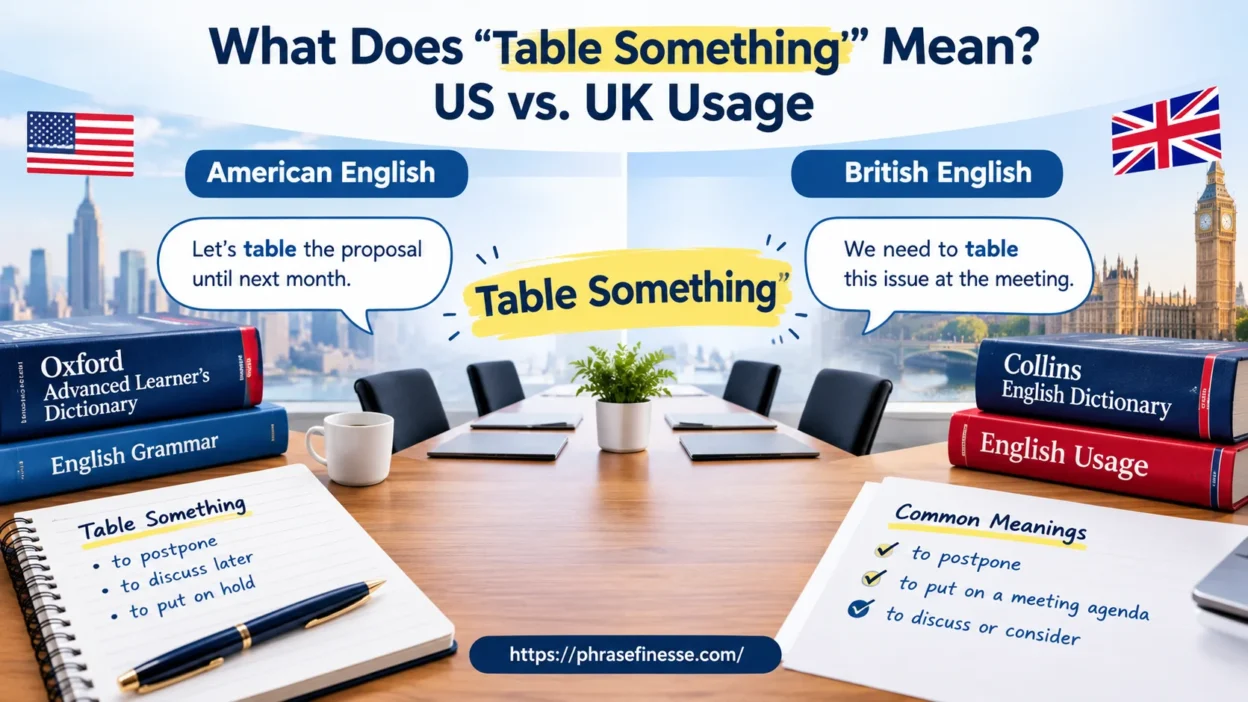
Have you ever heard someone say, “Let’s table this discussion,” and wondered whether they mean to postpone it or bring it forward for consideration? The phrase can be confusing because its meaning changes depending on the region and context. In this guide, What Does “Table Something” Mean? US vs. UK Usage will help you understand the phrase’s definition, origin, and correct usage in English communication, formal writing, and everyday conversations.
The expression “table something” is commonly used in meetings, business communication, project management, and professional settings when people need to manage topics, proposals, or decisions.
However, differences between American English and British English usage can create misunderstandings. Understanding this phrase improves grammar, clarity, and consistency in workplace discussions, scheduling, and time management situations.
This article explains the meaning of table something, explores its role in formal discussions, and provides practical examples to show how you can use it correctly.
Whether you encounter the phrase during calendar planning, online booking conversations, broadcasting discussions, or professional meetings, you’ll learn how context determines its meaning and how to apply it confidently in modern English.
What Does It Mean to “Table Something”?
The phrase “table something” means to place an issue, proposal, document, or idea into a formal discussion process. However, the exact meaning changes depending on the English variety being used.
The phrase commonly appears in:
- Business meetings
- Government discussions
- Legal settings
- Academic committees
- Project management conversations
- Professional communication
The confusion happens because the phrase developed two opposite meanings.
In one version, something moves away from immediate attention.
In the other version, something moves toward attention.
Think of it like a meeting room with two different traditions. One person sees the table as a place where ideas wait. Another sees it as the place where ideas officially arrive.
The Two Main Meanings of “Table Something”
| English Variety | Meaning of “Table Something” | Example |
| American English | To postpone, delay, or set aside | “The committee tabled the proposal until next week.” |
| British English | To formally present or submit | “The minister tabled a new report in Parliament.” |
Understanding this difference helps you avoid mistakes, especially when communicating with international audiences.
What Does “Table Something” Mean in American English?
In American English, to table something usually means to delay discussion or action on an issue.
When someone tables a topic, they do not necessarily reject it. They simply decide not to deal with it at that moment.
For example:
“The board decided to table the marketing proposal until more data was available.”
This means:
- The board did not approve the proposal.
- The board did not reject the proposal.
- The board postponed the discussion.
The topic remains open for future consideration.
How Americans Use “Table Something” in Meetings
The phrase appears frequently in professional environments.
A company executive might say:
“Let’s table this idea until we review the budget.”
The meaning is:
“Let’s stop discussing this now and return to it later.”
Common reasons for tabling an issue include:
- Missing information
- Limited meeting time
- Changing priorities
- Need for additional research
- Waiting for approval from another department
Examples of “Table Something” in American English
| Sentence | Meaning |
| “We should table the proposal for now.” | Delay discussion |
| “The committee tabled the issue.” | The committee postponed action |
| “Let’s table this conversation until tomorrow.” | Discuss it later |
| “The team tabled the project idea.” | The team paused consideration |
What Does “Table Something” Mean in British English?
In British English, to table something usually means to formally present something for discussion or consideration.
This meaning is especially common in government and official settings.
For example:
“The minister tabled the report before Parliament.”
This means:
- The minister officially introduced the report.
- The report became available for review.
- Officials could discuss its contents.
The idea comes from placing a document on a table where people can examine it.
British Examples of “Table Something”
| Sentence | Meaning |
| “The committee tabled the annual report.” | The committee presented the report |
| “The government tabled a new proposal.” | The government introduced the proposal |
| “The member tabled an amendment.” | The member submitted an amendment |
In British formal writing, “table” often carries a sense of official action.
Why Does “Table Something” Have Two Opposite Meanings?
The reason behind this unusual difference comes from language history.
The phrase connects to the idea of placing something on a table.
Historically, when people placed a document on a table, they made it available for others to examine. The document became part of a formal discussion.
Over time, different English-speaking regions developed different interpretations.
The Historical Development of the Phrase
The original idea was simple:
Put something on the table → Make it available for discussion
This meaning remained strong in British English.
However, American English developed a different interpretation.
In the United States, “table” became connected with the idea of removing something from immediate consideration. A topic placed on the table would wait there until people were ready to revisit it.
A Simple Way to Understand the Difference
Imagine a meeting table.
British interpretation:
A document arrives at the table.
Meaning:
“Everyone, look at this. Let’s discuss it.”
American interpretation:
A document goes onto the table and waits.
Meaning:
“We’ll deal with this later.”
The physical image is similar, but the action differs.
Is “Table Something” Only British?
No. “Table something” is not only British.
The phrase exists in both American and British English. The difference lies in how each region uses it.
Many people assume one version must be wrong, but that is not true.
English contains many regional differences.
Examples include:
| Word/Phrase | American English | British English |
| Football | American football | Soccer |
| Pants | Trousers | Underwear |
| Biscuit | Cookie | Small baked bread product |
| Table something | Postpone | Present |
Language changes based on culture, history, and everyday usage.
How “Table Something” Is Used in Business Communication
Professional communication creates the most confusion because international teams often work together.
A phrase that sounds perfectly clear in one country may create uncertainty in another.
For example:
“We should table the proposal.”
An American employee may understand:
“Let’s delay the proposal.”
A British employee may understand:
“Let’s introduce the proposal.”
That single sentence can completely change the direction of a meeting.
Case Study: An International Business Meeting
Imagine a company with offices in London and New York.
During a strategy meeting, the team discusses a new product launch.
The American manager says:
“Let’s table this idea until next quarter.”
The American team understands:
- Stop discussion.
- Review later.
- Wait for better timing.
However, the British team interprets it as:
- Add the idea to the meeting agenda.
- Discuss the details.
The result?
The teams leave the meeting with different expectations.
The solution is simple: use clearer language.
Instead of saying:
“Let’s table this.”
Say:
- “Let’s postpone this discussion.”
- “Let’s discuss this now.”
- “Let’s revisit this next month.”
- “Let’s formally present this proposal.”
How Americans Use “Table Something” in Government and Organizations
The American meaning appears often in committees and official meetings.
A group may table:
- A motion
- A proposal
- A budget request
- An amendment
- A policy discussion
When this happens, the group usually delays action.
Example: Committee Decision
A city council reviews a new transportation plan.
A member says:
“I move that we table this proposal.”
The meaning:
- The council should stop discussion.
- The proposal should return at a later meeting.
The proposal remains active unless the group takes another action.
See More : Patronizing vs. Condescending: What’s the Difference?
How British Speakers Use “Table Something” in Government
British formal language often uses “table” differently.
In parliamentary settings, officials frequently table:
- Reports
- Amendments
- Bills
- Motions
- Documents
The purpose is to officially introduce information.
For example:
“The opposition leader tabled an amendment.”
Meaning:
The opposition leader submitted the amendment for consideration.
Common Mistakes When Using “Table Something”
Assuming Everyone Understands the Same Meaning
The biggest mistake is believing the phrase has only one definition.
Because both meanings exist, your audience matters.
Before using the phrase, consider:
- Where your readers live
- Who will attend the meeting
- Whether the communication is formal or casual
Using “Table Something” in International Communication
Global teams should avoid unclear expressions.
Instead of:
“We’ll table the proposal.”
Write:
“We’ll postpone the proposal discussion.”
or:
“We’ll present the proposal during Friday’s meeting.”
Clear language prevents unnecessary confusion.
Mistaking “Table” for Rejection
Another common misunderstanding is thinking that tabling something means canceling it.
Usually, it does not.
A tabled issue may still return later.
For example:
“The committee tabled the report.”
This does not automatically mean:
- The report failed.
- The report was ignored.
- The report was permanently rejected.
It simply means the committee took a specific action based on its regional usage.
Better Alternatives to “Table Something”
When clarity matters, choose a more specific phrase.
| Intended Meaning | Clear Alternative |
| Delay discussion | Postpone, defer, revisit later |
| Present information | Submit, introduce, present |
| Start discussion | Raise, bring up, discuss |
| Stop temporarily | Pause, set aside |
These alternatives remove confusion.
For example:
Instead of:
“Let’s table the issue.”
Write:
“Let’s postpone the issue until next week.”
or:
“Let’s introduce the issue during tomorrow’s meeting.”
How to Know Which Meaning Someone Intends
When you hear “table something,” look at the situation.
Ask these questions:
- Who is speaking?
- Where are they from?
- What type of meeting is happening?
- What words appear around the phrase?
Context usually reveals the meaning.
Quick Interpretation Guide
| Situation | Likely Meaning |
| US workplace meeting | Delay |
| UK Parliament | Present |
| International conference | Unclear; ask for clarification |
| Casual conversation | Usually delay in American English |
FAQs
1. What does it mean to “table something”?
To table something means to bring a topic, proposal, or issue into a discussion or to postpone it for later consideration, depending on the region. In American English, it usually means to delay or set aside a matter temporarily. In some varieties of British English, it can mean to present something for discussion.
2. Does “table something” have different meanings in American and British English?
Yes, the meaning changes between American English and British English usage. In the United States, “table the proposal” often means to put the proposal on hold. In British English, the same phrase may mean to submit the proposal for review or discussion.
3. Is “table something” appropriate for formal writing?
Yes, table something can be appropriate in formal writing, especially in business documents, reports, and professional communication. However, because the phrase has different meanings worldwide, writers should provide clear context to avoid confusion.
4. Can I use “table something” in business meetings?
Absolutely. The phrase is common in business communication, meetings, and project management discussions. For example, a manager might say, “Let’s table this issue until next week,” meaning the team will postpone the conversation and revisit it later.
5. What are some alternatives to saying “table something”?
Depending on your intended meaning, you can use alternatives such as postpone, delay, set aside, defer, present, propose, or bring up for discussion. Choosing the right word improves clarity in professional conversations and formal writing.
6. How can I know which meaning of “table something” is intended?
You can determine the meaning by looking at the context, location, and type of conversation. In meetings, scheduling, and workplace discussions, surrounding words usually reveal whether the speaker means delaying a topic or introducing it for consideration.
Conclusion
The phrase “table something” may seem simple, but its meaning depends heavily on English usage, regional differences, and context. In American English, it generally means to postpone or set aside a topic, while in other English varieties, it can mean to formally introduce something for discussion.
Understanding this phrase helps you communicate more effectively in business communication, meetings, project management, and everyday conversations. Whether you are managing a calendar, planning schedules, or writing professional documents, using table something correctly ensures clearer and more confident communication.
By recognizing the difference between these meanings, you can avoid misunderstandings and improve your grammar, formal writing, and overall language consistency. Always consider your audience and context before using this expression, especially in international or professional settings.

Mia Rose is an English language specialist and editorial writer at Phrase Finesse, where she helps readers master grammar, vocabulary, spelling, and effective communication. Passionate about making English simple and practical, she creates well-researched, reader-friendly content that explains complex language concepts in a clear and engaging way.
With extensive experience in English language education, content writing, and editorial review, Mia specializes in grammar, punctuation, word choice, idioms, confusing word pairs, and writing style. Her articles are carefully researched, fact-checked, and designed to help students, professionals, writers, and English learners build confidence in both written and spoken English.



[…] See More : What Does “Table Something” Mean? US vs. UK Usage […]
[…] See More : What Does “Table Something” Mean? US vs. UK Usage […]
[…] See More : What Does “Table Something” Mean? US vs. UK Usage […]
[…] Read More : What Does “Table Something” Mean? US vs. UK Usage […]
[…] See More : What Does “Table Something” Mean? US vs. UK Usage […]