Have you ever paused while writing and wondered whether “Agencies or Agency’s or Agencies’” is correct? It’s a common question, especially in business communication, formal writing, and professional documents. A single apostrophe can change the meaning of a sentence, which makes understanding English usage, grammar, and possessive forms essential for clear and accurate communication.
Whether you work in project management, handle scheduling, organize meetings, manage a calendar, or coordinate online booking systems, correct grammar helps you communicate with confidence. The difference between agencies, agency’s, and agencies’ often causes confusion because each form serves a distinct purpose. Using the wrong version can affect clarity, professionalism, and consistency, particularly in reports, emails, contracts, and client-facing content.
In this guide, you’ll learn exactly when to use agencies (the plural form), agency’s (the singular possessive form), and agencies’ (the plural possessive form). We’ll break down the rules with simple explanations, practical examples, and real-world contexts, including broadcasting, time management, and workplace communication.
By the end, you’ll know how to choose the correct form every time and avoid one of the most common punctuation mistakes in modern English.
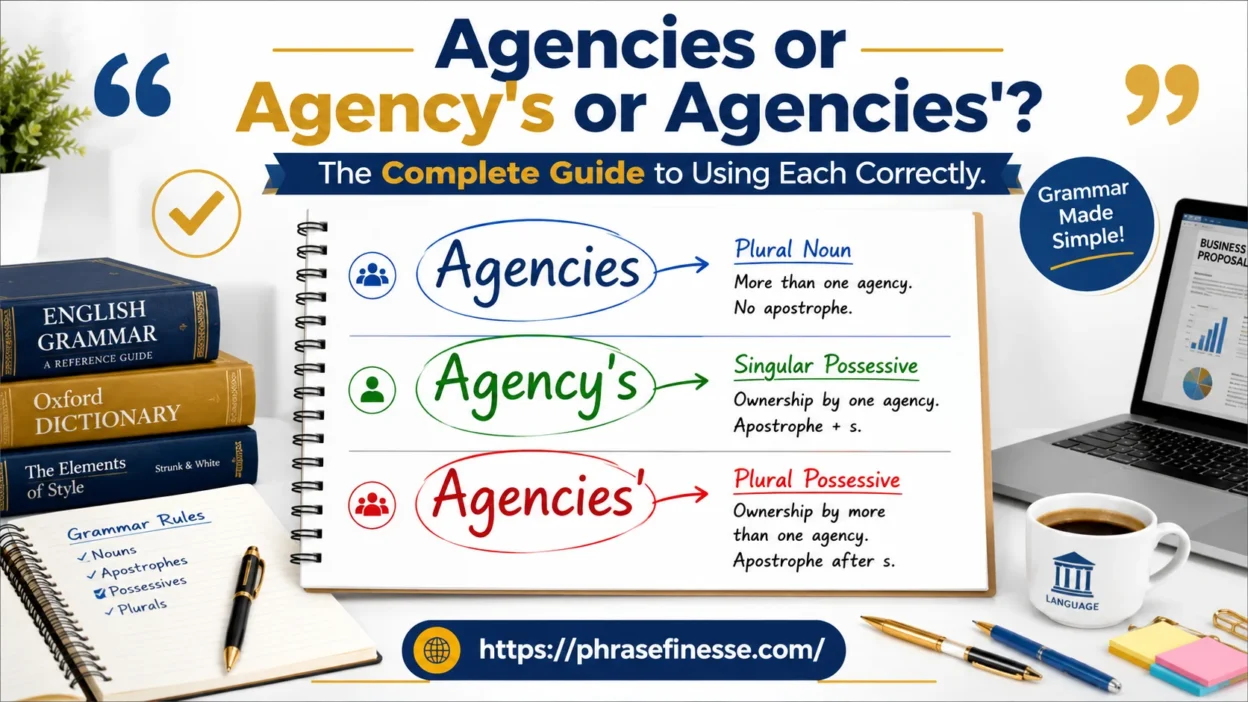
Agencies, Agency’s, and Agencies’ at a Glance
Before diving deeper, here’s a quick overview.
| Word | Meaning | Function |
| Agencies | More than one agency | Plural noun |
| Agency’s | Something belongs to one agency | Singular possessive noun |
| Agencies’ | Something belongs to multiple agencies | Plural possessive noun |
Quick Examples
- Several agencies submitted proposals.
- The agency’s director approved the campaign.
- The agencies’ directors met for a conference.
Notice how the apostrophe completely changes the meaning.
Understanding the Difference Between Plural and Possessive Nouns
Most confusion comes from mixing up plural nouns and possessive nouns.
A plural noun means there is more than one thing.
Examples:
- agency → agencies
- company → companies
- city → cities
A possessive noun shows ownership.
Examples:
- agency’s office
- company’s website
- city’s budget
A plural possessive noun shows ownership by more than one entity.
Examples:
- agencies’ budgets
- companies’ profits
- cities’ populations
Think of it this way:
Plural answers “How many?”
Possessive answers “Who owns it?”
That simple distinction solves most apostrophe mistakes.
What Does “Agencies” Mean?
The word agencies is simply the plural form of agency.
It refers to two or more agencies.
No ownership exists.
No apostrophe appears.
Definition
Agencies means multiple organizations, firms, departments, or institutions.
Formation Rule
When a singular noun ends in -y preceded by a consonant:
- Remove the y
- Add ies
Example:
| Singular | Plural |
| Agency | Agencies |
| Company | Companies |
| Country | Countries |
| Industry | Industries |
Examples of Agencies in Sentences
- Several marketing agencies competed for the contract.
- Government agencies released updated reports.
- Recruitment agencies help companies find talent.
- Advertising agencies often specialize in specific industries.
- Travel agencies continue adapting to online booking platforms.
Each sentence refers to multiple agencies.
Nothing is being owned.
What Does “Agency’s” Mean?
Agency’s is the singular possessive form.
It indicates that something belongs to one agency.
Definition
The apostrophe followed by the letter s shows ownership.
Formation Rule
For most singular nouns:
- Add apostrophe + s
Example:
| Singular Noun | Possessive Form |
| Agency | Agency’s |
| Company | Company’s |
| Department | Department’s |
| Business | Business’s |
Examples of Agency’s in Sentences
- The agency’s website received a redesign.
- The agency’s employees attended training.
- The agency’s proposal won the contract.
- The agency’s leadership team announced changes.
- The agency’s reputation helped attract new clients.
In every example, one agency owns something.
What Does “Agencies'” Mean?
Agencies’ is the plural possessive form.
It shows ownership by multiple agencies.
Definition
Several agencies share ownership of something.
Formation Rule
When a noun already ends in s because it is plural:
- Add only an apostrophe
Example:
| Plural Noun | Possessive Form |
| Agencies | Agencies’ |
| Companies | Companies’ |
| Businesses | Businesses’ |
| Departments | Departments’ |
Examples of Agencies’ in Sentences
- The agencies’ recommendations were similar.
- The agencies’ budgets increased this year.
- The agencies’ executives attended the summit.
- The agencies’ reports highlighted common challenges.
- The agencies’ collaboration improved efficiency.
Multiple agencies own or share something.
Agencies vs Agency’s vs Agencies’
This comparison table makes the distinction crystal clear.
| Form | Meaning | Example |
| Agencies | More than one agency | Several agencies participated. |
| Agency’s | Belonging to one agency | The agency’s office expanded. |
| Agencies’ | Belonging to several agencies | The agencies’ offices expanded. |
Visual Breakdown
Agency
↓ plural
Agencies
Agency
↓ ownership
Agency’s
Agencies
↓ ownership
Agencies’
This simple pattern applies to thousands of English nouns.
Read More: Flew or Flown? Difference Explained With Examples
Why Writers Commonly Confuse These Forms
English apostrophes often create confusion because they serve multiple purposes.
They indicate:
- Possession
- Contractions
- Omitted letters
As a result, many writers mistakenly add apostrophes whenever a word ends with “s.”
However:
Apostrophes do not create plural nouns.
This is one of the most common grammar mistakes in English.
Incorrect:
- Agency’s provide marketing services.
Correct:
- Agencies provide marketing services.
The apostrophe should only appear when ownership is involved.
Easy Trick to Remember the Difference
Here’s a quick test.
Ask Yourself: Is There Ownership?
If no ownership exists:
Use agencies
Example:
- Three agencies submitted bids.
If ownership exists:
Continue to the next question.
Ask Yourself: How Many Agencies Own It?
One agency owns it:
- Agency’s
Example:
- The agency’s office
Multiple agencies own it:
- Agencies’
Example:
- The agencies’ offices
Simple Formula
More than one agency?
= Agencies
One agency owns something?
= Agency’s
Several agencies own something?
= Agencies’
This shortcut works almost every time.
Real-World Business Examples
Business writing frequently uses all three forms.
Marketing Example
Plural:
- Digital marketing agencies compete globally.
Singular Possessive:
- The agency’s campaign generated impressive results.
Plural Possessive:
- The agencies’ campaigns influenced market trends.
Government Example
Plural:
- Federal agencies released updated guidance.
Singular Possessive:
- The agency’s report was published online.
Plural Possessive:
- The agencies’ reports reached similar conclusions.
Recruitment Example
Plural:
- Staffing agencies help employers fill vacancies.
Singular Possessive:
- The agency’s recruiter contacted applicants.
Plural Possessive:
- The agencies’ recruiters attended the job fair.
Common Mistakes Writers Make
Small punctuation errors can dramatically alter meaning.
Using Agency’s as a Plural
Incorrect:
- Several agency’s attended the conference.
Correct:
- Several agencies attended the conference.
Remember:
Plural nouns do not require apostrophes.
Forgetting Ownership
Incorrect:
- The agencies budget increased.
Correct:
- The agencies’ budget increased.
Ownership requires an apostrophe.
Using Agencies’ for a Single Agency
Incorrect:
- The agencies’ director approved the proposal.
Correct:
- The agency’s director approved the proposal.
Only one director belongs to one agency.
Random Apostrophe Insertion
Incorrect:
- Marketing agency’s offer consulting.
Correct:
- Marketing agencies offer consulting.
Apostrophes never create ordinary plurals.
A Quick Case Study: How One Apostrophe Changes Meaning
Consider these two sentences.
Example One
The agency’s manager approved the budget.
Meaning:
One agency has one manager.
Example Two
The agencies’ managers approved the budget.
Meaning:
Multiple agencies have multiple managers.
A single apostrophe placement completely changes the sentence.
Professional editors pay close attention to these distinctions because they affect clarity.
Professional Writing Examples
In Corporate Communications
Correct:
- The company’s growth exceeded expectations.
- The companies’ growth exceeded expectations.
Notice the same pattern.
In Marketing Content
Correct:
- The agency’s strategy increased conversions.
- The agencies’ strategies produced strong results.
In Government Documents
Correct:
- The agency’s regulations changed.
- The agencies’ regulations changed.
Precise grammar helps readers understand exactly who owns what.
Related Grammar Rules
The same principles apply across English grammar.
Company’s vs Companies’
| Form | Meaning |
| Company’s | One company owns something |
| Companies’ | Multiple companies own something |
Examples:
- The company’s headquarters
- The companies’ headquarters
Client’s vs Clients’
| Form | Meaning |
| Client’s | One client owns something |
| Clients’ | Multiple clients own something |
Examples:
- The client’s request
- The clients’ requests
Employee’s vs Employees’
| Form | Meaning |
| Employee’s | One employee owns something |
| Employees’ | Multiple employees own something |
Examples:
- The employee’s desk
- The employees’ desks
Business’s vs Businesses’
| Form | Meaning |
| Business’s | One business owns something |
| Businesses’ | Multiple businesses own something |
Examples:
- The business’s revenue
- The businesses’ revenue
Once you master the agencies example, you’ll understand countless similar grammar situations.
Practice Sentences
Choose the correct form.
Questions
- Several ______ submitted proposals.
- The ______ website was updated.
- The ______ budgets increased.
- Multiple advertising ______ attended the event.
- The ______ employees received awards.
Answers
| Question | Correct Answer |
| Several ______ submitted proposals | Agencies |
| The ______ website was updated | Agency’s |
| The ______ budgets increased | Agencies’ |
| Multiple advertising ______ attended the event | Agencies |
| The ______ employees received awards | Agency’s |
Practice reinforces the pattern quickly.
FAQs
1. What is the difference between agencies, agency’s, and agencies’?
Agencies is the plural form of agency. Agency’s shows that one agency owns or possesses something. Agencies’ shows that multiple agencies own or possess something.
Examples:
- Several agencies attended the conference.
- The agency’s director announced the changes.
- The agencies’ policies were updated last month.
2. When should I use agency’s?
Use agency’s when referring to something that belongs to a single agency.
Example:
- The agency’s marketing strategy increased customer engagement.
The apostrophe before the “s” indicates singular possession.
3. When should I use agencies’?
Use agencies’ when something belongs to two or more agencies.
Example:
- The agencies’ joint proposal received approval.
The apostrophe after the “s” indicates plural possession.
4. Is agencies a possessive word?
No. Agencies is simply the plural form of agency. It refers to more than one agency but does not show ownership.
Example:
- Several agencies participated in the project.
5. Why do people confuse agency’s and agencies’?
The confusion usually comes from apostrophe placement. Both forms are possessive, but agency’s refers to one agency, while agencies’ refers to multiple agencies. Understanding whether the owner is singular or plural helps you choose the correct form.
6. Are these rules important in professional and business writing?
Yes. Correct use of agencies, agency’s, and agencies’ improves business communication, formal writing, and overall consistency. Accurate grammar helps readers understand your message and presents a more professional image.
Conclusion
Understanding the difference between agencies, agency’s, and agencies’ is essential for accurate English usage and effective business communication. While agencies refers to more than one agency, agency’s shows possession by a single agency, and agencies’ indicates possession by multiple agencies. Although the distinction seems small, correct apostrophe placement can significantly improve clarity and professionalism.
Whether you’re writing emails, reports, contracts, or content related to project management, scheduling, meetings, online booking, or broadcasting, using the correct form demonstrates attention to detail and strong writing skills. Remember a simple rule: first identify whether you’re talking about one agency or several agencies, then decide whether possession is involved. With practice, choosing the correct form becomes second nature and helps maintain grammatical consistency in every piece of writing.

Alyan Ashraf is an English language writer and editor at Phrase Finesse, where he specializes in grammar, vocabulary, spelling, word usage, and clear communication. Passionate about the English language, he creates practical, research-backed content that helps readers avoid common mistakes and write with greater accuracy and confidence.
Known for his clear writing style and attention to detail, Alyan simplifies complex language topics into easy-to-understand guides filled with real-world examples and actionable insights. His work covers confusing word pairs, grammar rules, idioms, punctuation, and everyday English usage, making learning both accessible and engaging for students, professionals, writers, and non-native English speakers.
Every article Alyan writes is carefully researched, fact-checked, and designed to meet high editorial standards. His goal is to help readers strengthen their English skills, expand their vocabulary, and communicate more effectively in academic, professional, and everyday settings.
Through Phrase Finesse, Alyan is committed to publishing trusted language resources that make mastering English simpler, clearer, and more enjoyable for learners around the world