Have you ever paused before ending a formal letter and wondered whether “Yours Faithfully” or “Yours Sincerely”? is the correct closing? Choosing the right sign-off can influence the professionalism and tone of your message.
This guide explains the difference between “Yours Faithfully” and “Yours Sincerely”, helping you understand their proper English usage, grammar rules, and role in formal writing.
In professional settings, the correct letter closing creates clarity, respect, and consistency. Whether you are writing for business communication, arranging meetings, managing scheduling tasks, or handling project management responsibilities, using the appropriate formal expression matters. Even digital communication, such as emails, online booking confirmations, and official broadcasting messages, requires careful attention to traditional writing standards.
This article explores when to use “Yours Faithfully” and “Yours Sincerely”, including their meanings, differences, examples, and common mistakes. You’ll also learn how these professional phrases support effective communication, better time management, and polished workplace interactions.
By the end, you’ll have a clear understanding of these formal closings and how to apply them with confidence and consistency in every written message.
Quick Answer
The traditional rule is surprisingly simple:
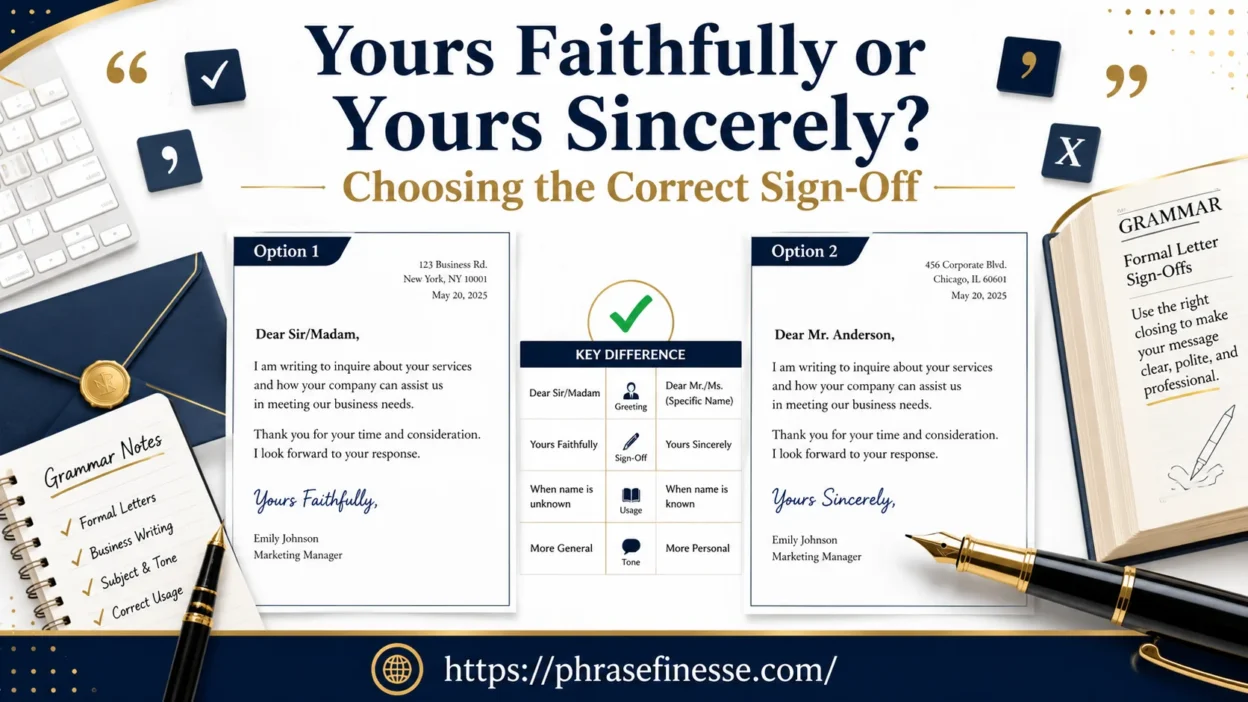
| Situation | Correct Sign-Off |
| You know the recipient’s name | Yours sincerely |
| You do not know the recipient’s name | Yours faithfully |
For example:
Known recipient
Dear Mr. Anderson,
Thank you for your assistance.
Yours sincerely,
Jane Smith
Unknown recipient
Dear Sir/Madam,
I am writing regarding my recent order.
Yours faithfully,
Jane Smith
The Easy Memory Trick
Think of it this way:
- Sincerely = Specific person
- Faithfully = Faceless recipient
If you know who you’re writing to, choose Yours sincerely.
If you don’t know who will read the letter, choose Yours faithfully.
What Does “Yours Faithfully” Mean?
Yours faithfully is a traditional formal closing used when the recipient’s name is unknown.
Historically, the phrase implied that the writer remained faithful to the purpose of the communication despite not having a personal relationship with the recipient.
Today, it continues to serve as the standard closing for formal letters addressed to:
- Dear Sir/Madam
- Dear Hiring Manager
- Dear Customer Service Team
- Dear Admissions Office
- Dear Human Resources Department
When to Use Yours Faithfully
Use this sign-off when:
- You do not know the recipient’s name.
- You are writing to a department.
- You are contacting a company generally.
- You are submitting a formal inquiry.
- You are filing a complaint.
- You are making an official request.
Example
Dear Sir/Madam,
I would like to request information regarding your graduate program.
Yours faithfully,
Michael Davis
Why It Matters
Formal letter conventions developed long before email existed. In traditional business correspondence, the greeting and sign-off worked together as a matched pair.
Because “Dear Sir/Madam” addresses an unknown individual, “Yours faithfully” became the accepted closing.
Read More: Students or Student’s, or Students’? Use Correctly with Examples
What Does “Yours Sincerely” Mean?
Yours sincerely is used when the writer knows the recipient’s name.
The word “sincerely” suggests genuine respect and direct communication between two identified individuals.
It remains one of the most widely accepted professional sign-offs in business and academic writing.
When to Use Yours Sincerely
Use it when:
- You know the recipient’s name.
- The letter begins with Dear Mr., Mrs., Ms., Dr., or Professor.
- You are applying for a job.
- You are writing to a client.
- You are communicating with a colleague formally.
- You are contacting a university representative.
Example
Dear Dr. Peterson,
Thank you for reviewing my application.
Yours sincerely,
Emily Carter
Why Professionals Prefer It
A named greeting creates a direct connection between sender and recipient.
Using Yours sincerely reinforces that personalized communication and aligns with established business writing standards.
The Core Difference Between Yours Faithfully and Yours Sincerely
The distinction comes down to one factor:
Do you know the recipient’s name?
That’s it.
Side-by-Side Comparison
| Feature | Yours Faithfully | Yours Sincerely |
| Recipient known? | No | Yes |
| Traditional UK usage | Yes | Yes |
| Business letters | Common | Common |
| Job applications | Sometimes | Frequently |
| Complaint letters | Common | Less common |
| Academic letters | Occasionally | Frequently |
| Formality level | Very formal | Formal |
Greeting and Closing Pairings
| Greeting | Closing |
| Dear Sir/Madam | Yours faithfully |
| Dear Hiring Manager | Yours faithfully |
| Dear Customer Support Team | Yours faithfully |
| Dear Mr. Johnson | Yours sincerely |
| Dear Dr. Lee | Yours sincerely |
| Dear Professor Adams | Yours sincerely |
Think of the greeting and sign-off as dance partners. They work best together when properly matched.
British English vs American English Usage
One reason people get confused is that British and American writing conventions differ.
British English Rules
In the United Kingdom, traditional business-writing rules remain widely recognized.
The standard convention is:
- Unknown recipient → Yours faithfully
- Known recipient → Yours sincerely
Many schools, universities, government offices, and businesses still teach and follow this format.
American English Practices
In the United States, writers generally use more flexible sign-offs.
Many Americans simply use:
- Sincerely
- Sincerely yours
- Best regards
- Regards
- Thank you
As a result, Americans often encounter fewer situations where they must choose between faithfully and sincerely.
Regional Comparison
| Region | Unknown Recipient | Known Recipient |
| United Kingdom | Yours faithfully | Yours sincerely |
| United States | Sincerely | Sincerely |
| Canada | Often follows UK tradition | Often follows UK tradition |
| International Business | Depends on organization | Usually sincerely |
Which Rule Should You Follow?
If you’re writing for:
- A UK employer → Follow traditional rules.
- A US employer → Sincerely is usually acceptable.
- An international audience → Consider company style guidelines.
Why the Greeting Determines the Closing
Many people memorize the rule without understanding the reason behind it.
The logic comes from traditional correspondence etiquette.
When you write:
Dear Sir/Madam
you don’t know who will read the letter.
The relationship is impersonal.
Therefore:
Yours faithfully
acknowledges that distance.
When you write:
Dear Ms. Wilson
you are addressing a specific person.
The communication becomes personal and direct.
Therefore:
Yours sincerely
reflects that personal connection.
Understanding this principle makes the rule easier to remember.
Common Mistakes People Make
Even experienced professionals occasionally misuse these sign-offs.
Here are the most common errors.
Using Yours Faithfully After Naming the Recipient
Incorrect:
Dear Mr. Roberts,
Yours faithfully,
Correct:
Dear Mr. Roberts,
Yours sincerely,
Using Yours Sincerely with Dear Sir/Madam
Incorrect:
Dear Sir/Madam,
Yours sincerely,
Traditional convention considers this mismatched.
Correct:
Dear Sir/Madam,
Yours faithfully,
Mixing Casual and Formal Language
Example:
Dear Sir/Madam,
Just wanted to check in.
Cheers,
The greeting sounds extremely formal.
The closing sounds casual.
The tone becomes inconsistent.
Ignoring Country-Specific Expectations
A UK recruiter may notice incorrect usage immediately.
An American recruiter may not care.
Knowing your audience always helps.
Real-World Examples of Correct Letter Closings
Let’s examine practical scenarios.
Job Application with a Named Hiring Manager
Dear Ms. Jackson,
I am applying for the Marketing Coordinator position.
Yours sincerely,
Alex Turner
Job Application Without a Named Contact
Dear Hiring Manager,
I am pleased to submit my application.
Yours faithfully,
Alex Turner
Customer Complaint
Dear Customer Service Team,
I am writing regarding a defective product.
Yours faithfully,
Alex Turner
University Admissions Inquiry
Dear Admissions Office,
I would appreciate information regarding scholarship opportunities.
Yours faithfully,
Alex Turner
Scholarship Officer with Known Name
Dear Ms. Garcia,
Thank you for considering my application.
Yours sincerely,
Alex Turner
Case Study: How One Small Sign-Off Affected a Job Application
Imagine two candidates applying for the same position.
Candidate A
Dear Hiring Manager,
Yours sincerely,
Candidate B
Dear Hiring Manager,
Yours faithfully,
Both applicants may be qualified.
However, Candidate B demonstrates familiarity with traditional business writing conventions.
Will this guarantee a job offer?
No.
But in competitive hiring situations, small details often contribute to an overall professional impression.
As the saying goes:
“Little things make big things happen.”
Professional communication is often a collection of small details executed correctly.
Are Yours Faithfully and Yours Sincerely Still Used in Emails?
Many people assume these closings disappeared with printed letters.
Not exactly.
Situations Where They Still Appear
They remain common in:
- Government correspondence
- Legal communication
- Academic applications
- Formal complaints
- Official business letters
- Professional references
Situations Where They’re Less Common
Modern workplace emails often favor:
- Best regards
- Kind regards
- Regards
- Many thanks
- Thank you
Example Modern Email
Dear Mr. Thompson,
Thank you for your assistance.
Kind regards,
Rachel Brown
This feels professional while sounding less rigid than traditional letter closings.
Best Alternatives to Yours Faithfully and Yours Sincerely
Sometimes neither option feels right.
Modern business communication offers several alternatives.
Formal Alternatives
| Sign-Off | Formality |
| Sincerely | Formal |
| Respectfully | Very Formal |
| With Appreciation | Formal |
| Kind Regards | Semi-Formal |
| Best Regards | Semi-Formal |
| Warm Regards | Friendly Professional |
Choosing the Right Alternative
Consider:
- Industry standards
- Relationship with recipient
- Communication channel
- Organizational culture
Professional Ranking
Most formal to least formal:
- Respectfully
- Yours faithfully
- Yours sincerely
- Sincerely
- Kind regards
- Best regards
- Warm regards
Which Sign-Off Should You Use Today?
Modern communication evolves constantly.
However, the classic rule remains useful.
1. Use Yours Faithfully When
- Recipient unknown
- Formal letter
- Complaint letter
- Government inquiry
- Official request
2. Use Yours Sincerely When
- Recipient known
- Job application
- Business proposal
- Academic correspondence
- Client communication
3. Use Modern Alternatives When
- Sending emails
- Communicating internally
- Maintaining ongoing business relationships
- Writing less formal messages
Professional Sign-Off Decision Guide
Use this quick framework.
Step One
Do you know the recipient’s name?
- Yes → Continue to Step Two
- No → Use Yours Faithfully
Step Two
Is the communication formal?
- Yes → Use Yours Sincerely
- No → Use Kind Regards or Best Regards
Visual Flowchart
Do you know the person’s name?
|
+—–+—–+
| |
Yes No
| |
Use Yours Use Yours
Sincerely Faithfully
Simple. Effective. Easy to remember.
FAQs
1. What is the difference between “Yours Faithfully” and “Yours Sincerely”?
The main difference depends on how you address the recipient. Use “Yours Faithfully” when you begin a formal letter with a general greeting such as “Dear Sir/Madam” because you do not know the person’s name. Use “Yours Sincerely” when you address the recipient by name, such as “Dear Mr. Smith” or “Dear Ms. Johnson.” Both are professional letter closings, but they follow different formal writing conventions.
2. When should I use “Yours Faithfully” in a letter or email?
You should use “Yours Faithfully” when writing to someone whose identity you do not know. It commonly appears in business communication, job applications, complaint letters, and official inquiries. For example, if your letter starts with “Dear Hiring Manager” or “Dear Sir/Madam,” “Yours Faithfully” is usually the appropriate closing.
3. When is “Yours Sincerely” the correct choice?
Use “Yours Sincerely” when you know the recipient’s name and include it in the greeting. This closing works well for professional emails, business letters, and workplace communication. It shows a more personal connection while maintaining a respectful and formal tone.
4. Are “Yours Faithfully” and “Yours Sincerely” used in American English?
In American English, “Sincerely” is more common than both “Yours Faithfully” and “Yours Sincerely.” American writers often end formal letters with “Sincerely” regardless of whether they know the recipient’s name. However, “Yours Faithfully” remains widely recognized in British English and other international forms of formal writing.
5. Can I use “Yours Faithfully” or “Yours Sincerely” in emails?
Yes, you can use both expressions in formal emails, especially in professional environments. However, modern business communication often prefers shorter closings such as “Sincerely,” “Best regards,” or “Kind regards.” Your choice should match the level of formality, relationship, and purpose of the message.
6. Why is choosing the correct formal closing important?
Using the correct formal closing improves the professionalism, clarity, and consistency of your writing. Whether you are sending a workplace email, organizing meetings, managing calendar tasks, or communicating through digital platforms, proper grammar and English usage help create a positive impression.
Conclusion
Understanding the difference between “Yours Faithfully” and “Yours Sincerely” helps you write more effective and professional messages. Although both phrases serve as respectful letter endings, their usage depends on whether you know the recipient’s name. Remember the simple rule: use “Yours Faithfully” for unknown recipients and “Yours Sincerely” when addressing someone by name.
Strong formal writing skills improve your confidence in professional situations, from business letters and emails to workplace communication. By applying the correct grammar rules, maintaining consistency, and choosing suitable expressions, you can make every message sound polished, respectful, and purposeful. Whether you are preparing documents, scheduling meetings, or managing professional conversations, the right closing phrase always adds value to your communication.