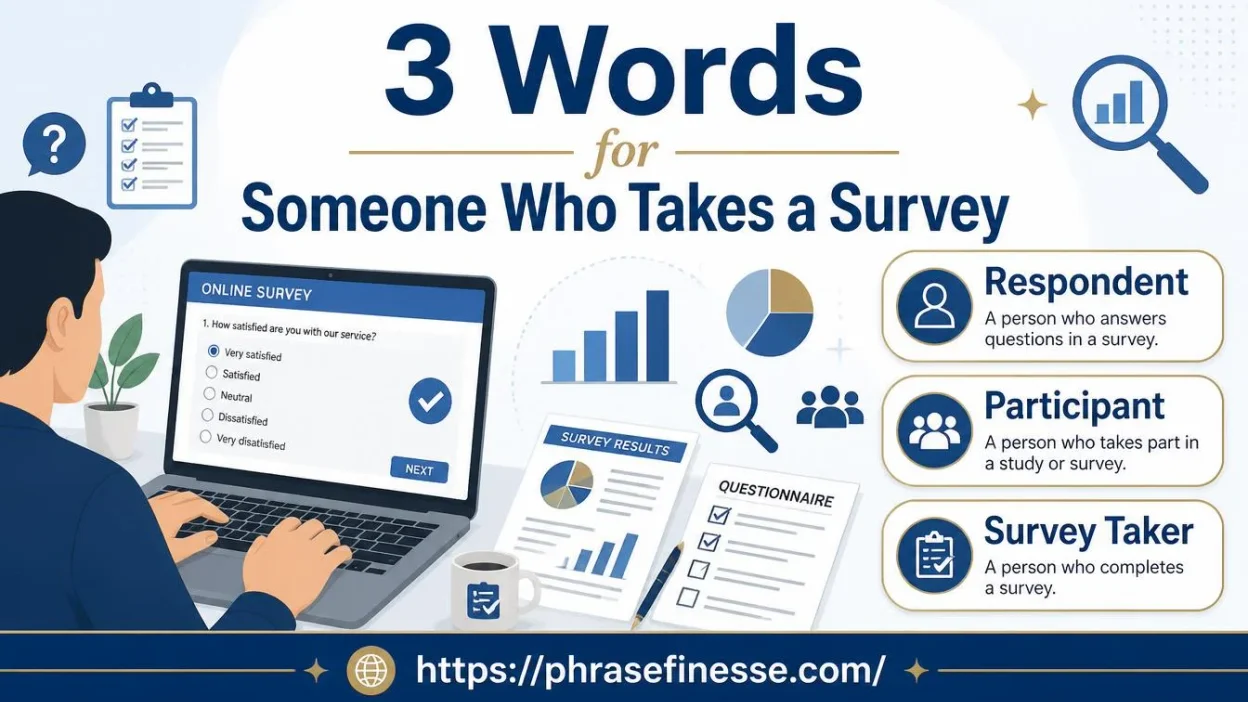
Have you ever wondered what to call someone who collects opinions, asks questions, and gathers information from people? The answer depends on the situation, purpose, and level of involvement. In this guide,3 Words for Someone Who Takes a Survey will help you discover the most accurate terms used for a survey participant, survey taker, and data collector while exploring their meanings, roles, and real-world applications.
Understanding the right survey terminology improves your English usage, grammar, and formal writing skills. Whether you are writing for business communication, conducting market research, or preparing reports for meetings and project management, choosing the correct word creates clarity and consistency.
These terms also appear in areas like online booking, broadcasting, and customer feedback systems where collecting accurate responses matters.
This article will explain the differences between common survey-related words, their proper usage, and interesting facts behind each term. You’ll learn how these expressions fit into professional contexts, including scheduling, time management, calendar planning, and research activities.
By the end, you’ll have a better understanding of how to use these words naturally in everyday conversations and professional formal communication.
What Do You Call a Person Who Takes a Survey?
The most common words for a person who takes a survey are:
| Term | Meaning | Common Usage | Formality |
| Respondent | Someone who answers survey questions | Research, statistics, business surveys | High |
| Participant | Someone who takes part in a survey or study | Research studies and experiments | Medium-High |
| Survey Taker | Someone who completes a survey | Everyday English | Medium |
Among these options, respondent is generally considered the most precise and widely accepted term in professional settings.
However, each word has a unique purpose. Understanding those differences can improve both your writing and communication.
Respondent
Meaning and Definition
A respondent is a person who answers questions in a survey, questionnaire, poll, or research study.
The word comes from the verb respond, meaning “to answer” or “to reply.”
Researchers, statisticians, and market analysts frequently use this term because it clearly identifies someone who provides answers to survey questions.
Dictionary-style definition:
A respondent is an individual who provides answers or information in response to a survey, questionnaire, interview, or poll.
Because surveys revolve around collecting responses, this term has become the gold standard in research environments.
When to Use Respondent
Use respondent when discussing:
- Academic research
- Scientific studies
- Market research
- Government surveys
- Customer satisfaction surveys
- Public opinion polls
- Census data collection
For example:
- The survey included 5,000 respondents from across the country.
- Each respondent answered ten demographic questions.
- Researchers analyzed responses from every respondent.
In these situations, “respondent” sounds professional and precise.
Example Sentences Using Respondent
Here are several examples:
- Every respondent completed the questionnaire online.
- The respondents reported high levels of customer satisfaction.
- Researchers removed incomplete responses before analyzing respondent data.
- Each respondent remained anonymous throughout the study.
- Survey respondents received a gift card for participating.
Notice how naturally the term fits into formal writing.
Why Researchers Prefer the Term Respondent
Researchers value accuracy. The word respondent focuses specifically on the act of answering questions.
A participant may join a study without answering survey questions. A respondent, however, actively provides answers.
That distinction matters.
Benefits of Using “Respondent”
| Benefit | Explanation |
| Precision | Clearly identifies someone answering questions |
| Professionalism | Common in scholarly and business reports |
| Clarity | Reduces ambiguity |
| Universality | Recognized globally in research communities |
As a result, you’ll find the word in:
- Academic journals
- Government reports
- Market research studies
- Statistical analyses
- Consumer behavior reports
Real-World Example
Imagine a company surveys 20,000 customers.
The final report might state:
“Eighty-two percent of respondents indicated they would recommend the product to others.”
Using “survey takers” would sound less formal. Using “participants” would be acceptable, but slightly less precise.
This is why respondent remains the preferred choice.
Participant
Meaning and Definition
A participant is a person who takes part in an activity, event, study, or survey.
Unlike respondent, participant has a broader meaning.
Someone can participate without necessarily answering survey questions.
For example:
- A person in a clinical trial is a participant.
- Someone in a focus group is a participant.
- A volunteer in a psychology experiment is a participant.
In all these cases, participation extends beyond simply answering questions.
When to Use Participant
Use participant when referring to:
- Research studies
- Experiments
- Focus groups
- Behavioral research
- Educational studies
- Long-term investigations
For example:
- Study participants attended three sessions.
- Participants completed a survey at the end of the experiment.
- Researchers monitored participants over six months.
The term emphasizes involvement rather than response.
Example Sentences Using Participant
Here are several examples:
- Participants were recruited through social media advertisements.
- Each participant signed an informed consent form.
- Participants completed a questionnaire after the workshop.
- The study involved 500 participants.
- Researchers interviewed participants individually.
These examples demonstrate the broader nature of the word.
Respondent vs. Participant
Many people use these terms interchangeably.
While that’s sometimes acceptable, important differences exist.
| Factor | Respondent | Participant |
| Answers survey questions | Yes | Usually |
| Takes part in study | Sometimes | Yes |
| Used in research reports | Very often | Often |
| Broader meaning | No | Yes |
| Most precise survey term | Yes | No |
Simple Rule
Think of it this way:
Every respondent is usually a participant.
Not every participant is necessarily a respondent.
A focus group member may discuss ideas verbally without completing a survey. That person is a participant but not always a respondent.
Case Study: University Research Project
A university conducts a study on student learning habits.
The process includes:
- Observation sessions
- Interviews
- Questionnaires
- Follow-up discussions
Everyone involved is considered a participant.
Only those who complete questionnaires are considered respondents.
This example highlights the distinction clearly.
Survey Taker
Meaning and Definition
A survey taker is simply someone who completes a survey.
The phrase is easy to understand and commonly used in everyday conversation.
Unlike respondent, it isn’t technical or academic.
Most people immediately understand what it means.
When to Use Survey Taker
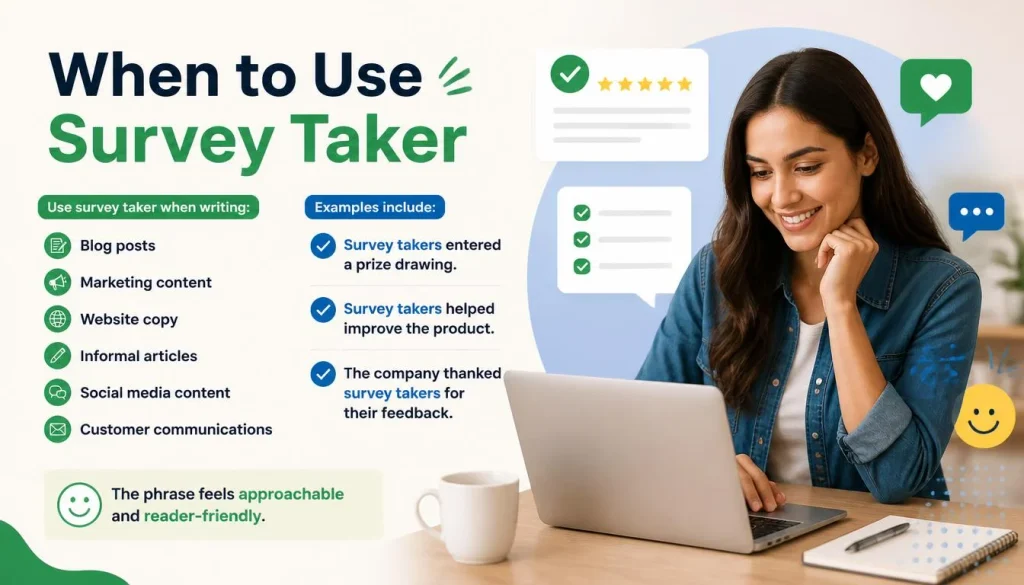
Use survey taker when writing:
- Blog posts
- Marketing content
- Website copy
- Informal articles
- Social media content
- Customer communications
Examples include:
- Survey takers entered a prize drawing.
- Survey takers helped improve the product.
- The company thanked survey takers for their feedback.
The phrase feels approachable and reader-friendly.
Example Sentences Using Survey Taker
- Every survey taker received a discount coupon.
- Survey takers completed the form in under five minutes.
- Survey takers shared valuable insights.
- The company appreciated feedback from all survey takers.
- Survey takers helped identify customer concerns.
Advantages and Limitations
Advantages
- Easy to understand
- Friendly tone
- Suitable for general audiences
- No specialized knowledge required
Limitations
- Less formal
- Rare in academic writing
- Less precise than respondent
- Uncommon in scientific reports
For professional research, respondent remains the stronger choice.
Respondent vs. Participant vs. Survey Taker
Choosing the right word depends on context.
Here’s a quick comparison.
| Situation | Best Term |
| Academic research paper | Respondent |
| Scientific journal | Respondent |
| Market research report | Respondent |
| Focus group study | Participant |
| Psychology experiment | Participant |
| Blog article | Survey Taker |
| Marketing campaign | Survey Taker |
| Customer feedback survey | Respondent |
Which Word Is Most Accurate?
If you’re looking for the single most accurate term for someone who takes a survey, the answer is:
Respondent
Why?
Because surveys exist to gather responses.
The word directly describes what the person does.
However, context still matters.
Best Choice by Situation
| Context | Recommended Word |
| Formal research | Respondent |
| Business analytics | Respondent |
| Scientific studies | Participant or Respondent |
| Casual writing | Survey Taker |
| Educational content | Survey Taker or Participant |
Related Words Often Used in Research
Several related terms appear alongside respondent and participant.
Understanding them helps avoid confusion.
Interviewee
An interviewee is someone who answers questions during an interview.
Unlike surveys, interviews often involve:
- Open-ended discussions
- Follow-up questions
- Personal interaction
Example
A journalist interviews a celebrity.
The celebrity is the interviewee.
A survey respondent typically completes structured questions instead.
Read More :Comma Before “Even”: When to Use It and When to Skip It
Research Subject
Historically, researchers often used the term research subject.
Today, many organizations prefer participant because it sounds more respectful and collaborative.
Example
Older psychology studies often referred to human subjects.
Modern studies usually refer to participants.
The meaning remains similar, but language has evolved.
Panelist
A panelist belongs to a survey panel.
Survey panels consist of individuals who regularly participate in surveys over time.
Market research companies frequently maintain these panels.
Example
A panelist may complete surveys every month about shopping habits.
This differs from a one-time respondent.
Informant
In social science research, an informant provides specialized knowledge or insights.
Examples include:
- Community leaders
- Experts
- Industry professionals
Informants contribute detailed information rather than simply answering standardized questions.
How Professionals Refer to Survey Participants
Different industries favor different terminology.
Let’s examine common practices.
Market Research Industry
Market researchers overwhelmingly prefer:
- Respondent
- Consumer respondent
- Survey respondent
Example:
“The survey gathered responses from 3,200 respondents.”
This terminology appears in nearly every major market research report.
Academic Research
Universities commonly use:
- Participant
- Respondent
Choice depends on study design.
If questionnaires are involved, respondent often appears.
If broader activities occur, participant becomes more common.
Customer Experience Surveys
Businesses usually use:
- Respondent
- Customer respondent
- Survey respondent
Examples include:
- Net Promoter Score surveys
- Customer satisfaction surveys
- Product feedback surveys
Government Surveys
Government agencies frequently use respondent.
Examples include:
- Census surveys
- Labor statistics surveys
- Economic studies
- Public health surveys
Official reports often contain phrases like:
“Survey respondents reported increased employment opportunities.”
Common Mistakes When Naming Someone Who Takes a Survey
Many writers unintentionally choose inaccurate terminology.
Here are the most common mistakes.
Using “Subject” for Simple Surveys
A person completing a basic questionnaire is usually not a subject.
The term often implies experimental conditions.
Better choice:
- Respondent
- Participant
Confusing Interviewees with Respondents
Interviews and surveys are not identical.
| Interviewee | Respondent |
| Participates in interview | Completes survey |
| Interactive discussion | Structured responses |
| Often qualitative | Often quantitative |
Using the correct term improves clarity.
Assuming All Participants Are Respondents
A participant may:
- Attend meetings
- Join experiments
- Participate in observations
Without answering questions, they may not qualify as respondents.
Using Technical Terms for Casual Audiences
Imagine a blog aimed at everyday readers.
“Survey taker” may be easier to understand than “respondent.”
Always consider your audience.
Why Word Choice Matters in Research and Communication
Precise language improves understanding.
A single word can influence how professional your writing appears.
Consider these two sentences:
Less precise:
People took the survey.
More precise:
Survey respondents provided detailed feedback.
The second sentence immediately sounds more authoritative.
Strong terminology creates stronger communication.
Quick Reference Guide
Use this cheat sheet whenever you’re unsure.
| If You Mean… | Use This Word |
| Someone answering survey questions | Respondent |
| Someone involved in a study | Participant |
| Someone completing a survey in everyday language | Survey Taker |
| Someone answering interview questions | Interviewee |
| Member of a recurring survey group | Panelist |
| Expert providing information | Informant |
FAQs
1. What do you call a person who takes a survey?
A person who takes a survey can be called a survey respondent, survey participant, or survey taker. The best term depends on the context. A respondent usually refers to someone who provides answers, while a participant is a broader term used in research studies.
2. Is a survey taker the same as a survey respondent?
Not always. A survey taker is a general term for anyone completing a survey. A survey respondent specifically refers to someone who provides answers or feedback. In research and professional writing, respondent is often considered the more formal and accurate term.
3. What is the professional word for someone who completes a survey?
The most professional terms are survey respondent and research participant. These words are commonly used in academic studies, market research, customer feedback reports, and formal business communication because they clearly describe the person providing information.
4. What is the difference between a survey participant and a survey collector?
A survey participant is the person who answers questions and shares opinions. A survey collector or survey administrator is the person who creates, distributes, or gathers survey responses. Their roles are different in the survey process.
5. Can “survey taker” be used in formal writing?
Yes, but survey taker sounds more casual. For formal writing, research papers, reports, and professional documents, terms like survey respondent or survey participant are usually better choices because they provide more precise meaning.
6. Why is choosing the right survey-related word important?
Using the correct survey terminology improves clarity, accuracy, and professionalism. Whether you are writing an article, preparing a report, managing a research project, or communicating with an audience, the right word helps readers understand the role of each person involved.
Conclusion
Knowing the right words for a person who takes a survey can improve your English usage, formal writing, and professional communication. While survey taker, survey respondent, and survey participant may seem similar, each term carries a slightly different meaning depending on the situation.
A survey respondent is often the best choice for research and business contexts because it highlights the person who provides answers. A survey participant works well for broader studies, while survey taker is useful in casual conversations.
Understanding these differences helps you choose more accurate language in reports, articles, customer feedback projects, and everyday communication. By using the correct survey-related terms, you can make your writing clearer, more consistent, and easier for your audience to understand.

Mia Rose is an English language specialist and editorial writer at Phrase Finesse, where she helps readers master grammar, vocabulary, spelling, and effective communication. Passionate about making English simple and practical, she creates well-researched, reader-friendly content that explains complex language concepts in a clear and engaging way.
With extensive experience in English language education, content writing, and editorial review, Mia specializes in grammar, punctuation, word choice, idioms, confusing word pairs, and writing style. Her articles are carefully researched, fact-checked, and designed to help students, professionals, writers, and English learners build confidence in both written and spoken English.