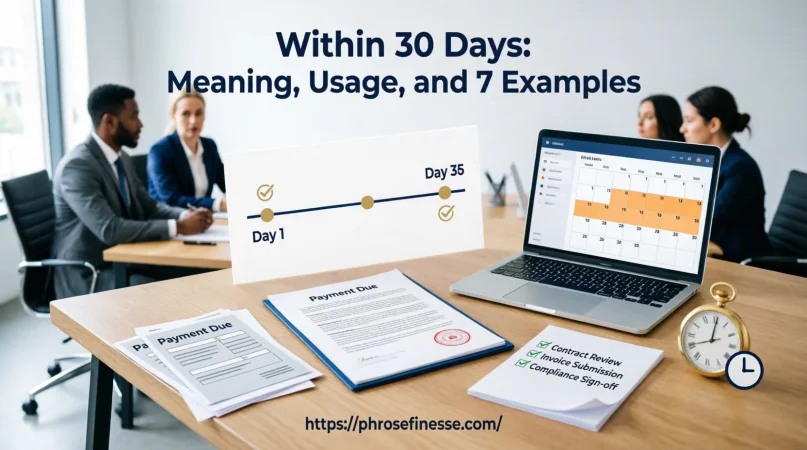
Have you ever received an email asking you to respond within 30 days and wondered exactly what deadline it creates? Understanding Within 30 Days: Meaning, Usage, and 7 Examples is essential for avoiding missed deadlines, misunderstandings, and costly delays.
In professional environments, this common phrase appears in contracts, invoices, policies, and business communication, making it important to interpret it correctly.
The meaning of within 30 days may seem straightforward, but its practical application can vary depending on context. Whether you’re dealing with scheduling, time management, project management, meetings, or a shared calendar, knowing how the phrase is used can improve accuracy and efficiency.
It also plays a key role in formal writing, English usage, and maintaining professional consistency across workplace communications.
In this guide, you’ll learn the precise meaning of the expression, how businesses commonly use it, and when confusion can arise. We’ll explore seven practical examples drawn from real-world scenarios, including online booking, broadcasting, administrative deadlines, and workplace processes.
By the end, you’ll understand how to use and interpret the phrase confidently in both professional and everyday situations.
What Does “Within 30 Days” Mean?
The phrase within 30 days means that an action must occur at any time before the end of a 30-day period, including the final day unless otherwise specified.
In simple terms, you have a window of time that starts on a specific date and ends when the 30-day period expires.
For example:
“Please submit the required documents within 30 days.”
This means the documents can be submitted:
- On Day 1
- On Day 10
- On Day 20
- On Day 30
All of these dates satisfy the requirement.
However, submitting them after Day 30 would generally be considered late.
Simple Definition
| Phrase | Meaning |
| Within 30 Days | Any time before the 30-day deadline expires |
| By Day 30 | No later than the 30th day |
| After 30 Days | Beginning on Day 31 |
The key concept is flexibility.
Instead of requiring action on one exact date, the phrase provides a timeframe during which the action can occur.
How Businesses Typically Interpret “Within 30 Days”
In business settings, the countdown usually begins after a specific event occurs.
These events often include:
- Invoice issuance
- Product delivery
- Contract signing
- Service completion
- Employee onboarding
- Regulatory notification
- Insurance claim acknowledgment
For example:
Payment is due within 30 days of the invoice date.
If the invoice date is July 1, the payment deadline typically falls on July 31.
Businesses rely on this wording because it creates a clear timeframe while offering flexibility.
Quick Rule to Remember
A useful rule is:
If the action happens anytime from Day 1 through Day 30, it generally meets the requirement.
Think of the period as a countdown clock.
Day 1 ————————– Day 30
✔ Valid ✔ Valid
Once the clock passes Day 30, the opportunity usually expires.
How to Calculate “Within 30 Days” Correctly
Many disputes happen because people calculate dates incorrectly.
The safest approach is to follow a simple process.
Identify the Trigger Date
Every 30-day period starts with a triggering event.
Examples include:
| Trigger Event | Example |
| Invoice Date | Invoice issued July 1 |
| Contract Signing | Agreement signed August 15 |
| Product Delivery | Package delivered September 3 |
| Notice Received | Notice received October 10 |
Before calculating anything, identify the exact starting point.
Count Calendar Days
Unless otherwise stated, most references to within 30 days mean calendar days.
Calendar days include:
- Weekdays
- Weekends
- Holidays
For example:
| Start Date | Deadline |
| January 1 | January 31 |
| March 10 | April 9 |
| June 15 | July 15 |
| November 20 | December 20 |
Notice that weekends do not pause the countdown.
The calendar keeps moving regardless.
Check Whether Special Terms Apply
Some contracts replace calendar days with business days.
Business days usually exclude:
- Saturdays
- Sundays
- Public holidays
This distinction can dramatically change a deadline.
Example
30 Calendar Days
- Start: July 1
- End: July 31
30 Business Days
- Start: July 1
- End: Approximately mid-August
That difference could be several weeks.
Always read the surrounding language carefully.
Does “Within 30 Days” Include the 30th Day?
Yes.
In most business, legal, and contractual contexts, the final day is included.
This means actions completed on Day 30 remain valid.
Example
Suppose a contract states:
The customer must notify the supplier within 30 days of delivery.
Delivery occurs on April 1.
Notification submitted on April 30 generally satisfies the requirement.
Notification submitted on May 1 may be considered late.
Why This Matters
The inclusion of the final day affects:
- Contract compliance
- Invoice payments
- Insurance claims
- Tax submissions
- Refund requests
- Regulatory filings
Missing a deadline by a single day can have significant consequences.
“Within 30 Days” vs. “In 30 Days”
Many people use these phrases interchangeably, but they don’t mean exactly the same thing.
| Phrase | Meaning |
| Within 30 Days | Any time before Day 30 expires |
| In 30 Days | Around or after the 30-day mark |
Business Example
Within 30 Days
Please pay within 30 days.
Payment can be made on:
- Day 5
- Day 12
- Day 25
- Day 30
In 30 Days
The software update will be released in 30 days.
The update is expected around Day 30 itself.
The first phrase creates a window.
The second points toward a future date.
“Within 30 Days” vs. “30 Days From Today”
These expressions appear similar but serve different purposes.
| Expression | Purpose |
| Within 30 Days | Defines a period available for action |
| 30 Days From Today | Identifies a specific future date |
Example
If today is July 1:
30 Days From Today
- Deadline = July 31
Within 30 Days
- Action can occur any day between July 1 and July 31
One emphasizes a timeframe.
The other emphasizes a target date.
Common Business Situations Where “Within 30 Days” Appears
This phrase appears across virtually every industry.
Let’s explore where you’ll encounter it most often.
Invoice Payment Terms
One of the most common examples is Net 30 payment terms.
Businesses frequently state:
Payment due within 30 days of invoice date.
This gives customers flexibility while helping companies maintain cash flow.
Example
Invoice Date: May 5
Payment Deadline: June 4
Any payment made before or on June 4 complies with the agreement.
Employment and HR Documents
Human resources departments often use 30-day deadlines.
Examples include:
- Benefits enrollment
- Tax documentation
- Policy acknowledgments
- Training completion
A new employee might receive instructions stating:
Complete all onboarding forms within 30 days of hire.
Service Agreements
Service providers commonly establish response periods.
Examples include:
- Maintenance requests
- Warranty claims
- Contract renewals
- Cancellation notices
These deadlines create predictable business operations.
Purchase Orders
Suppliers and buyers often rely on 30-day periods.
Common situations include:
- Payment schedules
- Order disputes
- Product inspections
- Acceptance notices
Customer Refund Policies
Many retailers offer return periods.
For example:
Customers may request a refund within 30 days of purchase.
This policy creates a fair balance between customer protection and business certainty.
Insurance Claims
Insurance companies frequently impose reporting deadlines.
Claims often require notification:
- Within 30 days of loss
- Within 30 days of discovery
- Within 30 days of notification
Failure to meet deadlines can complicate claim processing.
Government and Regulatory Notices
Government agencies commonly use 30-day response periods.
Examples include:
- Appeals
- Tax notices
- Permit renewals
- Compliance submissions
These deadlines often carry legal significance.
7 Helpful Examples of “Within 30 Days” in Business Context
The best way to understand the phrase is to see it in action.
Vendor Payment Example
Statement
Payment must be made within 30 days of invoice receipt.
Meaning
The customer can pay at any point during the next 30 days.
Business Takeaway
This provides flexibility while establishing a firm deadline.
Client Contract Approval Example
Statement
The contract must be approved within 30 days of issuance.
Meaning
The client has a 30-day review period.
Business Takeaway
Approvals delayed beyond the deadline may require renegotiation.
Employee Documentation Example
Statement
Employees must submit identification documents within 30 days of hire.
Meaning
Submission can occur anytime during the first month.
Business Takeaway
Organizations remain compliant with employment regulations.
Refund Request Example
Statement
Refund requests must be filed within 30 days of purchase.
Meaning
Customers retain return rights throughout the period.
Business Takeaway
Clear deadlines reduce disputes.
See More :Is Equal To vs. Equals: Which Is Correct?
Insurance Claim Example
Statement
Claims must be reported within 30 days of the incident.
Meaning
The claimant has a limited reporting window.
Business Takeaway
Prompt reporting improves claim investigations.
Compliance Reporting Example
Statement
Reports must be submitted within 30 days after quarter-end.
Meaning
The organization has one month to prepare filings.
Business Takeaway
Regulatory compliance depends on timely submissions.
Project Review Example
Statement
Stakeholders must provide feedback within 30 days of delivery.
Meaning
Feedback can arrive at any time during the review period.
Business Takeaway
Projects move forward without indefinite delays.
Real-World Case Study: A Costly Payment Delay
Consider a supplier issuing an invoice on March 1 with payment due within 30 days.
The customer incorrectly assumes payment is due after 30 full days have passed and sends payment on April 1.
However, the actual deadline was March 31.
Result:
- Late payment fee assessed
- Supplier relationship strained
- Accounting reconciliation delayed
A simple misunderstanding created unnecessary costs.
This illustrates why precise date calculations matter.
Common Mistakes People Make With “Within 30 Days”
Even experienced professionals sometimes misunderstand deadline language.
Assuming It Means Exactly 30 Days Later
Many people believe action should occur on Day 30.
That’s incorrect.
The phrase creates a range, not a single target date.
Confusing Calendar Days and Business Days
This mistake causes countless deadline issues.
Always verify which type of day the document references.
Quick Comparison
| Type | Includes Weekends |
| Calendar Days | Yes |
| Business Days | No |
Ignoring Contract Definitions
Some contracts contain specific definitions sections.
These sections may redefine standard terms.
Never assume.
Always verify.
Forgetting Time Zone Requirements
Global organizations often operate across multiple countries.
A deadline that expires at midnight in New York may arrive hours earlier elsewhere.
Missing the Trigger Event
Many errors begin with using the wrong start date.
Ask:
- When did the countdown begin?
- What event triggered it?
- Does the agreement specify a starting point?
Is “Within 30 Days” Legally Binding?
In many situations, yes.
Courts, regulators, and arbitrators frequently enforce clearly written deadlines.
However, interpretation depends on:
- Contract language
- Jurisdiction
- Applicable laws
- Industry regulations
Legal Principle
Courts generally interpret words according to their ordinary meaning unless a contract provides a different definition.
That makes clarity extremely important.
Why Exact Wording Matters
Compare these examples:
| Wording | Interpretation |
| Within 30 Days | Flexible period |
| No Later Than 30 Days | Firm deadline |
| Within 30 Business Days | Excludes weekends |
| By July 31 | Exact date |
Specific wording reduces ambiguity.
Ambiguous Language to Avoid
Poorly written deadlines often create disputes.
Examples include:
- As soon as possible
- Promptly
- In a reasonable time
- Shortly thereafter
These phrases lack objective measurement.
Specific dates are much safer.
Alternative Ways to Say “Within 30 Days” in Professional Writing
Sometimes a different phrase improves clarity.
Formal Alternatives
- No later than 30 days after
- Within thirty calendar days
- Before the expiration of 30 days
- By the end of the 30-day period
- Within thirty consecutive days
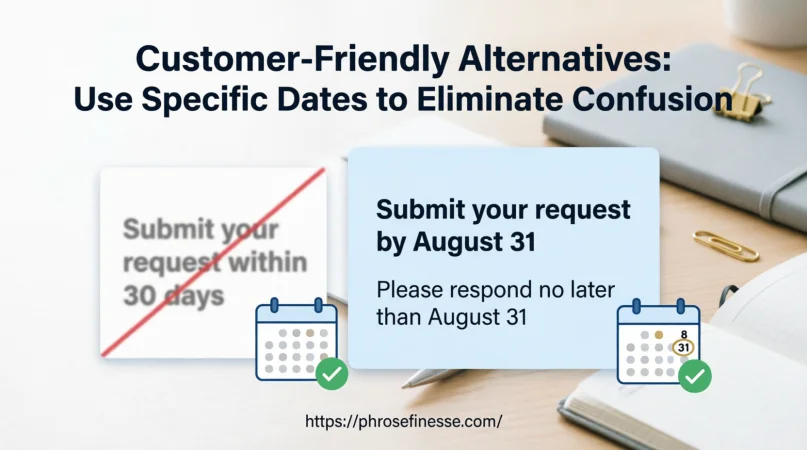
Customer-Friendly Alternatives
Instead of writing:
Submit your request within 30 days.
You could write:
Submit your request by August 31.
Or:
Please respond no later than August 31.
Specific dates eliminate confusion.
Best Practices for Using “Within 30 Days” in Business Communication
Strong communication prevents misunderstandings.
Here are proven practices.
State the Exact Deadline Date
Rather than relying solely on a timeframe:
Better
Payment due by August 31, 2025.
Less Clear
Payment due within 30 days.
Specify Calendar or Business Days
Always clarify the type of day being counted.
Examples:
- Within 30 calendar days
- Within 30 business days
This small detail prevents major confusion.
Avoid Ambiguous Language
Replace vague wording with precise instructions.
Clarity saves time and reduces disputes.
Include Examples
Examples improve understanding immediately.
For instance:
Submit documents within 30 calendar days of receipt. If received on June 1, the deadline is July 1.
Confirm Expectations in Writing
When deadlines matter, written confirmation protects everyone involved.
Email documentation creates a clear record.
Quick Reference Table: Understanding “Within 30 Days”
| Question | Answer |
| Does it include Day 30? | Yes |
| Does it usually mean calendar days? | Yes, unless specified otherwise |
| Can action occur before Day 30? | Yes |
| Is it legally enforceable? | Often, yes |
| Does it equal 30 business days? | No |
| Should exact dates be included? | Absolutely |
FAQs
What does “within 30 days” mean?
“Within 30 days” means that an action must be completed before the end of a 30-day period starting from a specified date or event. The action can occur on any day during that period, including the 30th day.
Does “within 30 days” include the 30th day?
Yes. In most business and legal contexts, the phrase includes the 30th day unless a document specifically states otherwise.
Is “within 30 days” the same as “in 30 days”?
No. Within 30 days means any time before the 30-day deadline, while in 30 days usually refers to something happening exactly 30 days later.
How is “within 30 days” used in business communication?
Businesses commonly use the phrase in contracts, invoices, customer notices, service agreements, and project timelines to establish a clear deadline for completing an action.
Can “within 30 days” create confusion?
Yes. Confusion often occurs when the starting date is not clearly defined. To avoid misunderstandings, identify the event or date from which the 30-day period begins.
How can I calculate a deadline that is within 30 days?
Start with the specified date and count forward 30 calendar days. Using a calendar or digital scheduling tool can help ensure accuracy and prevent missed deadlines.
Conclusion
Understanding the phrase within 30 days is essential in modern business communication. While it generally means that an action must be completed at any point before the end of a 30-day period, confusion can arise when the starting date is unclear.
Whether you’re reviewing contracts, managing deadlines, handling online booking, coordinating meetings, or overseeing project management tasks, interpreting this phrase correctly helps prevent misunderstandings and missed obligations.
Clear communication and proper time management go hand in hand. By understanding how within 30 days functions in different contexts, you can improve formal writing, maintain professional consistency, and ensure that schedules, payments, and commitments stay on track. When in doubt, always confirm the exact deadline date rather than relying on assumptions..

Alyan Ashraf is an English language writer and editor at Phrase Finesse, where he specializes in grammar, vocabulary, spelling, word usage, and clear communication. Passionate about the English language, he creates practical, research-backed content that helps readers avoid common mistakes and write with greater accuracy and confidence.
Known for his clear writing style and attention to detail, Alyan simplifies complex language topics into easy-to-understand guides filled with real-world examples and actionable insights. His work covers confusing word pairs, grammar rules, idioms, punctuation, and everyday English usage, making learning both accessible and engaging for students, professionals, writers, and non-native English speakers.
Every article Alyan writes is carefully researched, fact-checked, and designed to meet high editorial standards. His goal is to help readers strengthen their English skills, expand their vocabulary, and communicate more effectively in academic, professional, and everyday settings.
Through Phrase Finesse, Alyan is committed to publishing trusted language resources that make mastering English simpler, clearer, and more enjoyable for learners around the world