Have you ever paused before writing “on behalf of” and wondered whether “on the behalf of” is also correct? If so, you’re not alone.On Behalf Of vs. On The Behalf Of: Which Is Correct? is a common English usage question that affects grammar, formal writing, business communication, and everyday conversations.
Choosing the correct expression helps your writing sound polished, professional, and grammatically accurate in every context.
Whether you’re sending emails, preparing documents, organizing meetings, handling project management tasks, managing a calendar, or writing about scheduling, time management, online booking, or broadcasting, using the right phrase strengthens both clarity and credibility.
This guide explains the grammatical difference between “on behalf of” and “on the behalf of”, explores why one form is considered standard, and shows how native English speakers use it naturally in modern communication. You’ll also discover practical examples, common mistakes, and tips for maintaining consistency across personal and professional writing.
By the end of this article, you’ll confidently know which version belongs in professional emails, academic papers, workplace messages, and everyday English. We’ll break down the grammar rules in simple terms, provide real-world examples, and answer the questions learners ask most often.
If you want clearer, more accurate, and more natural formal writing, this guide will help you use the correct expression with confidence every time.
Quick Answer:
If you’re looking for the short answer, here it is:
✅ On behalf of = Correct and standard
❌ On the behalf of = Usually incorrect or unnecessary
Examples
Correct
- I am writing on behalf of the marketing department.
- She accepted the award on behalf of her father.
- The attorney spoke on behalf of the client.
Usually Incorrect
- I am writing on the behalf of the marketing department.
- She accepted the award on the behalf of her father.
In modern English, adding “the” serves no grammatical purpose. The phrase “on behalf of” is already a complete and established expression.
What Does “On Behalf Of” Mean?
To understand why the phrase works, it’s helpful to understand what it means.
Meaning: Representing Someone
Most often, “on behalf of” means acting as a representative for another person or organization.
For example:
“I am speaking on behalf of the committee.”
The speaker represents the committee and communicates its views.
Meaning: Acting for Someone’s Benefit
The phrase can also mean acting in someone’s interest or for their benefit.
For example:
“The charity works on behalf of disadvantaged children.”
The charity’s efforts benefit those children.
Simple Definition
On behalf of = as a representative of someone or for the benefit of someone.
Understanding the Word “Behalf”
Many people use the phrase correctly without knowing what “behalf” actually means.
Historically, the word comes from Old English and originally referred to a person’s side, interest, or cause.
Today, the word rarely appears by itself. Instead, it survives mainly in fixed expressions such as:
- On behalf of
- In behalf of
That is why the phrase sounds natural as a complete unit.
Think of it the same way you think of expressions such as:
- In charge of
- By means of
- In favor of
- On account of
You don’t usually alter these phrases by adding extra words. The same principle applies to “on behalf of.”
Why “On Behalf Of” Is Grammatically Correct
One reason this expression confuses people is that many English nouns take articles such as a, an, or the.
However, not every noun follows that pattern.
Fixed Idiomatic Expression
On behalf of functions as an idiomatic phrase.
An idiom is a group of words that native speakers consistently use together.
Examples include:
| Correct Expression | Incorrect Variation |
| In favor of | In the favor of |
| On account of | On the account of |
| By means of | By the means of |
| On behalf of | On the behalf of |
Notice a pattern?
The standard versions do not require “the.”
Because English speakers have used “on behalf of” for centuries, it has become the accepted form.
Why “On The Behalf Of” Sounds Unnatural
Although you may occasionally encounter “on the behalf of,” it sounds awkward to most native speakers.
Why?
Because it disrupts a phrase that English speakers already recognize as a complete unit.
Consider these examples:
Natural
- On behalf of our organization, thank you.
- She spoke on behalf of the family.
Unnatural
- On the behalf of our organization, thank you.
- She spoke on the behalf of the family.
The second versions aren’t necessarily impossible to understand. They simply sound unusual and unnecessary.
Language often depends on convention. Since millions of speakers consistently use “on behalf of,” that version became the standard.
Is “On The Behalf Of” Ever Correct?
This question deserves a more detailed answer.
Technically, examples of “on the behalf of” have appeared in historical texts. Older forms of English sometimes used the phrase.
However, modern style guides and grammar references overwhelmingly prefer “on behalf of.”
Historical Usage
In earlier centuries, writers occasionally inserted articles into expressions that later became fixed.
English was less standardized than it is today.
As a result, you might find examples of:
- On the behalf of
- In the behalf of
in old documents.
Modern Usage
Today, professional editors usually replace:
“on the behalf of”
with:
“on behalf of”
This change improves clarity and aligns with contemporary English usage.
Practical Rule
If you’re writing:
- Emails
- Essays
- Reports
- Legal documents
- Academic papers
- Business correspondence
Always choose “on behalf of.”
Examples of “On Behalf Of” in Everyday English
The best way to learn a phrase is to see it in context.
Business Examples
- I am writing on behalf of our customer service team.
- She attended the conference on behalf of the company.
- On behalf of management, thank you for your dedication.
Workplace Examples
- He submitted the report on behalf of his supervisor.
- Sarah answered the questions on behalf of the project group.
- The director made the announcement on behalf of the board.
Academic Examples
- The professor spoke on behalf of the research department.
- I accepted the scholarship on behalf of my brother.
- The student representative addressed the audience on behalf of the graduating class.
Legal Examples
- The lawyer acted on behalf of her client.
- The attorney negotiated on behalf of the corporation.
- The spokesperson issued a statement on behalf of the defendant.
Personal Examples
- She bought flowers on behalf of the family.
- I called the landlord on behalf of my roommate.
- He thanked everyone on behalf of his parents.
On Behalf Of in Professional Emails
This expression appears frequently in workplace communication.
Announcements
On behalf of the executive team, we’d like to announce our new initiative.
Appreciation Messages
On behalf of everyone in the department, thank you for your hard work.
Customer Communication
I am contacting you on behalf of our support team regarding your request.
Invitations
On behalf of the organizing committee, I would like to invite you to attend the event.
These examples demonstrate why the phrase remains so common in business writing.
Common Mistakes People Make
Even experienced writers occasionally misuse this expression.
Let’s examine the most frequent errors.
Adding “The” Unnecessarily
Incorrect
- On the behalf of our organization
Correct
- On behalf of our organization
This is the most common mistake.
Using the Wrong Preposition
Incorrect
- At behalf of
- By behalf of
Correct
- On behalf of
The expression requires the preposition “on.”
Confusing Representation with Possession
Some writers incorrectly assume the phrase shows ownership.
However, “on behalf of” is about representation or benefit.
Example
She spoke on behalf of the team.
This means she represented the team.
It does not mean she owned the team.
Overusing the Phrase
While useful, repeating the expression too often can make writing feel repetitive.
Repetitive
- On behalf of the company, thank you.
- On behalf of the company, we appreciate your support.
- On behalf of the company, we welcome your feedback.
Better
- Thank you for your support.
- The company appreciates your business.
- We welcome your feedback.
Variety improves readability.
Overusing the Phrase
While useful, repeating the expression too often can make writing feel repetitive.
Repetitive
Better
Variety improves readability.
On Behalf Of vs. In Behalf Of
Many people don’t realize another expression exists:
In behalf of
Although less common, it has a distinct history.
What Does “In Behalf Of” Mean?
Traditionally, “in behalf of” means:
For the benefit of someone.
Example
- She worked tirelessly in behalf of animal welfare.
The focus is helping someone.
What Does “On Behalf Of” Mean?
Traditionally:
Acting as a representative of someone.
Example
- She spoke on behalf of the organization.
The focus is representation.
Comparison Table
| Expression | Traditional Meaning | Modern Usage |
| On behalf of | Representing someone | Very common |
| In behalf of | For someone’s benefit | Less common |
Can They Be Interchanged?
Sometimes.
Consider these examples:
Possible
- The charity works on behalf of children.
- The charity works in behalf of children.
Less Interchangeable
- The spokesperson spoke on behalf of the company.
- The spokesperson spoke in behalf of the company.
The first sentence sounds much more natural.
That is why modern English overwhelmingly favors “on behalf of.”
Read More :Have Anyone or Has Anyone? Which Is Correct?
Synonyms and Alternatives to “On Behalf Of”
Using alternatives can make your writing more dynamic.
Formal Alternatives
- Representing
- Acting for
- As a representative of
- In the interests of
- For
Examples
- She attended the meeting representing the company.
- He signed the agreement acting for his client.
- They spoke in the interests of local residents.

Informal Alternatives
- Speaking for
- For
- Supporting
- Helping
Examples
- I’m speaking for the whole group.
- She did it for her family.
- He worked hard supporting the community.
Comparison Table
| Alternative | Best Context |
| On behalf of | General formal writing |
| Representing | Business and legal settings |
| Acting for | Legal matters |
| Speaking for | Informal communication |
| In the interests of | Advocacy and policy writing |
Real-World Case Studies
Understanding real situations makes grammar easier to remember.
Case Study: Corporate Announcement
A company’s CEO cannot attend a conference.
Instead, the vice president delivers the speech.
Correct Statement
“I am speaking on behalf of our CEO today.”
The vice president represents the CEO.
Case Study: Charity Organization
A nonprofit advocates for children’s rights.
Correct Statement
“We work on behalf of vulnerable children.”
The organization acts for their benefit.
Case Study: Legal Representation
An attorney appears in court.
Correct Statement
“The attorney is acting on behalf of the client.”
The lawyer represents another person.
This is one of the most common professional uses of the phrase.
Why Native Speakers Prefer “On Behalf Of”
Language isn’t always governed solely by logic.
Usage matters.
When millions of speakers consistently choose one version over another, that version becomes standard.
Several factors explain the popularity of “on behalf of.”
Tradition
The phrase has existed for centuries.
Consistency
Writers, educators, journalists, and editors consistently use it.
Clarity
Readers immediately recognize its meaning.
Professional Acceptance
Business, legal, and academic communities all prefer it.
As a result, it became the dominant form in modern English.
Grammar Breakdown of “On Behalf Of”
Here’s a closer look at the structure.
| Word | Part of Speech | Function |
| On | Preposition | Introduces the phrase |
| Behalf | Noun | Means interest, cause, or representation |
| Of | Preposition | Connects the represented party |
Together, these words create a fixed expression.
Removing or changing one element can make the phrase sound unnatural.
When Should You Use “On Behalf Of”?
Use the phrase whenever you are:
Representing Someone
- Employees representing companies
- Lawyers representing clients
- Spokespersons representing organizations
Acting for Someone’s Interests
- Advocacy groups
- Charitable organizations
- Community leaders
Delivering Messages
- Formal announcements
- Public speeches
- Written correspondence
Expressing Gratitude
- Award ceremonies
- Business events
- Family celebrations
Quick Usage Checklist
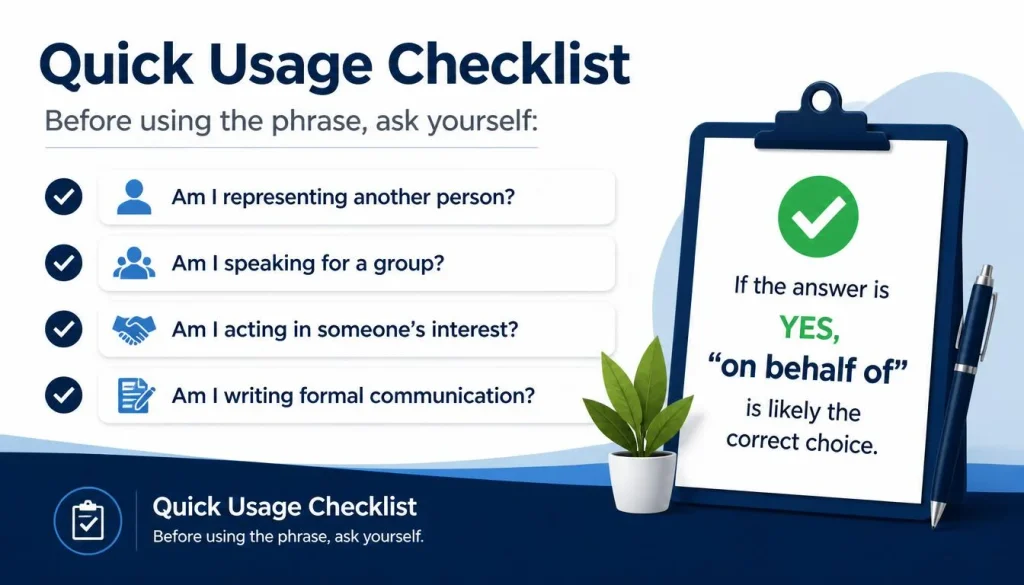
Before using the phrase, ask yourself:
- Am I representing another person?
- Am I speaking for a group?
- Am I acting in someone’s interest?
- Am I writing formal communication?
If the answer is yes, “on behalf of” is likely the correct choice.
FAQs
1. Is “on behalf of” or “on the behalf of” grammatically correct?
On behalf of is the standard and grammatically correct expression in modern English. While on the behalf of occasionally appears in older or highly formal texts, it is considered uncommon and is generally avoided in everyday and professional writing.
2. What does “on behalf of” mean?
On behalf of means acting for someone else, representing another person, or speaking in their place. It is commonly used in business communication, legal documents, formal speeches, and everyday conversations.
3. Can I use “on behalf of” in professional emails?
Yes. On behalf of is widely accepted in formal writing, business emails, official announcements, meeting invitations, and workplace communication. It sounds natural and professional.
4. Why do some people say “on the behalf of”?
The phrase on the behalf of has historical usage and still appears occasionally in legal or literary contexts. However, modern English strongly favors on behalf of, making it the preferred choice for almost all situations.
5. What are some examples of “on behalf of” in a sentence?
Here are a few examples:
- I am writing on behalf of our management team.
- She accepted the award on behalf of her colleagues.
- Thank you on behalf of everyone who attended the event.
- He spoke on behalf of the entire organization.
6. Is “on behalf of” suitable for both British and American English?
Yes. On behalf of is the standard expression in both British English and American English. It is recognized as the correct form across professional, academic, and everyday communication.
Conclusion
Choosing between “on behalf of” and “on the behalf of” is easier than it may seem. In modern English usage, on behalf of is the correct, natural, and widely accepted expression, while on the behalf of is rare and generally unnecessary outside a few historical or legal contexts. Using the standard form improves grammar, strengthens formal writing, and ensures consistency in both personal and professional communication.
Whether you’re drafting a business email, delivering a speech, writing official documents, or simply improving your English, understanding this distinction helps you communicate with greater confidence.
When in doubt, choose on behalf of—it’s the version native speakers, style guides, and professional writers overwhelmingly prefer.

Mia Rose is an English language specialist and editorial writer at Phrase Finesse, where she helps readers master grammar, vocabulary, spelling, and effective communication. Passionate about making English simple and practical, she creates well-researched, reader-friendly content that explains complex language concepts in a clear and engaging way.
With extensive experience in English language education, content writing, and editorial review, Mia specializes in grammar, punctuation, word choice, idioms, confusing word pairs, and writing style. Her articles are carefully researched, fact-checked, and designed to help students, professionals, writers, and English learners build confidence in both written and spoken English.